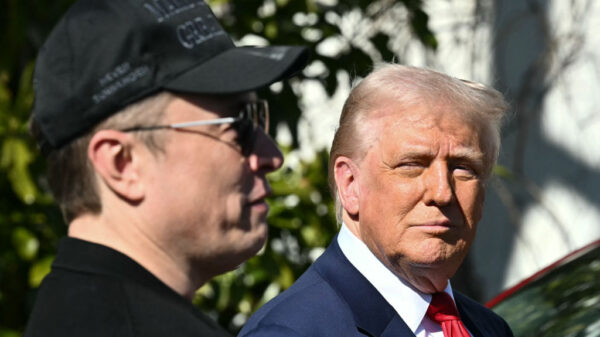
President Donald Trump is intensifying his pressure on NATO member countries by threatening to impose higher tariffs if they do not support an American acquisition of Greenland. Despite these efforts, experts suggest Trump’s approach may be ineffective due to a fundamental issue: the financial burden of his tariffs has largely fallen on American consumers rather than foreign exporters.
A report released on Monday by the Kiel Institute for the World Economy, a nonpartisan German think tank, highlights this reality, indicating that American importers and consumers bore 96 percent of the tariff burden during the first 11 months of Trump’s presidency. While Trump has touted his protectionist policies as generating up to $18 trillion in revenue and foreign investment, the actual revenue from tariffs amounted to $288.5 billion in gross tariff and excise tax revenue in 2025. According to the Kiel Institute’s findings, Americans shouldered an astonishing $277 billion in import taxes, while foreign exporters contributed only $11.5 billion.
Trump’s threats to countries with which the U.S. has established trade agreements may undermine American credibility and introduce further economic uncertainty. Scott Lincicome, vice president of general economics at the Cato Institute, commented, “Trump’s tariff announcement confirms what trade policy experts have long warned. Because Trump’s trade deals are unilateral and non-binding, they can be easily changed on a whim and are unlikely to constrain his daily tariff impulses.” This unpredictability has complicated matters for American small businesses that rely on imports while failing to alter the terms of trade. Instead of “slashing margins to maintain volume” in the U.S. market, foreign firms often “redirect their sales to Europe, Asia, or other destinations,” as noted by Kiel Institute researchers.
Trump’s interest in acquiring Greenland is not new; he first suggested it in 2019 and revisited the idea following his 2024 election victory. Shortly after the capture of Venezuelan dictator Nicolás Maduro, the Trump administration escalated its rhetoric, hinting that military action could be considered to seize Greenland, which is an autonomous territory of the Kingdom of Denmark.
In response to these provocative statements, military units from Denmark, Norway, Sweden, France, Germany, the U.K., the Netherlands, and Finland were dispatched to Greenland last week. On Saturday, Trump escalated tensions further, threatening to impose “a 10% Tariff on any and all goods sent to the United States of America” effective February 1, with plans to increase it to 25% on June 1 until an agreement is reached for the “Complete and Total purchase of Greenland.”
Trump has justified the U.S. interest in Greenland by claiming it is crucial for maximizing the efficacy of the Golden Dome, a multilayered defense shield expected to cost hundreds of billions of dollars. Notably, the 1951 Defense of Greenland Agreement already permits the U.S. to establish and operate defense areas for NATO member protection.
Regardless of Trump’s motivations for pursuing the acquisition of Greenland, the strategy of using tariffs as a bargaining chip is unlikely to foster cooperation among NATO allies. As tensions rise, the approach may be perceived as self-defeating, risking the very economic well-being it aims to protect by limiting Americans’ access to essential goods.
See also EPAM’s Cursor Partnership: A Game-Changer or Risky Investment for Shareholders?
 LG CNS and Bank of Korea Launch Pioneering AI System for Digital Currency Transactions
 China’s AI Surge: DeepSeek R-1 Breaks Barriers, Outpaces US in Open-Source Downloads
 Runway Reveals AI Videos Achieving 95% Realism, Challenging Media Authenticity
 CODIT Unveils ChatCODIT: AI Agent Transforming Global Regulatory Compliance Insights