In the rapidly evolving landscape of marketing, Marketing Operations, or MOps, plays a crucial role in ensuring campaigns launch with precision and yield measurable returns. As the number of marketing technology applications is projected to rise to 14,106 in 2024—a 27.8% increase year-over-year, according to MarTech—MOps professionals are tasked with managing complex ecosystems, from CRM systems to automation platforms. They ensure that data flows seamlessly to support informed decision-making, aligning tactics with revenue objectives.
At its essence, MOps oversees CRM management, lead scoring, workflow design, and analytics dashboards, functioning much like a pit crew in a race. “Marketing ops is like the pit crew, and sales and marketing are the race car drivers,” explains Darrell Alfonso of Indeed in MarTech. This analogy underscores how effective operations allow creative teams to innovate while ensuring campaigns are executed flawlessly, improving efficiency by 15% to 25% in ROI and engagement, as noted by McKinsey.
The responsibilities of MOps professionals encompass technology and data management—supervising stacks that can consist of 25-50 tools in mid-sized firms and over 250 in larger enterprises. Additionally, they focus on process strategy for governance, measurement via reporting, and lead management to optimize the sales funnel. However, a significant 65% of MOps professionals operate within dedicated teams, while 25% work solo, often spending over ten hours weekly managing automation, spreadsheets, and CRM.
From Backroom Support to Strategic Powerhouse
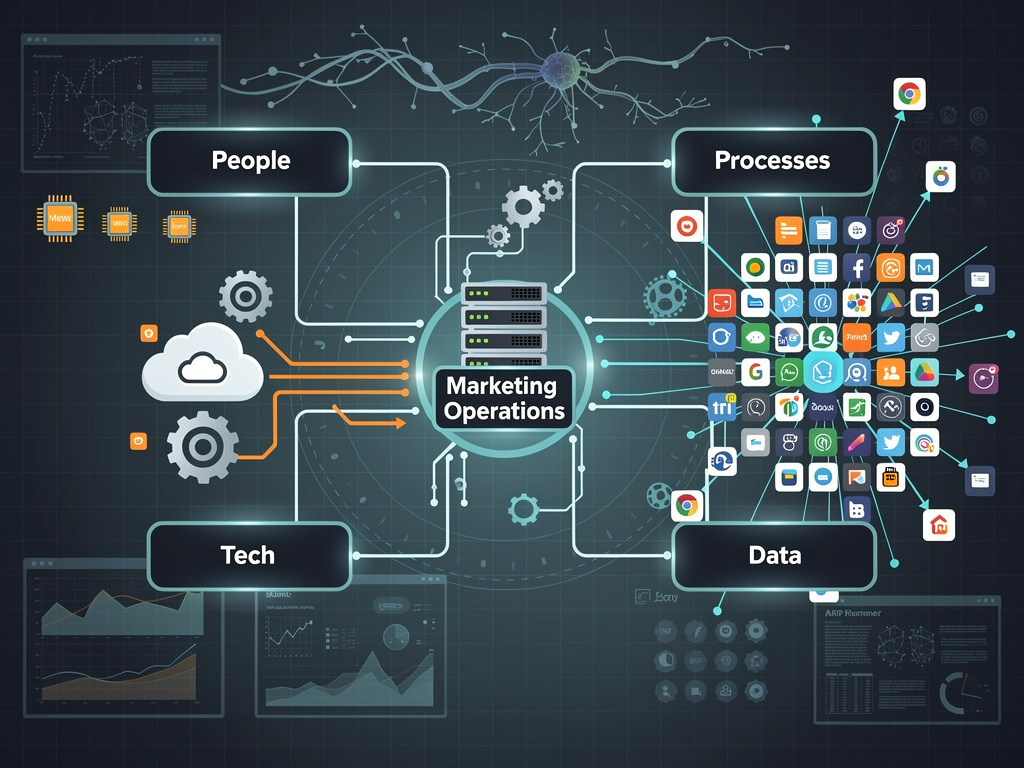
Historically rooted in the 1920s but gaining prominence around 2005, the MOps function has evolved dramatically in response to the explosion of martech. As reported in MarTech’s 2024 Career Survey, 59% of director-level MOps professionals spend more than ten hours weekly on automation tools. In larger organizations, fewer than 5% operate without this function, with most reporting directly to the Chief Marketing Officer (CMO). “The mission… is to improve the efficiency and effectiveness of marketing through people, process, technology and data,” asserts Debbie Qaqish of Pedowitz Group.
The 2024/2025 State of the MO Pro study indicates a rapidly maturing field, with 88% of practitioners prioritizing data initiatives and 54% investing in enrichment and intent tools. Nevertheless, challenges remain; only 36% report high satisfaction, a drop from 41%, amid leaner teams and expanding Revenue Operations (RevOps) scopes. Six emerging trends highlight the landscape: experienced professionals express uncertainty, integration remains a top priority despite dissatisfaction with technology, data maturity lags, training gaps widen, reporting pressures on ROI metrics mount, and digital maturity continues to elude many organizations.
As strategic influence expands, with 37% now claiming a “seat at the table,” the link between MOps involvement and improved organizational outcomes becomes increasingly clear. However, gender gaps persist, as women often report feeling less understood, despite their experience.
Unlike traditional marketing’s focus on creative messaging and demand generation, MOps provides the critical infrastructure needed for scalable success, emphasizing project management, analytics, and optimization. Traditional marketers may craft compelling campaigns driven by insights, while MOps ensures those efforts are supported by data analytics and system optimizations, maintaining brand compliance and alignment with revenue-driven key performance indicators (KPIs). MOps serves as a bridge between product, sales, and marketing, managing high-level campaigns while tactical managers handle execution. This structure leads to quicker launches, reduced errors, and greater scalability through automation, particularly in B2B environments where data stacks often become fragmented.
Recent analyses by MarTech identify bottlenecks that hinder efficiency, such as stakeholder friction and bloated tech stacks. “A disconnect between leadership and marketing teams means AI investments aren’t going to solve critical operational bottlenecks,” warns Ana Mourão in a July 2025 piece.
AI and Data Propel MOps Forward
Emerging trends for 2025-2026 highlight AI’s transformative impact on workflows, utilizing predictive analytics to forecast behaviors and implementing agentic AI to automate processes. The rise of self-service analytics through no-code tools empowers marketers without the need for engineering support. “AI doesn’t replace people—it replaces the processes that slow them down,” stated AJ Navarro of Sprout Social during MOps-Apalooza 2025, reflecting the sentiment shared by many in the field.
Events like MOps-Apalooza, which attracts over 400 participants for workshops and keynotes, foster community and dialogue around critical issues such as AI, alignment, and data quality. While compensation continues to rise, gaps in AI and data skills widen amid lean team structures. MarTech predicts a shift toward federated models, positioning MOps at the center of maintaining consistency across omnichannel efforts.
Investment in technology is on the rise, with 42% allocated to generative AI and 39% to analytics. However, governance challenges persist. “AI moves marketing operations from reactive reporting to predictive analysis,” notes an October 2025 article in MarTech, emphasizing the need for robust operational frameworks.
Looking ahead, MOps professionals are increasingly positioned for leadership roles, with pathways to Vice President or CMO roles through RevOps. As reported by MarketingProfs, this field serves as a launching pad for career advancement. Training gaps—currently affecting 56% of professionals—drive self-learning initiatives, while the trend of outsourcing “MOps as a Service” helps address expertise shortages. The integration of CreativeOps is also likely to gain traction as organizations seek to eliminate silos and scale content amidst the increasing volume produced by AI, highlighting the importance of building trust frameworks for measurable ROI.
For insiders, the future of MOps hinges on data democratization, AI orchestration, and cross-functional collaboration, essential for driving growth in an increasingly tech-saturated environment.
See also Cisco Predicts AI-Powered Concierge Agents Will Transform Customer Engagement by 2026
 Bold Brand Launches AI-Powered Marketing Services in Egypt and Saudi Arabia
 South Korea Becomes Second Largest Market for Google’s Gemini, Contributing $21M Revenue
 Farmmi Launches U.S. AI Marketing Subsidiary Bluesage to Drive Digital Growth
 Talkdesk Reveals Commerce Orchestration Strategy to Enhance Retail Customer Experience