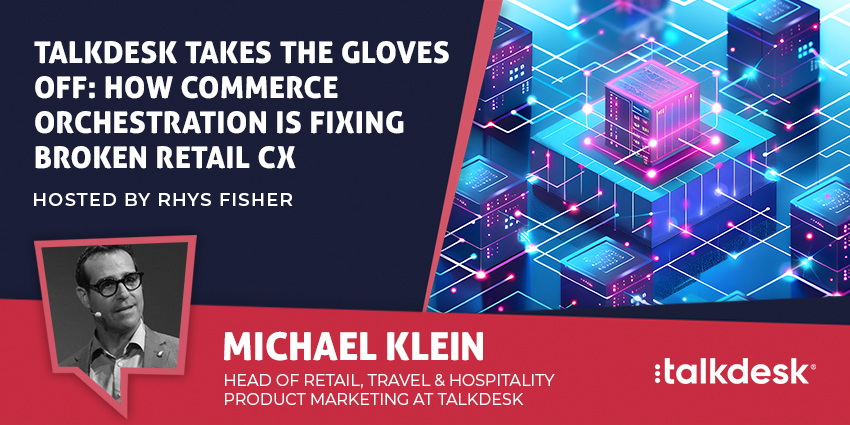
Retailers are overwhelmed by AI solutions, but many are struggling with disconnected systems that hinder customer experience, according to Michael Klein, Head of Retail, Travel & Hospitality Product Marketing at Talkdesk. In a landscape filled with chatbots and order tracking applications, Klein argues that merely adding more automation will not solve the underlying issues. Instead, he advocates for a concept he terms “commerce orchestration,” which integrates AI agents, systems, and data to create a seamless customer journey.
“The challenge isn’t a lack of technology, it’s silos,” Klein states. He emphasizes that modern customers expect brands to recognize their history without requiring them to repeat themselves or switch channels. This expectation necessitates a more integrated approach to customer service that goes beyond isolated “automation moments.” Talkdesk aims to implement Customer Experience Automation (CXA), a strategy that coordinates various AI agents across service, commerce, and fulfillment systems, facilitating smooth transitions to human agents when necessary.
Natural language processing is pivotal in this approach, allowing businesses to create AI agents that can be designed without extensive technical expertise. By improving accessibility, Klein suggests that the technology can be leveraged more effectively across retail organizations. He believes this shift is vital as retail customer service evolves from a cost center into a significant revenue driver.
Klein argues that by automating repetitive, low-complexity inquiries—like “Where’s my order?”—retailers can allow human agents to concentrate on higher-value interactions such as selling, advising, and proactive customer outreach. “It’s the gift of time,” he notes, explaining that AI can handle routine inquiries, enabling staff to foster more meaningful relationships with customers. The advancement of conversational AI also means that customer interactions can feel more personal and natural, resembling conversations with in-store associates rather than scripted bots.
However, as AI assumes more responsibilities, building customer trust remains essential. Klein underscores the need for clear guardrails, business rules, and human oversight, all governed by the responsible use of customer data. “A bad AI experience can damage loyalty fast,” he warns, highlighting that transparency and control must be integral to any AI deployment.
Some early adopters, like Rocky Brands, have already begun to realize the benefits of such a strategic approach, automating approximately 40% of customer interactions while maintaining low abandonment rates. Their phased implementation, described as a “crawl-walk-run” rollout, prioritizes high-impact use cases, allowing for gradual adaptation and minimizing disruption.
For retailers still mired in pilot programs, Klein offers straightforward advice: map the customer journey, streamline data management, and focus on orchestration rather than merely stacking additional tools. He insists that true success in AI deployment lies not in the volume of technology employed but in the effectiveness of its integration.
As the retail sector increasingly turns to advanced technologies like AI, the need for cohesive systems and customer-centric strategies becomes ever more critical. In a market where customer loyalty hinges on seamless experiences, the orchestration of AI and human resources may well define the future of retail success.
See also Liferay Survey Reveals 75% of Users Abandon Unsafe Websites, Impacting Trust
 AI Tools Transform SEO Strategies, Boost Ranking Accuracy and Efficiency
 Google Launches Seamless Transition from AI Overviews to AI Mode with Gemini 3 Upgrade
 Dotted Line Agency Appoints Mark Pavia as Head of Media and AI to Drive Growth
 Sky Media Launches AI Toolkit to Simplify TV Advertising for SMEs, Reducing Costs and Complexity