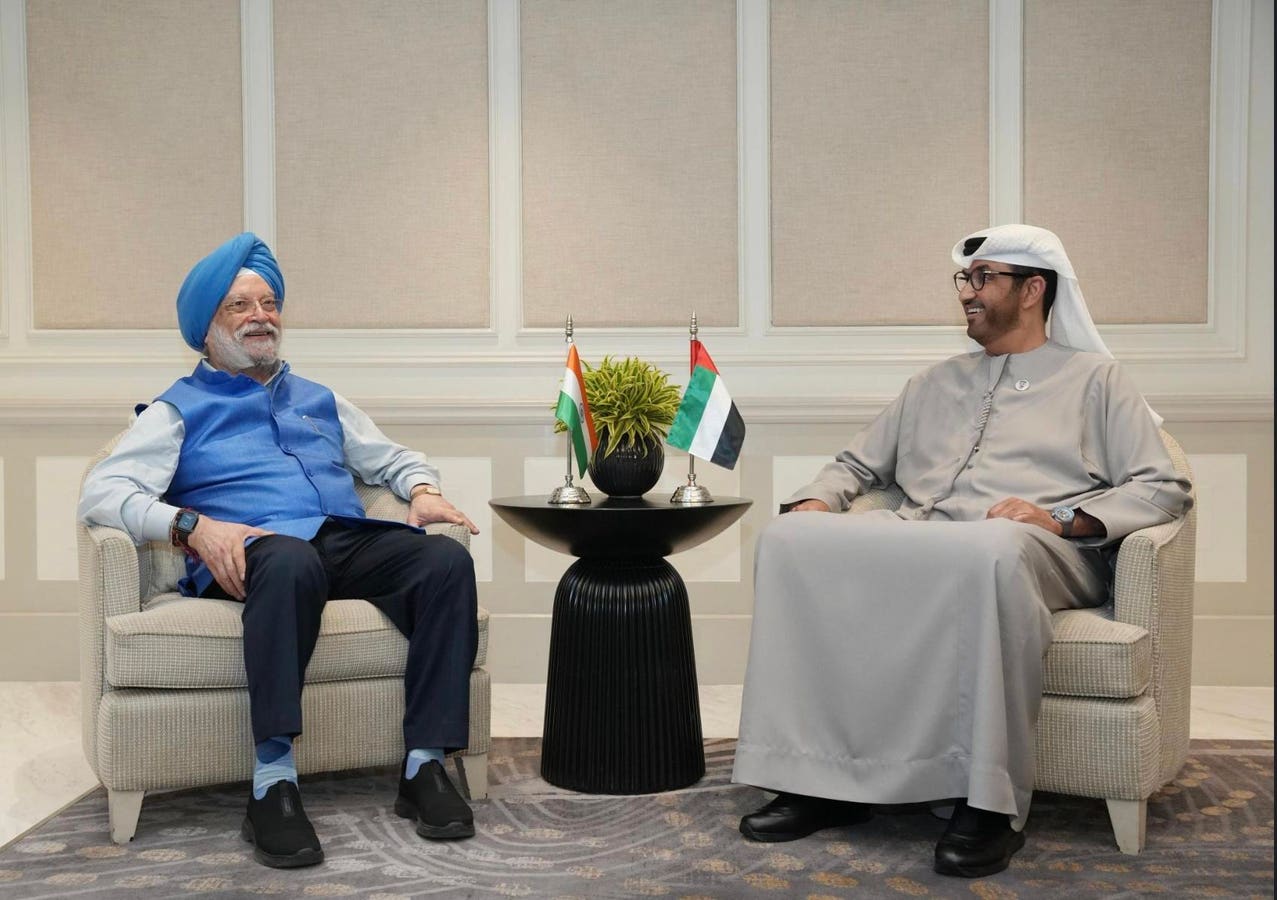
At India Energy Week, taking place from January 27 to 30, 2026, in Goa, the focus extends beyond traditional oil and gas discussions to encompass the increasing electricity demands of artificial intelligence (AI) technologies. India is positioning itself as a critical testbed for the intersection of energy infrastructure and AI expansion, underscored by the meeting between India’s petroleum minister Hardeep Singh Puri and ADNOC’s Dr. Sultan Al Jaber. ADNOC, the Abu Dhabi National Oil Company, identifies India as its largest liquefied natural gas (LNG) market and the fourth-largest supplier of crude oil.
The presence of Dr. Sultan Al Jaber at this event signifies a pivotal shift in energy dialogue. His role as ADNOC’s chief executive and a senior UAE minister lends weight to discussions about oil, gas, and energy transitions. However, the underlying narrative revolves around the essential electricity needed to support the growing AI landscape. While AI is often perceived as merely software, it is fundamentally reliant on physical infrastructure—steel, copper, water, and most importantly, power. As advanced economies grapple with aging electricity grids and regulatory challenges, India is emerging as a primary site for constructing the future of AI infrastructure.
The World Energy Outlook from the International Energy Agency (IEA) reveals that data centers already account for approximately 1.5% of global electricity demand, with this figure expected to escalate as AI workloads grow. Predictions suggest that demand from data centers, driven by AI and other technologies, could significantly increase by 2026. This shift highlights a fundamental change: electricity, rather than software, is becoming the critical bottleneck in the AI revolution.
In his keynote address, Al Jaber emphasized that the future of energy is defined by three major trends: the rise of emerging markets led by Asia and India, the rapid expansion of AI and digital infrastructure, and the transformation of energy systems. He warned that as demand surges, the risk lies not in oversupply but rather in underinvestment. He also pointed out the often-overlooked need for cooling systems, as rising temperatures and increasing wealth drive the demand for air-conditioning, further stressing the grid from both ends.
Currently, India’s data-center capacity is modest compared to that of the U.S. and China, standing at about 1.4 gigawatts. However, with a growing pipeline of projects, forecasts suggest a potential expansion to high-single-digit gigawatts by the end of the decade, marking a significant new industrial sector. According to an ADNOC spokesperson, India is vital to ADNOC’s operations, serving as its primary LNG market and a key player in the broader energy ecosystem, with Indian firms engaging in various capacities within ADNOC’s operations.
The structure of India Energy Week reflects these multifaceted discussions, featuring a large exhibition area and thematic zones that place “Digitalisation and AI” alongside pivotal topics such as nuclear energy and hydrogen production. This strategic positioning indicates that successful AI deployment at scale is inextricably linked to advancements in energy infrastructure.
India’s approach to energy policy reveals a critical truth often overlooked by Silicon Valley: those who shape energy frameworks will ultimately determine the constraints and outputs of the AI economy. For Gulf nations, the long-term strategy involves not only supplying energy to India but also investing in the critical infrastructure that will transform energy into reliable computing power and strategic advantages.
Capital efficiency is a guiding principle as Gulf countries invest in AI infrastructure both at home and abroad. However, their domestic markets lack the expansive opportunities for AI deployment that India offers, given its size, growth trajectory, and a government comfortable with leveraging energy as an industrial policy tool. As Hardeep Singh Puri characterizes India Energy Week as a transition from mere discussion to actionable collaboration, the potential for partnerships and investment emerges more clearly.
India’s modernization program, which includes an investment of approximately ₹3.03 lakh crore to upgrade distribution networks, underscores the strategic importance of reliable energy systems for high-density computing. For Gulf investors, this modernization represents not just a usual utility endeavor but a vital strategic play within the expanding global AI economy.
Beyond the immediate focus on energy supplies, there is a geopolitical dimension as well. While Europe and the U.S. engage in debates about AI’s environmental impact, India’s pragmatic approach emphasizes building capacity first before addressing finer allocation of resources. The prominence of nuclear energy and sustainable aviation fuels within the conference agenda highlights the importance of developing resilient energy systems capable of scaling without destabilizing surrounding infrastructures.
Upcoming Memorandums of Understanding (MoUs) are expected to highlight not only significant oil and LNG contracts but also critical agreements related to grid management systems, storage capabilities, and digital infrastructure partnerships essential for achieving AI-grade reliability. Nations capable of powering the backbone of advanced technologies will gain substantial competitive advantages in the 21st century. India appears to have recognized this early on, as evidenced by the significant stakeholders participating in Goa and their intent to forge lasting agreements.
See also Seagate Sees 25.2% Stock Surge Amid AI Storage Demand and Dividend Increase
 Shanghai Surpasses 120,000 PFLOPS in Intelligent Computing, Launches New Industry Initiative
 AMD Faces Unmet Demand for AI Chips, Cramer Highlights 119% Stock Surge
 Synopsys Partners with Lightmatter to Enhance AI Infrastructure with Optical Technology