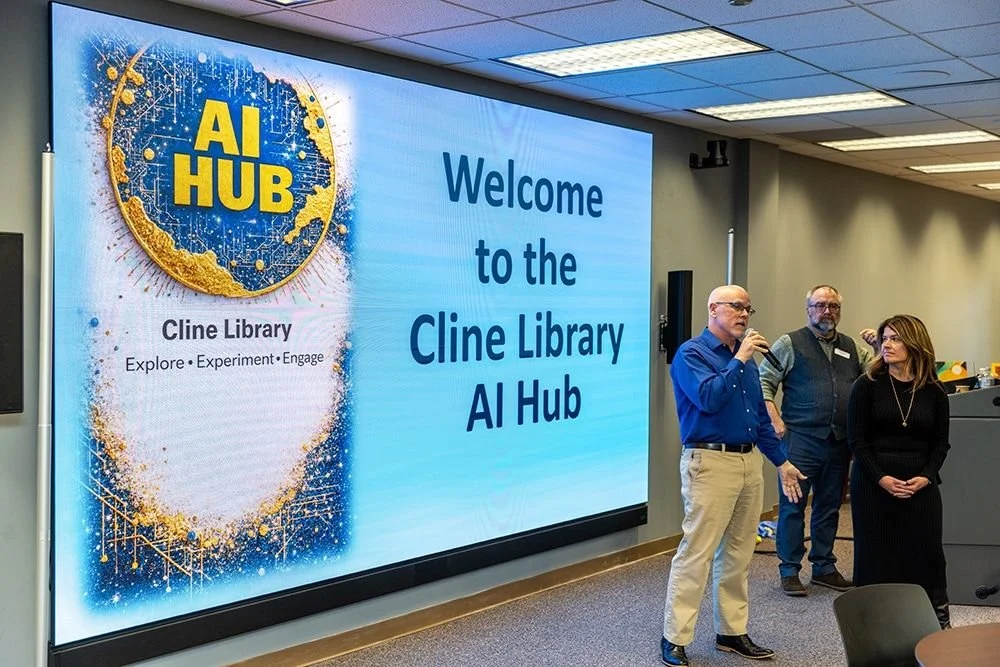
Northern Arizona University has launched a new AI Hub at its Cline Library, providing a dedicated on-campus space for students, faculty, staff, and community members to engage with generative AI and develop practical AI skills. This initiative reflects a broader trend among educational institutions to incorporate AI as a fundamental literacy essential for employability, critical thinking, and regional workforce development.
The AI Hub, located within the Cline Library, aims to serve as a central resource for the NAU community to experiment with ideas, compare methodologies across various disciplines, and receive immediate support for generative AI applications. Library staff, along with student AI ambassadors, are available to assist visitors in familiarizing themselves with AI tools, sharing their work, and exploring innovative approaches.
This endeavor is made possible through a donation from NAU alumnus James Owens, a 1971 graduate of the School of Communication. The university has designated this initiative as part of its “Year of AI Empowerment,” underscoring its commitment to integrating AI into the educational framework.
Cynthia Childrey, Dean and University Librarian at NAU, emphasized the library’s pivotal role in how AI is presented and understood on campus. “By collaboratively designing and creating the AI Hub as a shared campus and regional resource, Cline Library is providing a space where all members of our community can learn by doing and learn from each other,” she stated. Childrey also highlighted librarians’ expertise in information literacy and critical thinking as essential for guiding exploration and addressing the challenges associated with AI.
University President José Luis Cruz Rivera framed AI as a contemporary form of literacy rather than merely a technological tool. “That’s when I began to see AI not just as a toolset, but as a literacy—a kind of modern fluency that determines whether we remain in control of our thinking, of our creativity, of our humanity, or hand it off too easily,” he remarked. Rivera expressed that this shift in perspective is vital for equipping the university community with the necessary skills, confidence, and discernment to engage with AI thoughtfully, critically, and ethically.
The AI Hub’s launch event featured interactive stations designed to encourage participants to assess their AI knowledge and share views on ethical implications, opportunities, and concerns. Activities such as drafting an ethics statement for the hub and reflecting on aspirations and risks associated with AI will continue to be available throughout the semester. NAU plans to publish a feature later in the term detailing how the AI Hub was developed through community feedback.
Drop-in support and scheduled sessions with student AI ambassadors will sustain engagement, with additional programming anticipated in the spring. This initiative epitomizes a proactive approach in higher education to not only incorporate technological advancements but also prepare students for a rapidly evolving job market.
In a related note, the ETIH Innovation Awards 2026 have opened for submissions, recognizing education technology organizations that demonstrate measurable impacts across K–12, higher education, and lifelong learning. Entries are welcomed from the UK, the Americas, and globally, with submissions evaluated based on evidence of outcomes and real-world applications.
See also Techville Education Celebrates 25th Anniversary, Unveils Vision for AI in Public Education
 IXL Wins 13 Awards in 2025, Recognized as Top EdTech Resource for Personalized Learning
 UAE Ministry Partners with Microsoft to Launch Four AI Agents for Higher Education
 AI Redefines Learning Space Design: Insights from Education Tech Leaders on Future Trends
 Jordan’s Education System Must Reform for AI Economy Amid Growing Youth Unemployment