






















































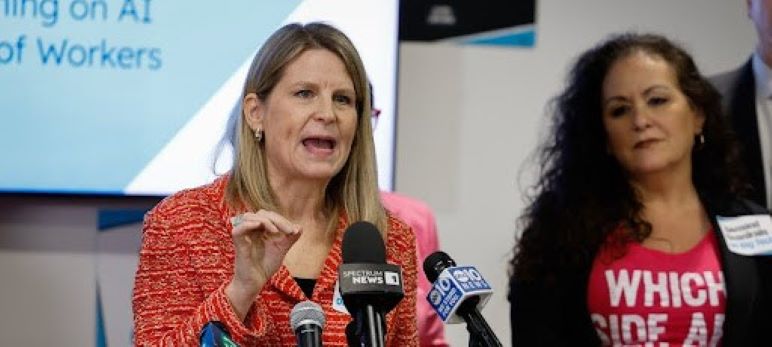
In a press conference held on February 4 in Sacramento, California Labor Federation president Lorena Gonzalez and other labor leaders called on Governor Gavin Newsom to address the implications of artificial intelligence (AI) on employment as he eyes a potential presidential run in 2028. They urged him to implement regulations that would protect workers from the adverse effects of AI, which they described as an escalating threat to job security.
The California Labor Federation is advocating for a suite of regulations, including restrictions on the use of predictive AI by managers, mandatory advance notice for AI-induced job losses, and limitations on workplace surveillance. Gonzalez emphasized the labor movement’s resolve to stand firm, stating, “I don’t think you’re going to have a lot of motivation to walk precincts for somebody who won’t engage working-class voters on the very things that are taking away their jobs.”
This push for regulatory measures highlights the balance Newsom faces between supporting technological innovation and addressing the legitimate concerns of workers and unions. The state is grappling with a projected $18 billion budget deficit while increasingly depending on AI technologies for tax revenue. Amid this financial backdrop, influential tech firms like Meta and OpenAI are establishing political action committees to support candidates who favor AI advancement.
Julie Salley, a consultant with the state assembly’s Consumer Privacy and Protection Committee, noted the potential fallout from unfavorable regulations. “If we hurt the bottom line then that’s also going to hurt the state, and I wouldn’t want to be the governor who caused a recession, especially if I may be running for a federal office,” she remarked. Last year, Newsom vetoed multiple AI-related bills that labor unions championed, including one aimed at safeguarding truckers from the encroachment of autonomous vehicles.
In a statement, Governor Newsom’s spokesperson, Tara Gallegos, highlighted his administration’s efforts, asserting, “No Governor has done more than Governor Gavin Newsom to regulate AI in a way that protects workers without killing jobs or innovation.” This statement reflects the administration’s attempt to portray a pro-worker stance while navigating the complexities of an evolving technological landscape.
Polls indicate that public sentiment is broadly in favor of AI regulation. A national Gallup poll from September 2025 revealed that 80% of Americans support regulatory measures to protect against AI, even at the cost of slowing innovation. Similar surveys conducted by Carnegie California and TechEquity found a strong desire among Californians for safeguards against AI’s potential harms.
At the press conference, Gonzalez announced plans for the labor federation to sponsor or support approximately two dozen bills this year aimed at addressing the negative impacts of AI on workers, urging Newsom to back these initiatives. She expressed concern that the governor has not adequately responded to these pressing issues. The governor’s office did not comment on her accusations.
As the political landscape shifts, labor leaders like Iowa Federation of Labor president Charlie Wishman warned that Newsom should expect scrutiny from union members and voters regarding his record on worker protections from AI during presidential caucuses. “You’re literally the person in the state who can actually help the rest of the nation on this,” he stated.
Concerns regarding AI extend beyond job displacement, with mounting evidence suggesting it may exacerbate wage theft, increase injury rates in warehouses, undermine workers’ self-worth, and facilitate surveillance practices aimed at stifling union organization. In line with these concerns, the California Labor Federation plans to support Senate Bill 947, which, if enacted, would prevent businesses from basing management decisions solely on predictions generated by AI models. This new version also modifies a previous requirement for prior notification to employees when AI is used in disciplinary actions.
As Newsom navigates his final year in office, he finds himself balancing the interests of both regulatory frameworks and pro-business strategies. His administration’s 2023 executive order aimed at generative AI reflects this delicate equilibrium, advocating for protective measures while seeking opportunities for innovation. In his recent state of the state address, he remarked, “No technology holds more promise and more peril, to jobs, to our economy, to our way of life than artificial intelligence.”
Tech advocates are rapidly mobilizing to influence political agendas. Though the exact lobbying expenditures by tech firms remain undocumented, there has been a noticeable increase in lobbying activities in Sacramento. Last year, Anthropic spent $200,000 on advocacy efforts, while OpenAI made its inaugural foray into lobbying. Meta’s lobbying expenditure reached $4.6 million, marking its highest-ever investment in promoting its positions within California’s political sphere.
Democratic Assemblymember Josh Lowenthal raised alarm over the emergence of pro-AI political action committees, expressing concerns about the potential entrenchment of tech wealth within the political system. “The alarm bells should be on for all of us because we have one, two, three years before this money gets so deeply entrenched with the current crop of elected officials that it can be devastating to an entire generation,” he asserted.
See also US, China, and India Pursue Divergent AI Strategies as Global Market Set to Hit $1.8 Trillion by 2030
 Clearnote Launches AI-Powered Legal Contracts Platform for $29.99 a Month
 Goldman Sachs Deploys Anthropic’s Claude AI for Core Accounting and Compliance Functions
 Illinois Proposes Comprehensive AI Bills to Regulate Education, Employment, and Liability
 FTC’s Limited Authority to Preempt State AI Laws Under Executive Order Explained















