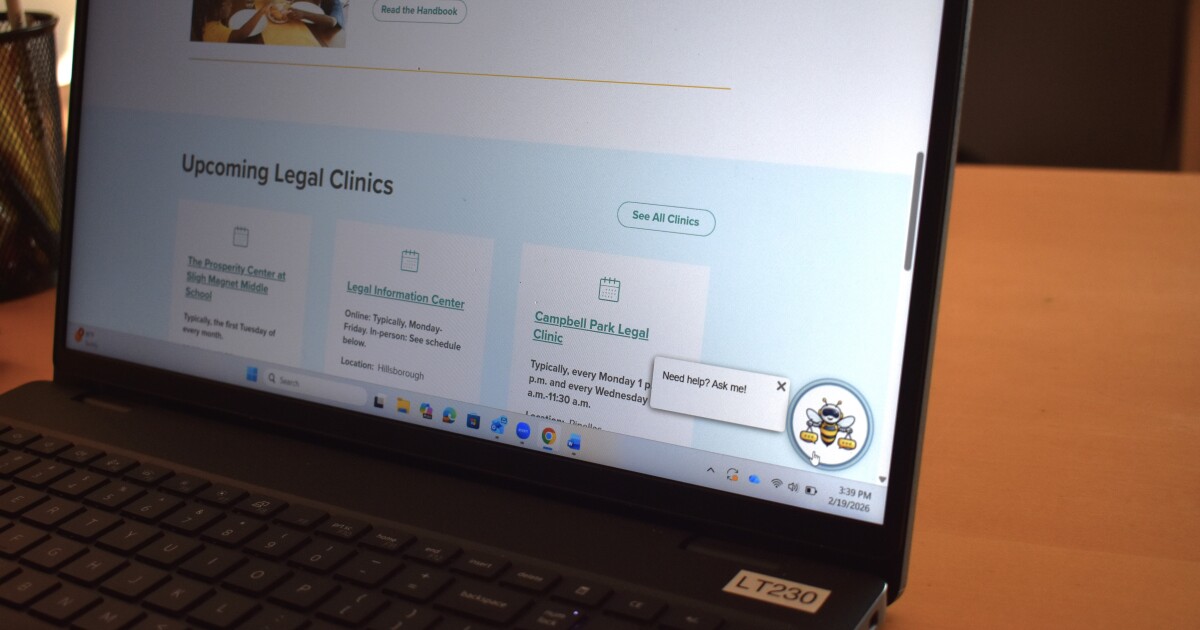
Bay Area Legal Services has launched a new AI chatbot named Bailey B., represented by a blinking bumblebee icon balancing the scales of justice. The service, which debuted on February 17, is accessible in the “Get Help” section of the nonprofit law firm’s website, appearing in the bottom right-hand corner of users’ screens.
Kezia Hill, the legal content manager at Bay Area Legal Services, describes Bailey as “a 1L (first-year) law student. A little stressed, but eager and ready to shine.” With a simple prompt, the AI chatbot can provide legal information on common landlord-tenant issues in Florida, including navigating eviction notices, requesting repairs, giving notice to vacate, and recovering security deposits.
Beyond answering queries, Bailey B. can also draft basic legal documents, such as a motion to determine rent, and direct users to trusted resources or additional support. Hill noted that the chatbot’s capabilities will expand to include drafting up to 40 different legal documents in the future.
While the tool aims to help users understand their legal rights in Florida, Hill emphasizes that interactions with Bailey B. should not be construed as legal advice. “So with AI, it’s really important to understand that it’s just simply giving you all your options. Here they are, and they’ve been fact-checked, they’ve been verified because attorneys have put this information in — now do with it what you will,” she stated.
Unlike other generative AI models such as Claude, Gemini, and ChatGPT, which rely on a wide array of publicly available sources, Bailey B. has been trained on carefully selected material curated by legal staff. Hill highlighted the necessity for the chatbot’s knowledge base to be regularly updated to maintain its effectiveness. “Laws are constantly changing,” she said. “If you’re not giving the bot every single piece of information that you have on this topic, when it’s asked a question, it’s either going to attempt to hallucinate or the answer is not quite right, which is not quite enough for what we’re going for.”
To mitigate the risks of misinformation, the chatbot has been equipped with guardrails to prevent hallucinations and ensure it does not present itself with undue confidence. Additionally, back-end controls allow for adjustments to the bot’s attitude and tone in its responses.
Bay Area Legal Services partnered with justice tech automation firm LawDroid to develop the chatbot’s wireframe and back-end controls. Bailey B. is notable for being the first of its kind in Florida and the third legal aid service nationwide to implement an AI chatbot in collaboration with LawDroid, following similar initiatives by Legal Aid of North Carolina and Atlanta Legal Aid.
In the Tampa Bay area, the chatbot is intended as a resource for individuals who do not qualify for the nonprofit’s free legal aid but still find traditional legal counsel prohibitively expensive. Hill pointed out that the target users are often those who slip through the cracks of the legal system: “Attorneys are a privilege. They’re extremely expensive to have, so we wanted to reach that gap and still provide support to those thousands — dare I say, millions — of people that really need legal help.”
Looking ahead, Hill mentioned plans to broaden the chatbot’s knowledge base to assist users with various family law matters, which typically involve extensive paperwork and high costs. A Spanish-language version of Bailey B. is also expected to launch in the coming months, further enhancing accessibility for a diverse user base.
See also Alloy Launches AI Assistant to Cut Risk Review Times from 20 Minutes to Seconds
 States Push Back Against Federal AI Policies as Health Insurers Face New Regulations
 Reason Foundation Urges HHS to Clarify AI Regulatory Framework for Enhanced Clinical Care
 State Regulations Surge: Over 200 Bills Target Data Centers Amid AI Boom
 HHS Launches AI Governance Strategy to Boost 70% Growth in Federal AI Projects