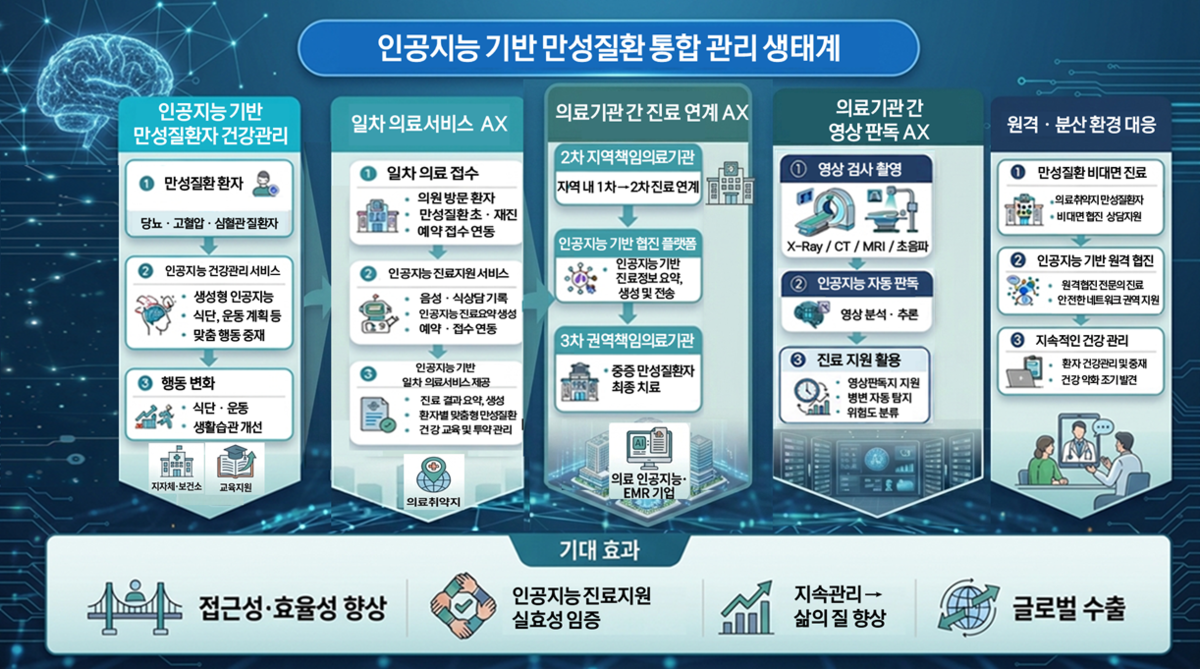
The Korean government is set to launch a comprehensive initiative named “Medical AX (AI Transformation)” aimed at integrating artificial intelligence into all facets of chronic disease management. Announced on Wednesday by the Ministry of Health and Welfare during a briefing at the President Hotel in Seoul, the initiative seeks to enhance the quality of medical services by leveraging AI throughout the entire spectrum, from daily health management to hospital care.
The briefing session was designed to inform AI companies, local governments, public health institutions, and medical facilities about the details and application procedures for the “Full-Cycle AI Transformation (AX) Project for Chronic Disease Patients.” This initiative is part of the broader “AX Sprint” program, which aims to support the early commercialization of AI-based services. Applications for implementation have been open since January 1, with the government aiming to see measurable outcomes, such as revenue generation or public service implementation, within one to two years.
Structured around five key categories, the project will offer AI services for managing exercise and dietary habits, support primary care medical services, facilitate coordination of medical information between healthcare institutions, foster collaboration on medical imaging interpretation, and develop remote consultation models. Collectively, these efforts will address multiple aspects of chronic disease management.
This initiative represents a significant shift in the healthcare delivery system, as it aims to establish a digital foundation for chronic disease management. The government plans to concurrently develop a public medical AX infrastructure that includes data standardization, activation of medical information exchange, and the enhancement of the healthcare big data platform.
Kim Hyun-sook, Director General for Advanced Medical Support, emphasized the transformative potential of the project, stating, “Through this project, AI technology will permeate all aspects of healthcare from citizens’ daily lives to university hospitals, improving the quality of medical care.” She also mentioned that a more systematic support framework will be established through the development of the “AI Basic Medical Strategy,” which is expected to be announced in the first half of this year.
The implications of this initiative could be profound, as it aims to create a more interconnected healthcare ecosystem where AI tools support not just patient management but also enhance operational efficiencies in medical facilities. This could lead to improved health outcomes for chronic disease patients, who often require continuous monitoring and comprehensive care strategies.
As the Korean government accelerates its push into AI-driven healthcare, industry stakeholders will be watching closely to see how effectively these initiatives can be implemented and whether they can lead to sustainable improvements in healthcare delivery. The successful integration of AI into chronic disease management might not only redefine patient care in South Korea but also serve as a model for other countries looking to innovate within their healthcare systems.
See also Malaysia Launches AI Recruitment System to Cut Costs and Enhance Labor Transparency
 Awingobit Urges Dialogue Over Calls to Suspend Publican AI System Amid Port Concerns
 OpenAI’s Leopold Aschenbrenner Warns AI Could Outpace Graduates by 2026
 AI Regulations Fail to Address Environmental Impact, Urgent Changes Needed
 Philippines Launches Nationwide Crackdown on Deepfakes Amid 2,665% Surge in Attacks