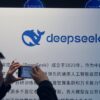
The Chinese AI startup DeepSeek has open-sourced its advanced Math-V2 model, making it available on Hugging Face and GitHub. This initiative, aimed at fostering innovation in mathematical reasoning, follows the model’s impressive performance at the International Mathematical Olympiad (IMO), where it achieved gold-medal status. The IMO, regarded as the world’s most prestigious mathematics competition, has been held annually since 1959 and is known for challenging participants with intricate problems that require deep insight and rigorous reasoning.
DeepSeek’s Math-V2 has not only excelled in the IMO but also in the upcoming 2024 Chinese Mathematical Olympiad, achieving gold-level scores on both platforms. This open-source release marks a significant shift in the landscape of advanced AI tools, traditionally dominated by proprietary systems, thereby lowering barriers for researchers and developers. As reported by the South China Morning Post, this move aims to facilitate experimentation with advanced AI capable of tackling high-level mathematical challenges.
DeepSeek researchers noted that enhancing AI’s mathematical capabilities could transform scientific research, impacting areas ranging from complex simulations to theoretical problem-solving. They expressed caution, however, that many AI systems today are primarily optimized to excel on standard math benchmarks, often achieving high scores without enhancing the underlying reasoning and problem-solving skills essential for real innovation.
Self-verifiable reasoning opens new path for advanced mathematical AI
To address these limitations, DeepSeek focused on enabling the Math-V2 model to “self-verify” its answers, even in scenarios where pre-existing solutions are not available. This self-checking ability allows the AI to evaluate the consistency and validity of its reasoning, ensuring that its conclusions are reliable not only when known solutions exist but also when addressing novel or unsolved mathematical challenges. This method promises to extend AI capabilities to more complex, open-ended problems, overcoming a long-standing limitation where most systems improve only on tasks with easily verifiable solutions.
Although the researchers acknowledged that significant challenges remain, they emphasized that self-verifying mathematical reasoning could pave the way for the development of more advanced AI systems in mathematics and related fields. The implications of this technology could be far-reaching, potentially redefining how complex mathematical problems are approached and solved.
The context of this announcement places DeepSeek in contrast with other leading AI firms. Following its gold medal achievement at the IMO, Google DeepMind made its proprietary model available only to subscribers of its premium Ultra plan, providing a limited access strategy. Meanwhile, OpenAI CEO Sam Altman revealed that the company’s experimental model, which also attained a gold medal at the IMO, will not be publicly accessible for several months. These differing strategies among AI companies highlight a divide, with some opting for controlled access to safeguard intellectual property, while others aim to expand availability to researchers and developers progressively.
As AI continues to evolve, the open-sourcing of models like DeepSeek’s Math-V2 could play a crucial role in democratizing access to advanced tools for mathematical reasoning. This shift may not only enhance academic research but also spur innovation across various industries, positioning AI as an essential partner in tackling some of the most challenging problems facing society today.
See also Philips Launches Verida: Transformative AI-Driven Spectral CT Cuts Exam Time by 50%
 Salesforce’s Stock Faces Crucial Test: AI Strategy’s Success at Stake This Week
 OpenAI Celebrates ChatGPT’s 3rd Anniversary as $100B AI Investment Surge Drives Market
 Ooredoo Expands Microsoft 365 Copilot Access, Elevating AI-Driven Productivity Across Workforce
 Oakley Launches META HSTN AI Glasses in India: Price and Features Revealed