















































U.S. shoppers spent a record $11.8 billion online on Black Friday, marking a 9.1% increase from 2024, according to Adobe Analytics, which tracks over 1 trillion visits to online retail websites. This surge comes amidst a backdrop of tighter consumer budgets, unemployment nearing a four-year high, and consumer confidence slumping to a seven-month low, as shoppers remain cautious in their spending.
Online shopping demand saw a significant boost with consumers adapting to new AI tools this holiday season. Mastercard SpendingPulse reported a 10.4% growth in e-commerce sales on Black Friday, while in-store sales rose only 1.7%. The use of artificial intelligence in retail saw traffic soar by 805% compared to the previous year, highlighting the impact of new tools like Walmart’s Sparky and Amazon’s Rufus for enhancing the shopping experience.
“Consumers are using new tools to get to what they need faster,” said Suzy Davidkhanian, an analyst at eMarketer. “Gift giving can be stressful, and LLMs (large language models) make the discovery process feel quicker and more guided.” Popular items included LEGO sets, Pokémon cards, gaming consoles such as the Nintendo Switch and PlayStation 5, as well as Apple AirPods and KitchenAid mixers.
AI agents influenced $14.2 billion in online sales globally
Globally, AI and agents were credited with influencing $14.2 billion in online sales on Black Friday, with $3 billion coming from U.S. consumers alone, according to Salesforce. The firm, which includes non-discretionary items like groceries in its data, reported that total U.S. online spending on Black Friday reached $18 billion, a 3% increase year-over-year, with luxury apparel and accessories particularly popular.
Despite the increase in U.S. consumer spending this Black Friday, higher prices limited overall demand, as shoppers purchased fewer items at checkout compared to the previous year. Discount rates remained flat relative to 2024, making it challenging for retailers to offer deeper discounts amid rising product prices driven by inflation.
Davidkhanian noted that promotions may not seem as appealing as last year due to elevated product costs, which have diminished the perceived value of deals. The combination of rising prices and stable discount rates means that the real value of Black Friday bargains has declined, according to Michael Ashley Schulman, Chief Investment Officer at Running Point.
Salesforce reported a 1% decline in order volumes as average selling prices rose by 7%, with units per transaction decreasing by 2% compared to the prior year. “There are two things driving up the average selling price in the United States,” said Caila Schwartz, director of consumer insights at Salesforce. “The first is absolutely the impact of tariffs, especially on those discretionary categories where we’ve seen a lot of growth in selling price. The other is the fact that we’re seeing a much stronger higher-income earner than average-income earner, evidenced by the strength in the luxury category.”
This robust spending indicates a promising outlook for Cyber Monday, projected to generate $14.2 billion in sales, a 6.3% increase year-over-year, making it the largest online shopping day of the year, as noted by Adobe. Electronics are anticipated to feature the deepest discounts on Cyber Monday, potentially reaching 30% off list prices, alongside substantial deals on apparel and computers.
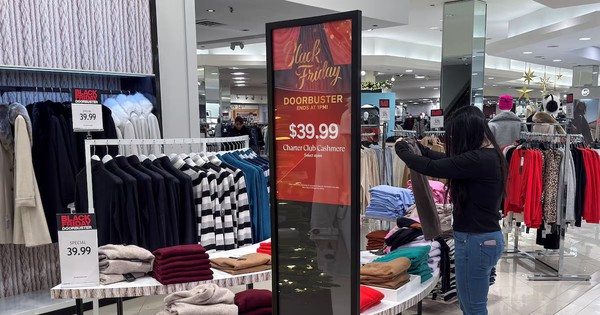
In contrast, physical stores experienced a more subdued shopping atmosphere on Black Friday, with some consumers expressing concern over overspending in light of ongoing inflation, trade uncertainties, and a softened labor market.
See also Michael Burry Issues $1B Warning on Nvidia Amid AI Boom Concerns and Depreciation Risks
 Episode Four Leverages AI ‘Hallucinations’ to Generate Creative Ad Ideas Faster
 Young Founder Launches Genta AI Amid University Challenges, Balances Work and Study
 Generative AI Set to Generate $13 Billion for Australia’s Healthcare by 2030
 AI Monetization to Surge in 2026 with $600B Tech Spending, Say Wedbush Analysts