

















































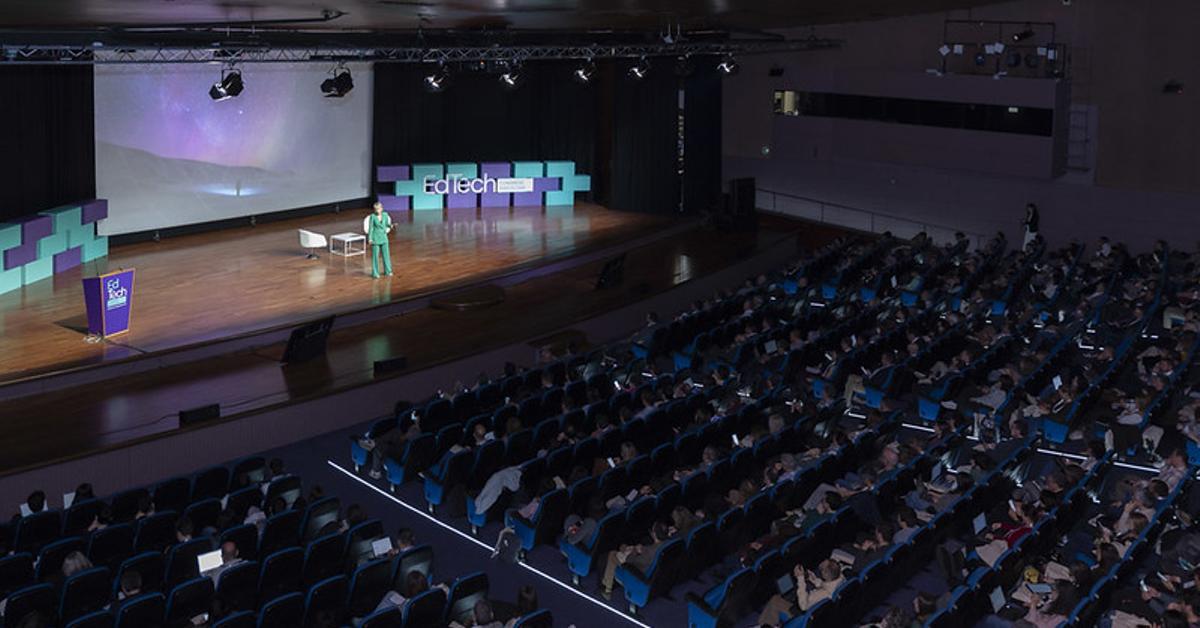
On February 4th and 5th, the Montjuïc Congress Palace will host the EdTech Congress Barcelona, a key event in the educational technology sector. Organized by Fira de Barcelona and the EduTech Cluster, this year’s congress marks a significant milestone through its partnership with Integrated Systems Europe (ISE), the preeminent international authority in the audiovisual realm. The simultaneous occurrence of both events will create a unique environment where technology, innovation, and education intersect.
With the theme “Reimagining education and training in the age of artificial intelligence,” the congress will gather 81 leading specialists alongside more than 60 technology companies. The aim is to explore how artificial intelligence is reshaping teaching methodologies, school management, and learning models, while also addressing the human-centered and inclusive criteria that should guide these transformations. In an era characterized by rapid digitalization, the EdTech Congress aspires to position AI as a catalyst for developing learning systems that are more flexible, accessible, and adaptive, ultimately fulfilling both current and future educational needs.
The event anticipates an audience of around 2,500 attendees, which will include educational managers, university representatives, ICT leaders, and corporate training professionals. This broad participation underscores the congress’s pivotal role in fostering dialogue among key stakeholders in the education sector.
The congress will feature notable presentations, commencing with a keynote address from Kristina Ishmael, a prominent figure in U.S. educational technology. The closing presentation will be delivered by Cristóbal Cobo, an esteemed researcher known for his humanistic approach and the concept of “invisible learning.” Other influential figures include Ousman Umar, founder of NASCO Feeding Minds, who is recognized for leveraging technology to empower rural African communities and combat poverty. The program also showcases experts such as Mariana Ferrarelli, an authority on educational AI; paleoanthropologist Ignacio Martínez Mendizábal, who advocates for human cooperation; philosopher and sociologist César Rendueles; digital innovation pioneer Faraón Llorens; and writer Belén Gopegui, who reflects on the connection between technology and intimacy.
Addressing critical topics related to education, the congress will tackle issues such as inclusion and digital accessibility, the integration of emerging technologies in classroom settings, digital well-being, effective teaching practices, and the transformation of universities and research environments under the influence of AI.
In addition to the keynote and panel discussions, more than 60 companies will showcase their innovations in hybrid classrooms, advanced connectivity solutions, AI-based assessment systems, accessibility features, and educational infrastructure. An immersive Demo & Immersive Lab will be dedicated to smart learning spaces, complemented by a Discovery Stage and an Investor Forum aimed at startups. Furthermore, an interdisciplinary hackathon focused on inclusion will be organized in collaboration with organizations such as Fundación La Caixa, Fundación Mona, 3Cat, and Fundación Sant Joan de Déu. Awards will also be presented to educational institutions recognized for their exemplary use of technology and AI.
A highlight of the 2026 edition is the partnership with Integrated Systems Europe (ISE), which will grant EdTech Congress participants access to the world’s largest audiovisual event. This collaboration is set to enhance the fusion of pedagogy and technology with cutting-edge audiovisual solutions, further establishing Barcelona as a global leader in educational innovation. ISE will take place concurrently from February 3 to 6 at the Gran Via venue of Fira de Barcelona, enabling EdTech attendees to explore new technological applications relevant to educational institutions.
Additionally, the inclusion of the We Love Learning Summit, organized by Netex Learning, will enrich the program by focusing on the implications of AI for corporate training, particularly in the financial sector. This expansion reflects the congress’s commitment to broadening its scope and impact within the educational landscape.
See also Affective AI Literacy Boosts Student Satisfaction, Reveals New Research Findings
 Graduates Face 5.8% Unemployment as AI Alters Job Market Dynamics and Higher Ed Value
 Google Launches Project Genie AI Model for Interactive Real-Time Environments
 Italy’s Online Education Market Reaches $2.05B, Projected to Hit $14.83B by 2033
 Kuwait Integrates AI and Cybersecurity into School Curricula for Future-Ready Education