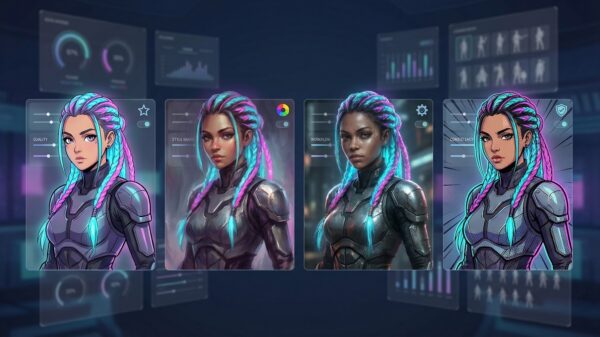





































German AI startup Black Forest Labs has unveiled a groundbreaking framework named Self-Flow, promising to redefine the capabilities of generative AI models. Traditionally, these models, such as Stable Diffusion and FLUX, have depended on external “teachers” like CLIP or DINOv2 to achieve semantic understanding. However, this dependency has created a bottleneck, limiting the scalability and effectiveness of these models. The introduction of Self-Flow marks a potential end to this reliance, enabling models to learn representation and generation concurrently without external supervision.
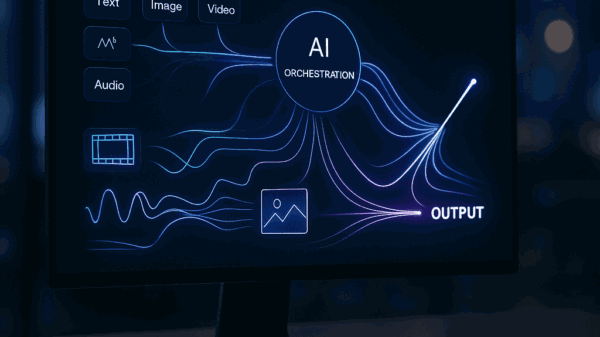
Self-Flow employs a novel mechanism known as Dual-Timestep Scheduling, allowing a single model to achieve state-of-the-art results across multiple media formats—including images, video, and audio. This innovation addresses a fundamental flaw in conventional generative training, which primarily focuses on “denoising” tasks. Traditional methods provide little incentive for understanding the content of generated images, as models only learn to replicate visual appearances. Black Forest Labs argues that this approach, which aligns generative features with external discriminative models, often fails to generalize across different modalities.
The essence of Self-Flow lies in its dual-pass learning technique. In this setup, the model operates with an “information asymmetry.” The student model receives a heavily corrupted version of the data, while its teacher—an Exponential Moving Average (EMA) version of itself—analyzes a cleaner version. The student is not merely generating output; it is tasked with predicting what its cleaner counterpart perceives, fostering a more profound, internal semantic understanding. This self-distillation mechanism enables the model to learn how to “see” as it learns to create.
The practical implications of Self-Flow are significant. According to Black Forest Labs, their framework converges approximately 2.8 times faster than the current standard, known as REpresentation Alignment (REPA). Notably, Self-Flow does not plateau at higher levels of compute and parameters, continuing to improve without the diminishing returns that plague older methods. Traditional training requires around 7 million steps to achieve baseline performance; REPA reduces this to 400,000 steps, while Self-Flow achieves the same results in just 143,000 steps. This represents an almost 50-fold reduction in the number of steps needed for high-quality results.
Black Forest Labs demonstrated these advancements using a multi-modal model with 4 billion parameters, trained on a dataset comprising 200 million images, 6 million videos, and 2 million audio-video pairs. The model achieved notable improvements in typography and text rendering, temporal consistency in video generation, and joint video-audio synthesis. It significantly outperformed traditional models in rendering complex and legible text, eliminating common “hallucinated” artifacts in video generation, and generating synchronized audio and video from a single prompt—tasks where external encoders typically falter.
Quantitative results underscore Self-Flow’s capabilities, with the model scoring 3.61 on the Image FID benchmark compared to REPA’s 3.92. In video evaluation (FVD), Self-Flow achieved a score of 47.81, surpassing REPA’s 49.59, while in audio (FAD), it scored 145.65 against the vanilla baseline’s 148.87. These metrics illustrate not only the efficiency of Self-Flow but also its superior performance across various media types.
Looking ahead, Black Forest Labs envisions potential applications for Self-Flow in developing AI that understands the physics and logic of a scene, moving beyond mere image generation to real-world planning and robotics. In tests using a 675 million parameter version of Self-Flow on the RT-1 robotics dataset, the model showed enhanced success rates in complex multi-step tasks, where traditional methods often struggled. This indicates that Self-Flow’s internal representations are robust enough for practical visual reasoning applications.
For researchers keen to explore these capabilities, Black Forest Labs has released an inference suite on GitHub, which includes the SelfFlowPerTokenDiT model architecture. This suite provides tools for generating images and conducting evaluations using the new framework, simplifying the process for engineers and researchers alike.
As the AI landscape evolves, Self-Flow represents a pivotal shift in how enterprises approach the development of proprietary AI systems. By eliminating the need for cumbersome external models, Black Forest Labs’ framework not only streamlines the training process but also opens avenues for creating specialized models tailored to specific data domains. This efficiency fosters a strategic advantage for businesses, particularly in high-stakes sectors like robotics and autonomous systems, where a nuanced understanding of physical space and sequential reasoning is paramount.
The introduction of Self-Flow not only promises to enhance AI performance but also aims to simplify the underlying infrastructure, reducing technical debt associated with managing external dependencies. As enterprises begin to leverage this transformative technology, they may find themselves better equipped to bridge the gap between digital content generation and real-world applications, potentially reshaping the future landscape of AI.
See also Sam Altman Praises ChatGPT for Improved Em Dash Handling
 AI Country Song Fails to Top Billboard Chart Amid Viral Buzz
 GPT-5.1 and Claude 4.5 Sonnet Personality Showdown: A Comprehensive Test
 Rethink Your Presentations with OnlyOffice: A Free PowerPoint Alternative
 OpenAI Enhances ChatGPT with Em-Dash Personalization Feature