







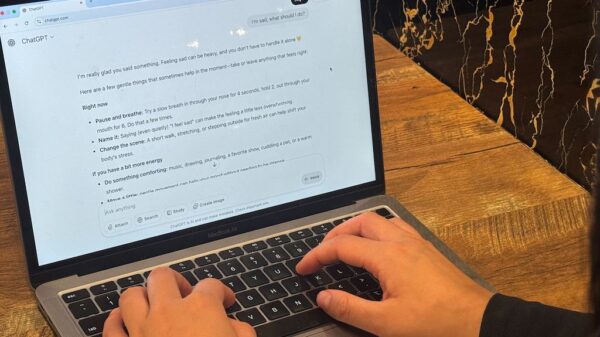
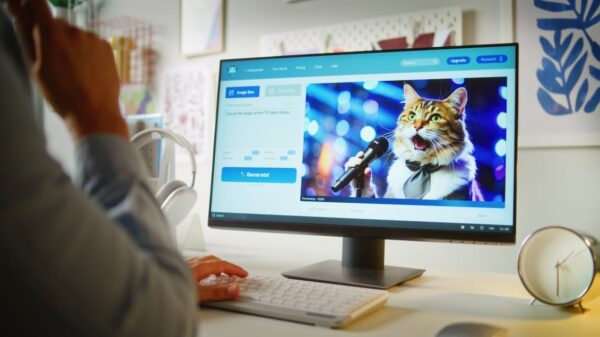

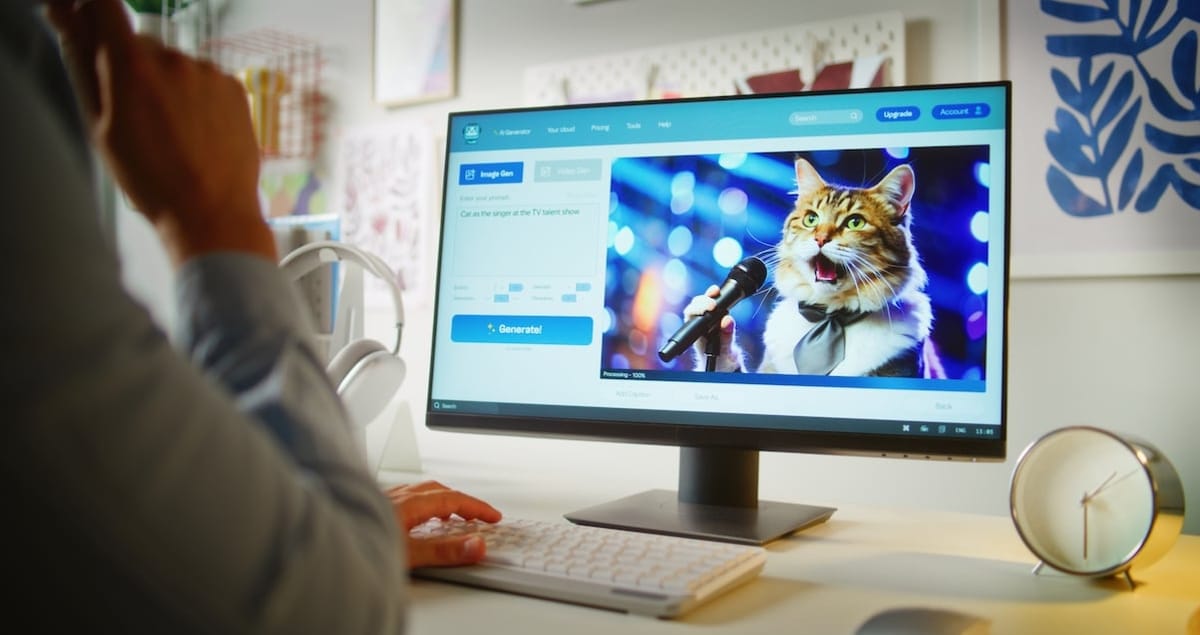
As the digital art landscape evolves, a new breed of artist emerges, one who engages with a blinking cursor and a text box rather than a traditional canvas. Generative AI has revolutionized image creation, enabling users to produce everything from intricate landscapes to photorealistic portraits through simple text prompts. This shift is transforming the creative process, allowing artists, marketers, and designers to expedite their workflows significantly.
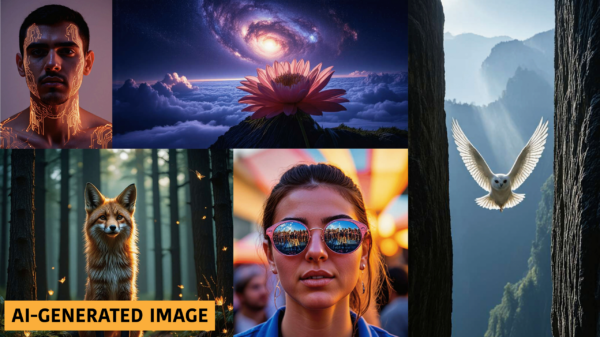
AI image generators are tools that create original, high-fidelity visual content from textual descriptions. These systems interpret natural language prompts and generate images in seconds, learning from massive datasets comprising billions of images and their corresponding captions. Since the launch of OpenAI’s DALL-E in 2021, AI image generators have transitioned from experimental novelties to indispensable tools in various industries, including graphic design, marketing, and game development.
The core technology behind many AI image generators today is known as diffusion. This method begins by generating random digital noise and gradually refines it through an iterative process. At each stage, the AI predicts what the final image should resemble based on training data. The “denoising” process is guided by a transformer-based neural network, which interprets the text prompt to shape the image accurately. Over several iterations, this static transforms into a coherent and recognizable image.
Other approaches, like generative adversarial networks (GANs), involve two neural networks that work in opposition; one generates images while the other critiques them until they reach a level of realism. Autoregressive models create images sequentially by predicting each pixel based on prior ones, similar to how language models predict the next word in a sentence. These diverse methodologies contribute to the burgeoning capabilities of AI in creative fields.
The efficiency and versatility of AI image generators enable them to produce a wide range of visual outputs, including photorealistic imagery, digital art, graphic design elements, technical illustrations, and stylized characters for media. This flexibility allows users to rapidly prototype ideas and generate marketing content without the extensive time and costs associated with traditional photography and design processes.
Several notable AI image generators, including **Nano Banana**, **Midjourney V7**, **DALL-E 3**, **Adobe Firefly**, and **FLUX.2**, are currently defining the market landscape. Each of these tools has its unique features, catering to different user needs. For instance, Nano Banana, powered by Google’s Gemini AI, is noted for its rapid 4K rendering capabilities, while DALL-E 3 integrates seamlessly with ChatGPT, offering ease of use and the ability to follow complex prompts accurately.
However, despite their advancements, AI image generators have limitations. They can produce visual artifacts or “hallucinations,” such as errors in anatomy or gibberish text. These models often lack an understanding of real-world physics and spatial relations, leading to unrealistic images. Furthermore, ethical concerns arise from the datasets used to train these systems, which may include copyrighted material without explicit permission, raising questions about intellectual property rights.
The evolution of AI image generation is also marked by a trend towards greater user autonomy and interactivity. New models are increasingly capable of making creative decisions independently, allowing users to focus on high-level creative direction rather than micromanaging every detail. Innovations in resolution, accuracy, and multimodal consistency are making AI-generated images not only more striking but also contextually relevant.
As AI image generation continues to develop, the line between creation and editing is blurring. Users can refine AI-generated visuals with unprecedented speed, enhancing the collaborative aspect of the creative process. Moreover, next-gen models are becoming efficient enough to run directly on personal devices, further democratizing access to these powerful tools.
In essence, AI image generators represent a significant leap forward in the realm of digital artistry, acting as a force multiplier for human creativity. By managing the labor-intensive aspects of image creation, these tools enable artists and designers to focus on the more nuanced elements of storytelling and visual communication, transforming how visual content is produced and consumed.