







































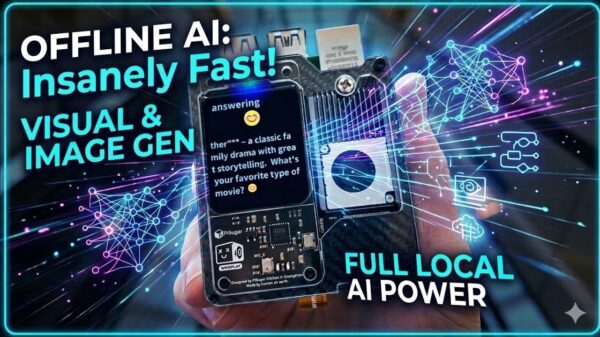


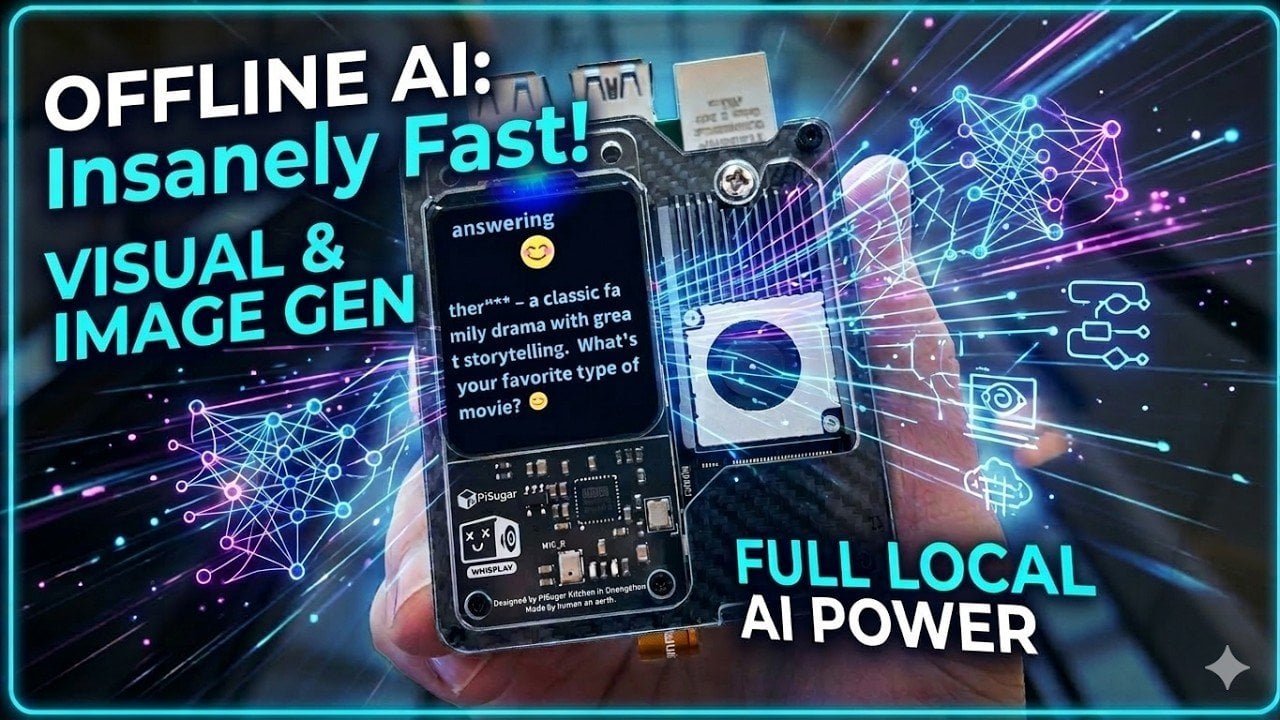
The Raspberry Pi 5 has launched a new chapter in offline artificial intelligence, merging sophisticated hardware and software designed for local AI systems that can analyze and generate content autonomously. At the core of this advancement is the CR3VL vision-language model, featuring a 2-billion-parameter architecture that enables precise image interpretation. Coupled with a latent consistency model, the device can produce high-quality visuals from text or voice prompts within seconds. This development, highlighted by Jdaie Lin, is facilitated by the LM AA50 accelerator and the Raspberry Pi AI Hat Plus 2, empowering users to execute tasks such as image-to-image transformations and voice-to-image generation entirely offline, enhancing privacy and reducing latency.
This local AI initiative showcases critical insights for developers and educators interested in edge AI. The Raspberry Pi 5’s integration of hardware allows for efficient local processing, despite limitations in memory and multitasking capabilities. The project covers practical applications, from creating visuals based on spoken descriptions to building privacy-centered AI assistants. This breakdown provides valuable perspectives for those wishing to engage with the Raspberry Pi 5 for innovative offline AI ventures.
Among its key features, the Raspberry Pi 5 leverages the LM AA50 accelerator alongside the Halo 10H chip, which integrates seamlessly in a compact design. Pre-configured software enables functionalities such as voice-to-image generation and wake word detection. Users can effortlessly activate AI assistants with voice commands, simplifying tasks like conversational queries and visual generation. This smooth integration of hardware and software makes it readily accessible for both novices and seasoned developers.
The performance characteristics of the LM AA50 accelerator underpin the Raspberry Pi 5’s capabilities, facilitating tasks in speech recognition, language modeling, and text-to-speech conversion in offline mode. This independence from cloud services ensures quick processing times and enhanced user privacy. However, the accelerator’s memory constraints limit the number of AI models that can function simultaneously, which could impact performance during more resource-intensive tasks.
As for the Raspberry Pi AI Hat Plus 2, its performance is commendable for running singular AI models effectively but lacks multitasking ability, which may restrict its application in projects requiring simultaneous processing. For example, while it can excel at recognizing speech or generating images, it struggles to undertake these tasks at once. Users need to consider these limitations when planning projects to maximize performance.
The enhanced AI capabilities of the Raspberry Pi 5 present numerous practical applications. It offers transformative features such as voice-to-image generation, which can be particularly beneficial for graphic designers and educators. Additionally, its potential as an offline AI assistant combines visual and conversational capabilities, creating interactive user experiences. Its design inherently supports privacy-focused edge AI applications, making it suitable for sensitive sectors such as healthcare and finance. Developers can also leverage the platform to create and experiment with local knowledge bases and chatbots without relying on external cloud infrastructure.
Despite its promising features, the Raspberry Pi 5 is not devoid of challenges. The memory limitations of the LM AA50 accelerator and multitasking constraints of the Halo 10H chip can hinder more demanding projects requiring parallel processing. However, future updates are anticipated to address these issues, enhancing functionalities such as wake word detection and local knowledge base support. Such enhancements are expected to broaden the device’s application range and efficiency.
As edge AI technology evolves, the Raspberry Pi 5 stands at the forefront, combining affordability with advanced offline capabilities. Its contributions are particularly pertinent for those interested in harnessing AI without the constraints of cloud dependency, making it a valuable resource for developers, educators, and creative professionals alike.
See also Sam Altman Praises ChatGPT for Improved Em Dash Handling
 AI Country Song Fails to Top Billboard Chart Amid Viral Buzz
 GPT-5.1 and Claude 4.5 Sonnet Personality Showdown: A Comprehensive Test
 Rethink Your Presentations with OnlyOffice: A Free PowerPoint Alternative
 OpenAI Enhances ChatGPT with Em-Dash Personalization Feature






