















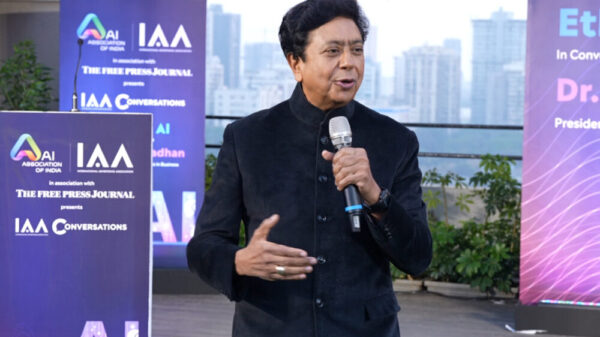




























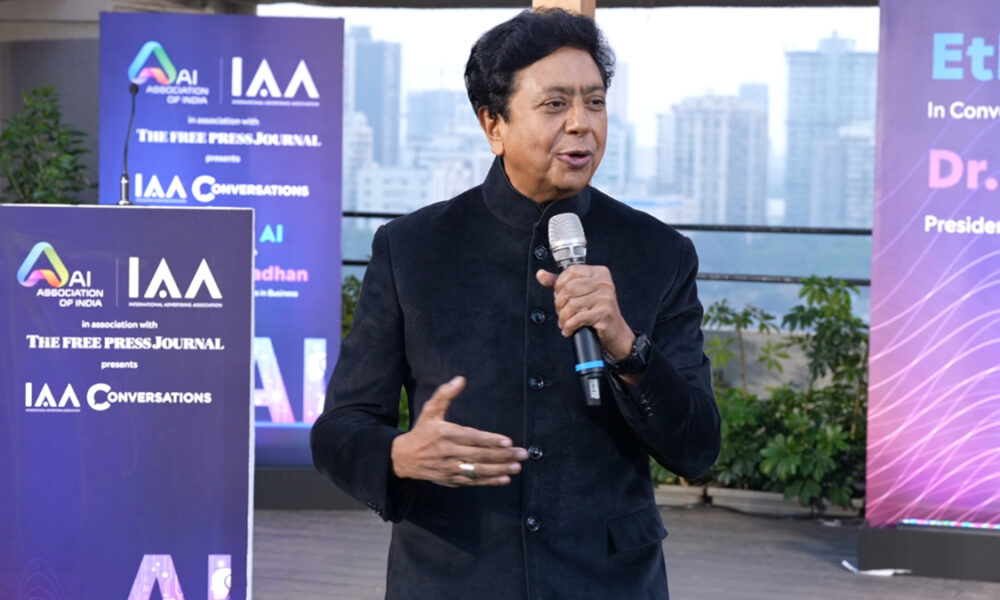
MUMBAI: Artificial intelligence (AI) is advancing at an unprecedented pace, yet its trajectory must be steered by human ethics, according to Sanjay Pradhan, president of the World Forum for Ethics in Business (WFEB). Pradhan delivered this message during the latest edition of IAA Conversations held in Mumbai on March 7, organized by the International Advertising Association (IAA) and the Artificial Intelligence Association of India (AIAI), in association with The Free Press Journal.
In front of a full audience, Pradhan emphasized the need for stronger ethical leadership to ensure that AI remains a beneficial tool for humanity rather than a governing force. He remarked, “Artificial intelligence has rapidly become one of the most powerful technologies humanity has created. It is unlocking breakthroughs in medicine, science and creativity at a pace unimaginable just a few years ago.”
However, he warned that the same technology poses significant risks, including the potential to amplify disinformation more swiftly than factual information can circulate, jeopardize privacy, exacerbate discrimination, and disrupt countless jobs. Echoing concerns from AI pioneers like Geoffrey Hinton, often regarded as the “godfather of AI,” Pradhan cautioned that the critical question is not whether AI will shape the world but whether humans will guide its development with ethics and wisdom.
Pradhan structured his address around four fundamental inquiries: why, what, how, and who. He introduced the audience to WFEB’s emerging AI Ethics Partnership, a global initiative aimed at promoting responsible AI practices. He outlined four urgent concerns that need attention: disinformation, bias and discrimination, data privacy, and job security.
To clarify the concept of ethical AI, Pradhan employed a metaphor, likening it to a three-layered cake. The outer layer signifies the visible value that ethical AI brings to businesses and society, the middle layer represents the organizational culture that transitions ethics from theoretical frameworks to everyday application, while the innermost layer, deemed the most crucial, embodies the conscience of individual leaders.
Drawing on Indian philosophical insights shared by WFEB co-founder Ravi Shankar, Pradhan noted that while artificial intelligence can replicate stored knowledge, true intelligence transcends limits and is grounded in conscience, creativity, and compassion. He suggested that practices such as breathwork and meditation could help leaders cultivate the calm clarity necessary for ethical decision-making.
The event featured a discussion that included Maninder Adityaraj Singh, chief of staff and head of innovation at Rediffusion Brand Solutions Pvt Ltd, and Yash Johri, a lawyer at the Supreme Court of India. Opening the session, IAA India chapter president Abhishek Karnani underscored the importance of industries engaging with AI responsibly.
“AI has to be befriended and understood,” added Sandeep Goyal, managing director of Rediffusion and national convenor of AIAI. He cautioned that the ethical use of AI will determine whether it becomes a friend or a foe.
As AI continues to transform industries and societies, Pradhan concluded with a compelling call to action. He urged businesses, governments, and individuals to collaborate in ensuring that the algorithms shaping the future reflect human values rather than mere logic.
See also Enhance Your Website”s Clarity for AI Understanding and User Engagement
 FoloToy Halts Sales of AI Teddy Bear After Disturbing Child Interactions Found
 AI Experts Discuss Vertical Markets: Strategies for Targeted Business Growth
 Law Firms Shift to AI-Driven Answer Engine Optimization for Enhanced Marketing Success
 Anthropic Disrupts State-Sponsored Cybercrime Using Claude AI, Reveals Key Insights