



















































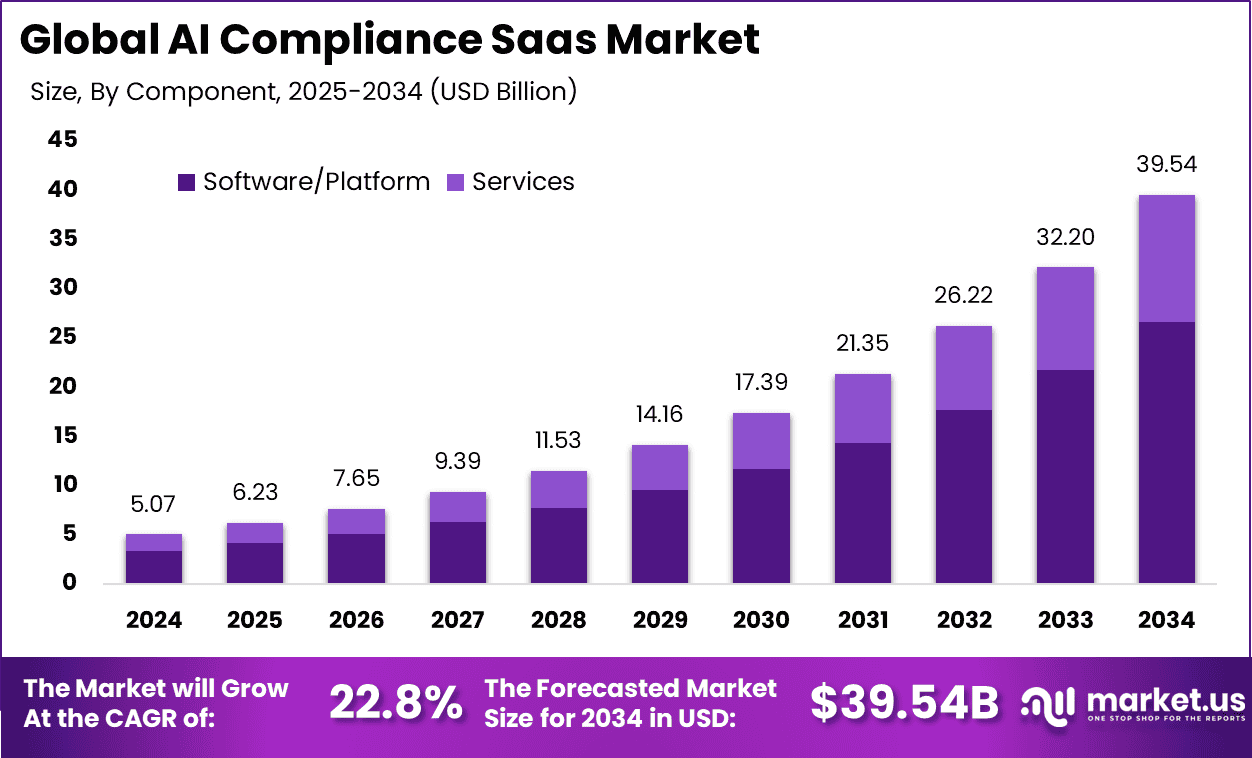
The Global AI Compliance SaaS Market is set to grow significantly, reaching USD 5.07 billion in 2024 and projected to expand to USD 39.54 billion by 2034, reflecting a remarkable CAGR of 22.8%. The acceleration in growth can be attributed to the increasing adoption of automated compliance platforms, which businesses are implementing to navigate regulatory complexities, enhance AI governance, and improve data privacy and risk assessment.
North America leads this burgeoning market with a commanding 45.4% market share, generating USD 2.30 billion in 2024. This dominance is bolstered by stringent regulations and a rapid rate of enterprise adoption. The reliance on AI systems across various sectors is driving demand for platforms that ensure transparency, accountability, and readiness for compliance.
The adoption of AI compliance platforms is enhancing economic productivity by alleviating regulatory burdens and mitigating the high costs associated with non-compliance. Industries such as finance, healthcare, retail, manufacturing, and IT are increasingly utilizing automated compliance tools to enhance audit accuracy and reduce manual workloads. Enhanced data security and improved governance benefit both governments and enterprises, facilitating smoother operations and accelerating innovation cycles. This economic efficiency promotes standardized frameworks for responsible AI adoption, fostering trust and stability within digital ecosystems.
Moreover, the expansion of compliance-focused SaaS solutions is stimulating considerable investment in cloud infrastructure, cybersecurity, and digital transformation initiatives. This trend contributes to job creation, escalated technology spending, and enhanced operational resilience, ultimately boosting global economic competitiveness.
Global enterprises are grappling with rising costs stemming from stricter data protection laws and the heightened demand for secure AI systems. To address these challenges, businesses are investing in compliance automation, documentation, and real-time monitoring tools. Sectors like BFSI, healthcare, and telecom are increasingly dependent on AI compliance SaaS to mitigate audit exposure, improve reporting accuracy, and eliminate manual inefficiencies.
As businesses navigate these complexities, effective strategies emerge. Centralizing AI compliance platforms to automate risk assessments, strengthening governance frameworks in line with global regulations, and integrating real-time monitoring for data usage and model transparency are pivotal moves. Investing in staff training on AI ethics and compliance, implementing cross-border compliance tools, and prioritizing cybersecurity during AI model deployment are also critical for maintaining compliance integrity.
The market landscape is characterized by several key takeaways: demand for AI compliance SaaS is surging due to regulatory tightening, with North America holding a substantial market share. Automating governance processes is proving to be an effective way to reduce audit, risk, and legal costs, especially in heavily regulated sectors. Future growth is expected to be propelled by mandates for AI transparency and responsible AI practices.
As organizations confront increasing regulatory expectations, the current market momentum for AI compliance SaaS remains robust. Businesses are increasingly viewing these compliance solutions as essential for ensuring operational continuity, mitigating risks, and building trust among stakeholders. The outlook for the sector is optimistic, fueled by an expanding AI ecosystem and evolving global legislation demanding transparency, explainability, and responsible AI utilization.
North America continues to dominate the market, driven by stringent AI and data protection laws and robust technological infrastructure. Europe closely follows, propelled by the influence of GDPR and other regulatory mandates that accelerate adoption. The Asia Pacific region is witnessing the fastest growth, driven by advancing AI policies in countries like China, India, Japan, and South Korea, while Latin America, the Middle East, and Africa are gradually increasing their adoption rates as digital transformation and fintech expansion drive compliance needs.
In terms of business opportunities, companies can leverage automated governance tools, cross-border compliance engines, real-time AI auditing, and privacy-by-design solutions. The generative AI landscape opens new avenues for bias detection and responsible AI policy integration, particularly for small and medium-sized enterprises that demand affordable compliance SaaS solutions. Consulting, training, and managed governance services also present recurring revenue opportunities.
Leading vendors in the AI compliance SaaS market are focusing on enhancing platform integration, real-time monitoring capabilities, and global compliance coverage. Investments are directed toward developing AI-driven governance frameworks that emphasize explainability and ethical assessments. Market strategies prioritize scalable cloud architecture and customizable workflows to ensure compliance across multiple regions, with a heightened focus on security, transparency, and interoperability.
Recent developments have included the introduction of AI audit automation tools featuring explainability, the expansion of cloud-native compliance platforms into new regions, and the launch of bias-detection modules for enterprise AI systems. Real-time privacy monitoring integrated with advanced analytics and collaborations with regulators to establish sector-specific governance guidelines are also reshaping the compliance landscape.
The AI Compliance SaaS market is evolving rapidly, driven by tightening regulations and the imperative for secure, responsible AI deployment. With robust growth prospects and escalating enterprise adoption, the sector is positioned to become increasingly integral to the global digital transformation landscape.
See also Houston County Adopts New Policy Manual, Signs $43K UKG HR Contract, and Backs Road Grants
 Nkechi Ogbonna Urges African Governments to Regulate AI Amid Rising Misinformation Risks
 AI Regulation Mirrors Social Media’s Path, Tackles Bias and Transparency Issues Ahead
 AI-Media Launches ADA Title II Compliance Initiative to Meet 2026 Digital Accessibility Deadlines
 FiscalNote Launches AI-Powered Impact Summaries for Tailored Policy Insights