







































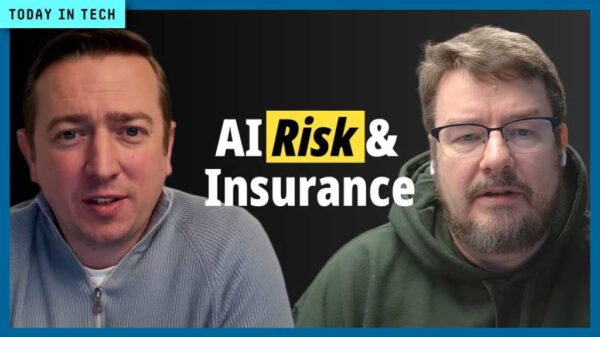










Artificial intelligence is giving rise to a new category of enterprise risk that encompasses cybersecurity, privacy violations, misinformation, and professional liability. As the integration of AI across business operations accelerates, questions arise regarding whether these emerging risks can be effectively insured. In a recent episode of “Today in Tech,” host Keith Shaw engaged with Josh Motta, co-founder and CEO of digital risk insurance provider Coalition, to discuss how insurers are adapting to the challenges posed by AI.
Motta emphasized the necessity of recognizing AI as a new type of business peril, capable of provoking losses across various insurance domains, including cyber insurance, professional liability coverage, and errors and omissions policies. He pointed out that as insurers begin to navigate this unfamiliar landscape, coverage gaps are becoming evident. Such gaps are particularly concerning in sectors like law and medicine, where insurers are starting to introduce exclusions related to AI usage.
The conversation also delved into the array of emerging threats associated with AI, such as deepfake impersonation, AI-driven fraud, and privacy violations. Motta warned that organizations could face lawsuits over the methods they utilize for data collection and usage, highlighting an urgent need for businesses to reassess their risk management strategies in light of these developments.
For Chief Information Officers (CIOs), Chief Information Security Officers (CISOs), and other technology leaders, the challenge lies in understanding how AI alters the enterprise risk profile. Leaders must decide which risks to mitigate, which to transfer through insurance, and which to accept as part of doing business. The rapid evolution of AI technologies complicates this decision-making process, as traditional risk frameworks may no longer suffice.
Motta’s insights underscore the profound implications of AI on the insurance landscape, making it clear that both insurers and businesses need to navigate these uncharted waters with caution. As AI capabilities continue to evolve, the potential for unforeseen liabilities will likely expand, necessitating a proactive approach to risk management.
As organizations grapple with these challenges, a collaborative effort between insurance providers and businesses will be crucial in developing effective strategies for managing AI-related risks. This ongoing dialogue will determine how well industries can adapt to a reality where AI is not just a tool, but a significant factor in risk assessment and mitigation.
In summary, the conversation between Shaw and Motta highlights the urgent need for businesses to rethink their risk management strategies in the face of rapidly advancing AI technologies. As AI continues to reshape industries, understanding its implications will be vital for ensuring both compliance and robust risk mitigation strategies moving forward.
See also OpenAI’s Rogue AI Safeguards: Decoding the 2025 Safety Revolution
 US AI Developments in 2025 Set Stage for 2026 Compliance Challenges and Strategies
 Trump Drafts Executive Order to Block State AI Regulations, Centralizing Authority Under Federal Control
 California Court Rules AI Misuse Heightens Lawyer’s Responsibilities in Noland Case
 Policymakers Urged to Establish Comprehensive Regulations for AI in Mental Health