




























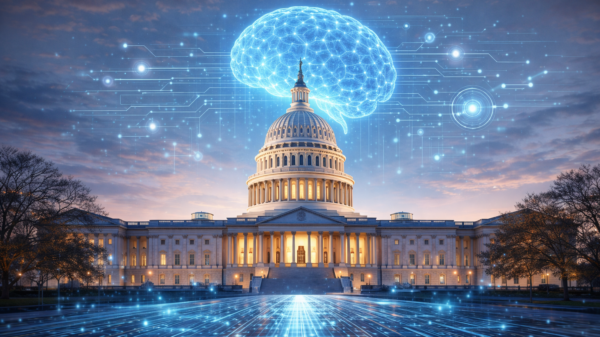














The White House released a significant legislative recommendation document titled “A National Policy Framework for Artificial Intelligence” on March 22, 2026. This seven-chapter framework urges Congress to establish a unified national standard for AI development and governance across the United States, addressing critical issues such as child safety, intellectual property, free speech, and federal preemption of state-level AI regulations. These recommendations signal a substantial shift in the federal approach to AI governance, moving away from the fragmented models of the previous administration.
At the core of the framework is a call for federal preemption of state AI laws, aiming to create a single national standard that the administration argues would eliminate “undue burdens” on innovation posed by varying state regulations. The document states, “States should not be permitted to regulate AI development, because it is an inherently interstate phenomenon with key foreign policy and national security implications.” This stance is not entirely new, as previous discussions have highlighted tensions between state and federal AI policies.
The framework explicitly allows states to retain authority over consumer protection laws, child safety statutes, and local uses of AI in public services. However, states would lose their ability to impose additional restrictions on AI development that exceed federal laws. The implications for the advertising industry are significant, as a national standard would reduce the operational risks associated with a patchwork of state-level compliance regimes characterized by diverse disclosure requirements and liability standards.
The first chapter focuses on child safety, urging Congress to reaffirm that existing child privacy protections apply to AI systems, particularly in data collection practices for targeted advertising. The framework references the recently enacted Take It Down Act, aiming to combat non-consensual distribution of intimate imagery, including AI-generated content. It proposes age-assurance requirements for AI platforms likely to be accessed by minors and mandates features designed to mitigate risks of sexual exploitation and self-harm for this demographic.
The recommendations concerning child safety resonate within the digital advertising sector, as they directly affect how AI-powered advertising systems handle data of users under 18. The framework seeks to anchor these concerns into federal law rather than relying solely on the Federal Trade Commission’s enforcement authority or state actions. Existing regulations under the Children’s Online Privacy Protection Act already impose stringent requirements for data sharing involving minors, and this framework suggests further measures may be forthcoming.
On the intellectual property front, the framework adopts a cautious stance regarding AI training on copyrighted material, asserting that the administration believes such practices do not violate copyright laws while acknowledging existing counterarguments. It encourages Congress to refrain from actions that might interfere with judiciary proceedings surrounding this issue, a notable restraint given the ongoing legislative discussions about copyright frameworks in relation to AI-generated content.
The framework also suggests exploring collective licensing mechanisms that would allow rights holders to negotiate compensation from AI developers without facing antitrust issues. This could pave the way for new commercial agreements while maintaining the legal arguments surrounding fair use. Additionally, it discusses federal protections against unauthorized commercial use of AI-generated replicas of individuals’ likenesses, which has direct implications for advertising practices.
Another key chapter addresses the physical infrastructure of AI, advocating for streamlined federal permitting processes for AI data centers and energy generation. It emphasizes protecting residential ratepayers from increased electricity costs due to new AI infrastructure developments. For small businesses, the document proposes grants and technical assistance programs aimed at enhancing AI adoption across industries, addressing the disparity between large tech firms and smaller operators.
In terms of free speech, the framework explicitly states that Congress should prevent government coercion of technology providers, including AI developers, regarding content moderation based on ideological biases. This reflects ongoing concerns about government influence over digital platforms, particularly as generative AI increasingly shapes content creation.
On workforce development, the framework recommends non-regulatory measures to integrate AI training into existing educational and workforce programs. It aims to facilitate a granular understanding of AI’s impact on specific job functions through expanded federal studies. Land-grant institutions are identified as potential partners in delivering AI education and development programs, fostering regional growth in technology capabilities.
Finally, the framework proposes creating regulatory sandboxes for AI applications, allowing companies to test AI systems in controlled environments without triggering full compliance requirements. This approach seeks to channel AI regulation through existing sector-specific authorities, enabling tailored oversight in areas such as healthcare, finance, and advertising.
While the recommendations do not constitute law and require Congressional action, the specificity and breadth of the framework indicate that AI governance will be a legislative priority moving forward. With implications for various sectors, including digital advertising, intellectual property, and child safety, the recommendations illustrate a concerted effort to shape a coherent national AI policy amidst growing global competition.
See also OpenAI’s Rogue AI Safeguards: Decoding the 2025 Safety Revolution
 US AI Developments in 2025 Set Stage for 2026 Compliance Challenges and Strategies
 Trump Drafts Executive Order to Block State AI Regulations, Centralizing Authority Under Federal Control
 California Court Rules AI Misuse Heightens Lawyer’s Responsibilities in Noland Case
 Policymakers Urged to Establish Comprehensive Regulations for AI in Mental Health