







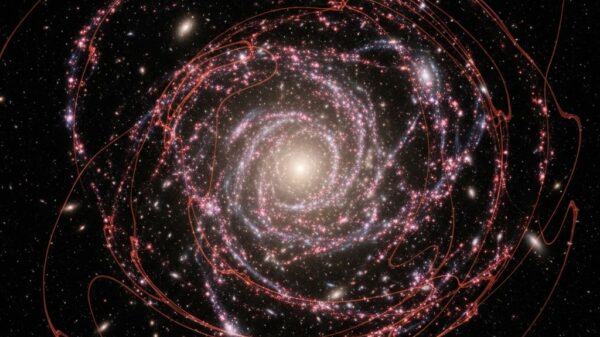








































Scientists are making strides in overcoming the significant data challenges posed by the Vera C. Rubin Observatory’s Legacy Survey of Space and Time (LSST), which aims to uncover the mysteries surrounding dark energy and dark matter. A team of researchers, including Eric Aubourg from Université Paris Cité, Camille Avestruz of the University of Michigan, and Matthew R. Becker at Argonne National Laboratory, has undertaken a comprehensive assessment of how artificial intelligence and machine learning (AI/ML) can be seamlessly integrated into the LSST Dark Energy Science Collaboration’s (DESC) workflows. This research is crucial not only for applying AI/ML but also for ensuring robust uncertainty quantification and reproducible pipelines, which are vital for generating trustworthy cosmological results from this landmark survey.
The team has identified key research priorities and is exploring emerging techniques, including large language models, that could revolutionize data analysis in the context of the LSST. Their work emphasizes the necessity of careful evaluation and governance when implementing AI/ML methodologies. Furthermore, researchers are developing physics-informed methods that embed known physical laws into AI/ML algorithms, enhancing their accuracy and generalizability. Validation frameworks are also being established to rigorously assess the performance and reliability of these AI/ML tools across various datasets and scenarios.
Active learning techniques are being employed to strategically select the most informative data points for training AI/ML models. This approach not only maximizes efficiency but also reduces the dependence on extensive labeled datasets. The researchers are mindful of potential biases and limitations inherent in these advanced AI systems, reinforcing the need for a collaborative environment that promotes knowledge sharing, tools, and best practices. The DESC recognizes the substantial computational resources required to process the vast datasets generated by the LSST and train complex AI/ML models. This commitment to collaboration positions DESC as an ideal testbed for robust AI/ML practices in fundamental physics.
Effective cosmological probe analysis relies on methods that produce reliable uncertainty quantification, withstand systematic effects, and scale effectively across the extensive petabyte-scale survey. Research indicates that the same core AI/ML methodologies and fundamental challenges arise across various scientific cases within DESC. Progress on these cross-cutting challenges could enhance multiple probes simultaneously, leading to the identification of significant methodological research priorities. There is a pronounced emphasis on Bayesian inference, with researchers investigating both explicit likelihood-based and implicit likelihood Bayesian posterior inference techniques.
The work also highlights the importance of addressing model misspecification and covariate shifts, as these can significantly affect the reliability of cosmological constraints. Measurements have confirmed the necessity for robust validation frameworks to assess inference results and ensure the credibility of AI/ML-driven analyses. Hybridizing generative modeling with physical models has emerged as a promising strategy for enhancing the accuracy and interpretability of cosmological inferences. The potential of innovative approaches, such as foundation models and large language models (LLMs) combined with agentic AI systems, is also being explored to accelerate scientific discovery within DESC.
Researchers are investigating training objectives and architectural innovations to tailor these models for specific cosmological tasks, with carefully defined evaluation metrics to gauge their performance. The collaboration underscores the significance of AI/ML not only for its analytical power but also for ensuring scientific accountability and transparency—elements that are critical for precision cosmology. Acknowledging limitations such as computational resources, data access, and required human expertise, the LSST DESC aims to build on its existing simulation infrastructure and scientific standards to serve as a testbed for developing robust AI/ML practices applicable to fundamental physics.
This strategic approach seeks to amplify the contributions of researchers, foster improved collaboration, and enhance accessibility within the field, ensuring that AI/ML serves as a powerful complement to human expertise rather than a replacement. As the LSST progresses, the integration of advanced AI/ML methodologies promises not only to advance our understanding of the universe but also to set a precedent for future scientific endeavors in cosmology and beyond.
See also AI Study Reveals Generated Faces Indistinguishable from Real Photos, Erodes Trust in Visual Media
 Gen AI Revolutionizes Market Research, Transforming $140B Industry Dynamics
 Researchers Unlock Light-Based AI Operations for Significant Energy Efficiency Gains
 Tempus AI Reports $334M Earnings Surge, Unveils Lymphoma Research Partnership
 Iaroslav Argunov Reveals Big Data Methodology Boosting Construction Profits by Billions