








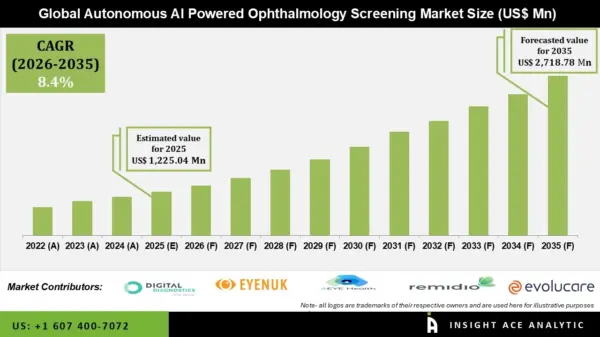








































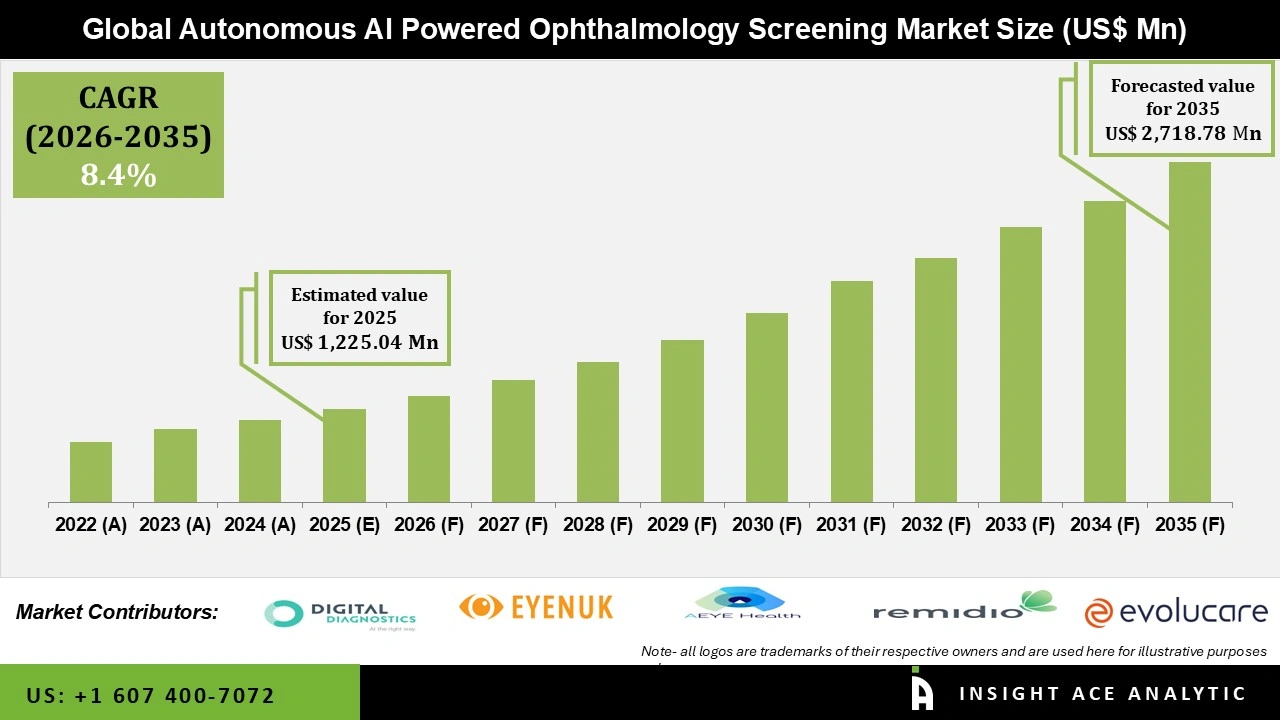
The global Autonomous AI Powered Ophthalmology Screening market is poised for significant growth, with projections indicating a rise from a valuation of USD 1,225.04 million in 2025 to USD 2,718.78 million by 2035, reflecting a compound annual growth rate (CAGR) of 8.4% during the forecast period from 2026 to 2035. This surge is driven by the increasing prevalence of eye conditions, particularly among aging populations and those with diabetes, and the growing demand for early and accessible retinal screening solutions.
Autonomous AI systems can independently analyze retinal images to identify various vision-threatening diseases, including age-related macular degeneration, glaucoma, and diabetic retinopathy. These systems utilize advanced deep learning algorithms trained on vast datasets of retinal images, enabling them to evaluate anomalies and generate diagnostic results without immediate oversight from ophthalmologists. The rapid adoption of these technologies is further supported by the expansion of tele-ophthalmology services and favorable regulatory approvals for AI-based diagnostic tools.
As the need for effective screening solutions escalates, particularly in rural areas with limited access to ophthalmologists, the autonomous AI powered ophthalmology screening market is becoming increasingly vital. The integration of AI in healthcare is enhancing the accuracy and efficiency of diagnostics, especially in settings where specialists are scarce. Furthermore, advancements in cloud-based data integration and high-resolution retinal imaging are stimulating competition within the market, prompting companies to develop user-friendly platforms suitable for non-specialist healthcare environments.
Despite its promising trajectory, the market faces challenges related to data privacy and cybersecurity, which raise concerns over potential data breaches involving sensitive patient information. The reliance on extensive imaging data necessitates stringent adherence to regulatory frameworks, which can vary significantly across regions. The lengthy process required for clinical validation of autonomous diagnostic systems adds to the complexity, potentially hindering their widespread acceptance among healthcare professionals.
In 2025, the diabetic retinopathy (DR) segment emerged as a key driver of the autonomous AI powered ophthalmology screening market, holding the largest share due to its high prevalence among diabetic populations and the risk of irreversible vision loss if left untreated. Increasing awareness among patients and healthcare providers, along with the implementation of screening programs, are propelling this segment’s growth. On the technology front, the image-based AI (Fundus) category is anticipated to expand rapidly, leveraging its capability for automated disease identification and its high accuracy in clinical settings.
The North America region is leading the market, buoyed by high rates of diabetes and age-related eye conditions in countries such as the United States and Canada. The region benefits from early regulatory approvals for AI-based diagnostic tools and a robust healthcare infrastructure, which facilitates the commercialization and deployment of these technologies. Additionally, supportive policies from regulatory bodies and increased investments in healthcare innovation are propelling the market forward.
As the autonomous AI powered ophthalmology screening market continues to grow, it is also adapting to emerging challenges. Companies are focusing on developing clinically validated systems that can integrate seamlessly into existing healthcare frameworks. The ongoing dialogue surrounding data privacy, regulatory compliance, and technology integration will shape the future landscape of this rapidly evolving sector.
See also UK Government Launches £40M AI Lab to Drive Fundamental Research and Transform Technology
 AI Study Reveals Generated Faces Indistinguishable from Real Photos, Erodes Trust in Visual Media
 Gen AI Revolutionizes Market Research, Transforming $140B Industry Dynamics
 Researchers Unlock Light-Based AI Operations for Significant Energy Efficiency Gains
 Tempus AI Reports $334M Earnings Surge, Unveils Lymphoma Research Partnership