



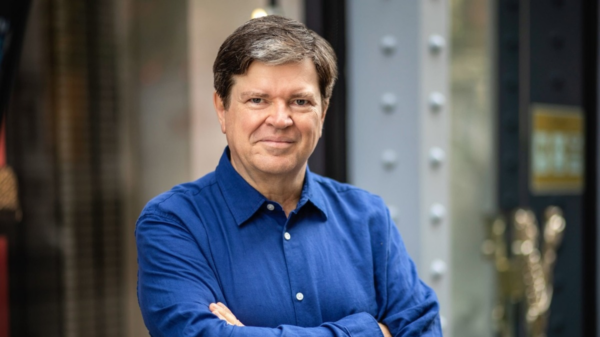









































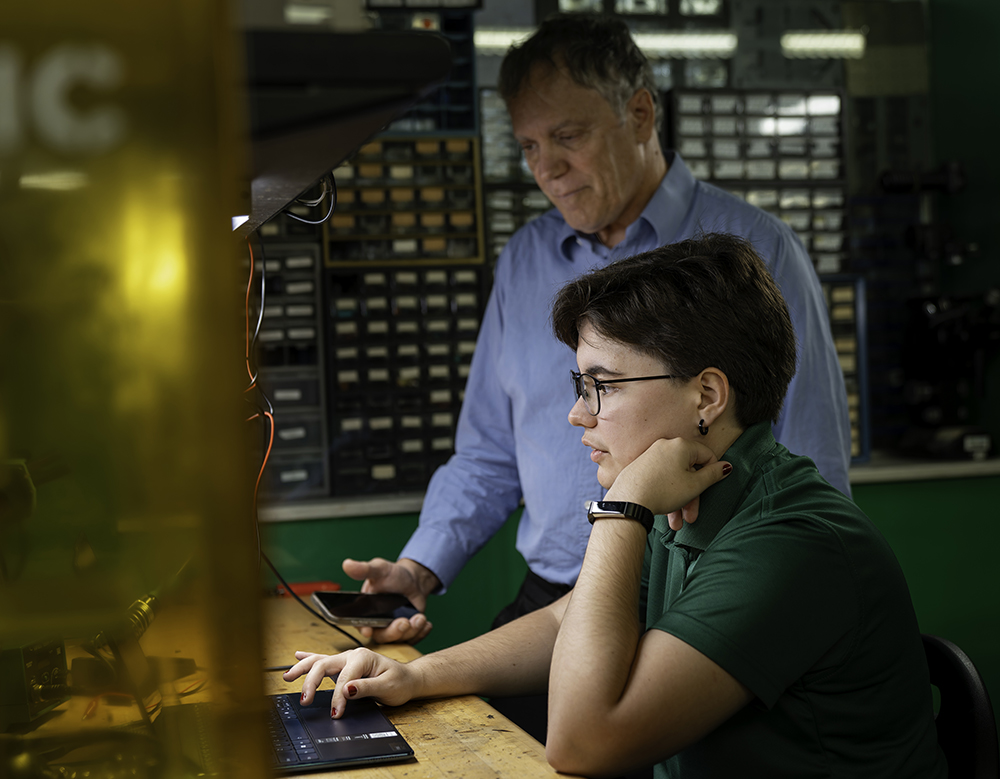
Lawrence Hall, a distinguished professor and associate dean of research innovation at the University of South Florida’s Bellini College of Artificial Intelligence, Cybersecurity and Computing, is often referred to as a “mad scientist” by his colleagues. In the 1980s, when artificial intelligence was more a concept of science fiction than reality, Hall was already laying the groundwork for what would become a pioneering career in the field. Today, he has transformed that early moniker into a more fitting title: Pioneer.
As one of the first AI researchers at USF, Hall has played a pivotal role in the establishment of the Bellini College, the first of its kind in Florida and one of a few nationwide. The college was named last spring following a record-breaking $40 million donation from Arnie and Lauren Bellini. “Everybody’s using it, touching it,” Hall noted, referring to the ubiquity of AI technology today, which is now often taken for granted in everyday devices.
This year, USF is celebrating its 70th anniversary, tracing its origins to December 18, 1956, when state leaders approved its founding. Hall’s work in AI is a significant part of this history, and the Bellini College is expected to influence every discipline at USF, shaping the university’s future direction.
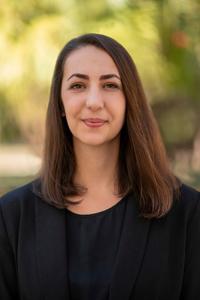
Michelle McAveety, a junior in computer engineering at the Bellini College, expressed her excitement about being at the forefront of technological evolution. “It’s very inspiring to get to be a part of that story,” she said, highlighting the college’s role in shaping the future of education and societal safety in the context of AI.
Hall’s journey into artificial intelligence began in 1986, two years after Kevin Boyer, the first USF professor focused on the field. Hall, who earned his doctorate in computer science from Florida State University, was advised to join USF due to its rising status as a university. “I thought that would be in five years and be up and done,” he recalled, reflecting on the long trajectory that has led USF to become an Association of American Universities member.
In those early years, technology resources were limited and considered outdated compared to today’s standards. Before the advent of the World Wide Web in 1989, the internet was a collection of text-based systems requiring direct connections via modems, making simple tasks like checking email feel laborious. “Maybe 200 examples at a time,” Hall recounted, noting the manual data entry required in early AI research when computers were largely “dumb terminals” connected to a central mainframe.
Despite the challenges, Hall and his early colleagues banded together, fostering a collaborative environment that advanced research and helped USF carve out a niche in AI. “USF was putting an emphasis on AI, partly because it made us more unique,” Hall said, emphasizing the significance of pioneering work that attracted others to the university.
This commitment to AI research culminated in the establishment of the Bellini College, with a mission to produce job-ready professionals in artificial intelligence, cybersecurity, and computing. The college adopts an interdisciplinary approach, encouraging collaboration across various disciplines at USF to enrich the educational experience and foster innovation.
Hall mentioned that the landscape for AI research has dramatically shifted since his early days at USF. The former “secluded” atmosphere has transformed into a collaborative environment characterized by a “hub and spoke model.” In this framework, core disciplines at the center—computer science, cybersecurity, information technology, and artificial intelligence—support specialized studies in fields like business and criminology.
As the Bellini College continues to grow, it is anticipated to attract companies eager to employ its graduates, further developing the Tampa Bay area into what some are dubbing “Cyber Bay.” Hall expressed confidence that the institution is poised to become a nexus for AI research and cybersecurity talent. Currently, approximately 3,000 students are enrolled in the college, with projections indicating that this number could reach 5,000 by 2027.
McAveety, who captains USF’s CyberHerd team competing in collegiate cybersecurity contests, highlighted the ongoing legacy of pioneers like Hall. The team’s success—often placing in the top three—underscores the importance of a strong foundation in research and collaboration. “I hope to give back to either USF or the broader community in just a fraction of the way that these wonderful people have,” she remarked, acknowledging the impact of dedicated faculty on the next generation of professionals.
See also MIT Jameel Clinic Launches AI Study to Predict Breast Cancer Risk in Japan with Mirai Tool
 CeriBell Achieves FDA Breakthrough Status for AI-Powered LVO Stroke Detection Solution
 Reinforcement Learning Transforms Resource Management in Communication Networks
 AI Personalizes Cancer Treatment: Insights from David R. Spigel of Sarah Cannon Research Institute
 AI Futures Adjusts Timeline: Superintelligence Expected by 2034 Amid Safety Concerns