









































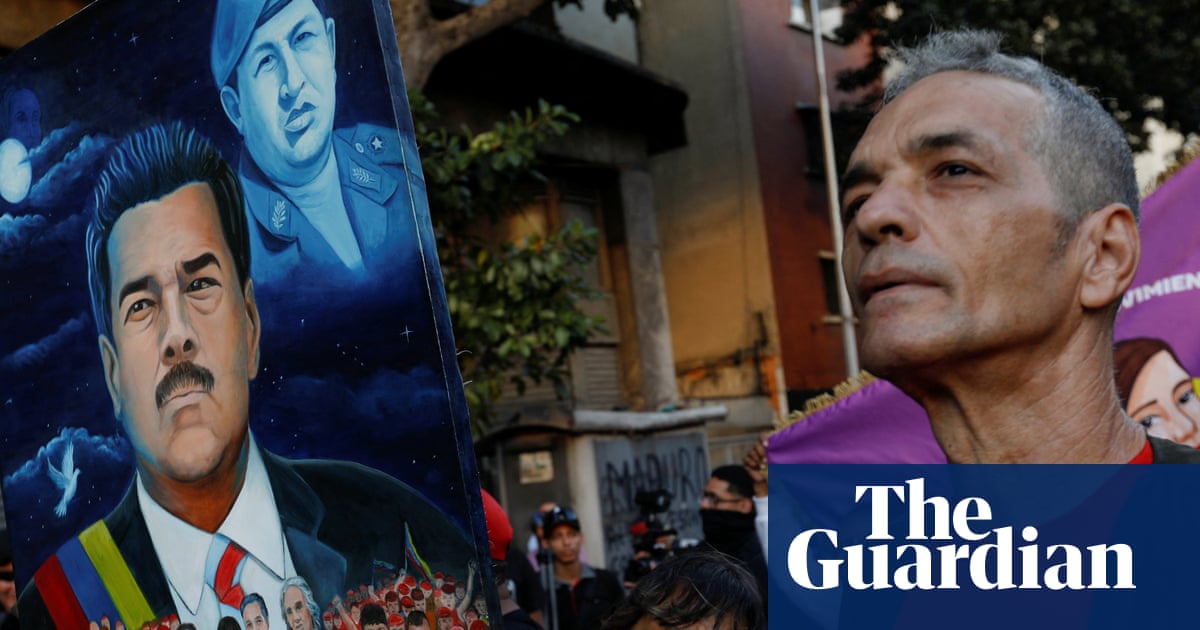
Minutes after former President Donald Trump announced a “large-scale strike” against Venezuela early on Saturday morning, social media platforms became inundated with false and misleading AI-generated images. These included fabricated photos of Nicolás Maduro being escorted off a plane by U.S. law enforcement and images purporting to show jubilant Venezuelans flooding the streets of Caracas, alongside videos depicting missiles striking the city—all of which were false.
The spread of this disinformation coincided with a lack of verified information regarding the raid, complicating efforts to distinguish fact from fiction. Real videos and images of U.S. aircraft flying over Caracas and explosions lighting up the night sky were mixed in with the deceptive content. By the time Trump shared a verified image showing Maduro blindfolded and handcuffed aboard the USS Iwo Jima warship, the AI-generated images featuring U.S. Drug Enforcement Administration (DEA) agents had already gone viral. According to the fact-checking site NewsGuard, these AI photos reached millions across platforms such as X, Instagram, Facebook, and TikTok.
Vince Lago, the mayor of Coral Gables, Florida, contributed to the misinformation by posting one of the fake images on Instagram, claiming that Maduro “is the leader of a narco-terrorist organization threatening our country.” His post garnered over 1,500 likes and remains online as of this writing.
To combat misinformation, tools like reverse image search and AI-detection sites can help verify the authenticity of online images, but their reliability varies. Sofia Rubinson, a senior editor at NewsGuard who specializes in misinformation, told the Guardian that the misleading images circulating about Caracas bear similarities to actual events, complicating fact-checking efforts. “Many of the AI-generated and out-of-context visuals that are currently flooding social media do not drastically distort the facts on the ground,” Rubinson noted. “Still, the use of these fabrications is filling gaps in real-time reporting and represents another tactic in the misinformation wars, one that is harder for fact-checkers to expose.”
NewsGuard published a report identifying five manipulated images and two misleading videos related to the military operation in Venezuela. One of the AI-generated photos depicts a soldier with Maduro, who is shown with a hood over his head. In another case, an out-of-context video presenting a U.S. special forces helicopter descending on a Venezuelan military site actually features footage taken in June at Fort Bragg, North Carolina. The misleading content has reached over 14 million views on X alone, according to NewsGuard.
In addition to fabricated images, outdated footage is also being circulated as current events. Laura Loomer, a far-right influencer and Trump confidant, shared footage of Venezuelans tearing down posters of Maduro, labeling it as recent. However, Wired confirmed that the clip is from 2024. Loomer subsequently removed the post.
Similar claims were made by another right-wing influencer, Alex Jones, who posted an aerial video on X showing thousands of people reportedly celebrating in Caracas. “Millions of Venezuelans flooded the streets… in celebration of the ouster of Communist dictator Nicholas Maduro,” Jones claimed, urging followers to harness similar energy in the U.S. The video, still online, has attracted over 2.2 million views. However, Community Notes, X’s crowdsource moderation tool, has pointed out that the footage is “at least 18 months old.” A reverse image search confirmed that it was originally from a protest in Caracas following Maduro’s disputed presidential win in July 2024.
Even Grok, X’s AI chatbot, contradicted Jones’ assertion, stating: “Current sources show no such celebrations in Caracas today, but pro-Maduro gatherings instead.” As the misinformation swirls, platforms such as Meta, X, and TikTok have yet to respond to requests for comment regarding the spread of these misleading visuals.
The rapid dissemination of false information in the wake of significant geopolitical events highlights a growing challenge in the digital age. As AI-generated content becomes increasingly sophisticated and accessible, the risk of misinformation complicates public perception and undermines trust in verified news sources.
See also Orbit AI Achieves 21 Consecutive Operational Days with New Satellite, Reinforcing Intellistake’s Infrastructure Vision
 AMD Unveils Helios AI Rack and MI500 GPUs Promising 1,000x Performance Boost at CES 2026
 Baidu and Huawei Capture 70% of China’s GPU Cloud Market Amid U.S. Export Controls
 AMD Launches Ryzen AI 400 Chips, Claims 30% Multitasking Boost Over Intel’s Ultra 9