










































As Ukraine enters its fourth year of full-scale war with Russia, the education sector faces unprecedented challenges. Schools continue to close due to air raids, teachers are scattering across borders, and electricity frequently cuts out mid-lesson, complicating the already strained learning environment. The realities of conflict have prompted urgent questions about how to support educators and reengage students who may never catch up after falling behind.
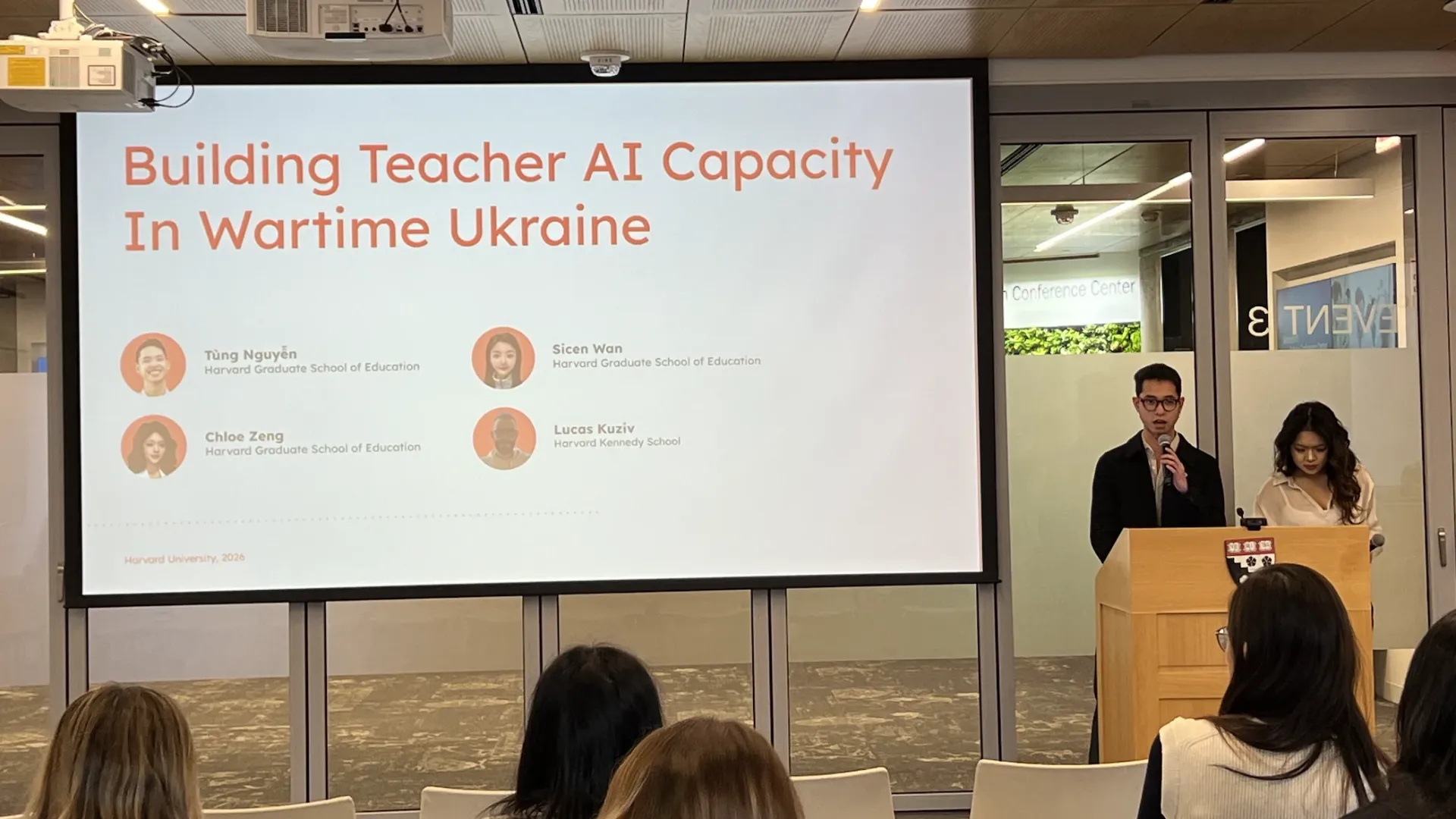
To address these pressing issues, the Harvard Graduate School of Education (HGSE) convened a conference on January 23 and 24 to explore the intersection of education and technology in crisis conditions. The event featured student-led policy analyses from a graduate class taught by Professor Fernando Reimers, highlighting partnerships with global ministries of education and NGOs.
A key panel, led by HGSE students Chloe Zeng, Lucas Kuziv, Sicen Wan, and Tung Nguyen, focused on the role of artificial intelligence (AI) in Ukraine’s education system. The central question was whether AI could effectively support teaching and learning amidst ongoing conflict. Since the Russian invasion in 2022, over 43,000 Ukrainian teachers have been displaced, with nearly one-third of classes now being taught fully online or in hybrid formats.
The war has inflicted significant damage on schools, with many destroyed and frequent power outages disrupting internet connectivity, particularly in frontline and rural areas. As a result, the panelists argued that emerging digital technologies, including AI, have evolved from optional tools into “essential infrastructure” for education. These technologies could help alleviate the burdens of the teacher shortage exacerbated by the war.
Major global technology firms, such as Google, Anthropic, and OpenAI, have stepped up to provide technical infrastructure and expertise. In a collaborative effort with the United Nations Educational, Scientific and Cultural Organization (UNESCO), Google supplied 50,000 computers in 2022 to help educators deliver distance learning to millions of displaced students.
Despite these investments, the HGSE student team found that resources do not automatically translate into effective outcomes. “The problem isn’t a lack of pilot programs or innovation,” noted Zeng. “It’s a lack of coherence.” Ukraine currently lacks a national framework that outlines essential AI-related skills for teachers and how to measure progress, leaving many initiatives operating in silos.
The challenges are further compounded by the institutional weaknesses exposed by the war, which have left teacher training programs severely weakened. Without clear guidelines and equitable resource distribution, AI adoption risks benefiting only the most well-resourced schools while neglecting those in more marginalized areas.
The students identified three main challenges affecting the effective implementation of AI in education: the absence of a shared roadmap for AI use, the unstable infrastructure exacerbated by frequent power outages and school destruction, and the uneven distribution of resources that favors teachers in less affected regions over those in conflict zones.
To tackle these issues, the student team proposed three policy options: a voluntary micro-credential program for 10,000 “AI Master Teachers,” the establishment of 35 regional AI innovation hubs for intensive coaching, and a centrally guided national AI upskilling program. They ultimately recommended the third option, combined with targeted interventions in areas where conditions permit.
This recommendation reflects a broader shift in the training of future education leaders at HGSE and beyond. AI is becoming a critical focus for policymakers across income levels. Other HGSE candidates presented projects addressing various educational issues, such as under-financed classrooms in Uruguay and remote learning in Papua New Guinea, illustrating the potential for AI and digital solutions to address challenges in low-resource or conflict-affected areas.
However, the risk persists that technology may be framed as a panacea, sidelining deeper systemic issues. As the global education community seeks innovative solutions, the experience of Ukraine underscores the importance of coherent strategies to effectively leverage AI and technology in tumultuous environments, ensuring all students have a chance to learn and succeed in the face of adversity.
See also PaleBlueDot AI Secures $150M Series B, Surpassing $1B Valuation for Global AI Compute Expansion
 NVIDIA and TSMC Stocks Surge Over 59% on Strong AI Demand and Eased Trade Tensions
 Ex-Google Engineer Linwei Ding Convicted of Stealing 2,000+ AI Trade Secrets for China
 UCSD and Columbia Launch ChipBench to Evaluate LLMs in AI Chip Design with Key Metrics
 Rancho Cordova Students Develop AI Bots for City Services, Supported by $5M Initiative