




















































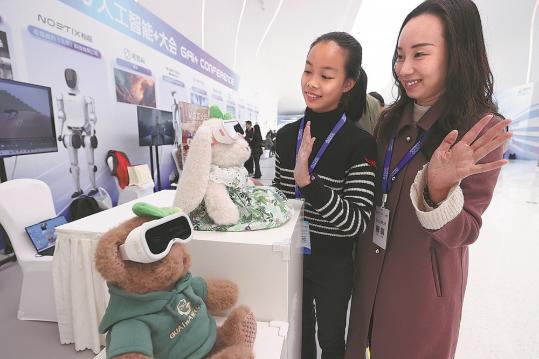
Industry players are rapidly advancing into the artificial intelligence-driven toys market, aiming to capitalize on a burgeoning consumer base as supportive government policies invigorate the sector. The push for AI toys, designed to offer emotional support and companionship, is anticipated to ignite new consumer trends by leveraging advanced technologies to deepen emotional connections with users.
“Young consumers are increasingly paying for emotional value, and AI companionship is emerging as a key early-use case,” noted Sun Zhaozhi, founder and CEO of Shanghai-based AI toy startup Robopoet. His insights reflect a growing trend where companies, including established giants, are increasingly drawn to this evolving market.
Data from the Ministry of Industry and Information Technology indicates that China’s AI toy market was valued at 24.6 billion yuan (approximately $3.49 billion) in 2024, with expectations for growth to 29 billion yuan in 2025. This growth is underpinned by a recent action plan from several government bodies, which identified collectible toys as a priority consumption category for the first time, aiming to boost ten consumer segments to exceed 100 billion yuan by 2027.
“The deep integration of AI with traditional toy manufacturing is reshaping product forms and value chains, making AI toys a new engine for high-quality industrial development,” stated He Yaqiong, head of the consumer products industry department at the Ministry of Industry and Information Technology. This transformation is expected to attract further investments and innovations.
Robopoet’s flagship AI plush toy, Fuzozo, priced at 399 yuan, has already made waves in the market, selling over 1,000 units within the first ten minutes of its presale during the “618” shopping festival. It topped AI toy sales on major platforms, JD and Tmall, during this year’s Double 11 shopping festival, with total sales reaching about 100,000 units for the year. The company aims for 1 million units next year, projecting 400-500 million yuan in gross merchandise value.
As consumer preferences diversify, a growing number of companies are shifting focus towards AI-powered pet companions. “Unlike typical robots designed to serve humans, our product simulates a live pet that needs care,” explained He Jiabin, co-founder and CEO of AI robot pet manufacturer Ropet. He highlighted that the caregiving aspect offers users a sense of healing, helping alleviate anxiety and loneliness.
Ropet’s AI-powered robot pets are designed to adapt to users’ habits, developing unique traits through behavioral learning and interaction. Following its domestic launch on JD in late October, the product quickly ascended to the top three in the robot category by sales during the Double 11 shopping festival.
“Our business logic is straightforward: first create an appealing hardware product, then use high usage rates to accumulate behavioral data, and finally leverage this data to deliver true intelligence,” He Jiabin noted, emphasizing the company’s strategy for long-term engagement.
As the domestic market accelerates, Chinese AI toys are also gaining traction internationally. The Ministry of Industry and Information Technology reported that China’s domestic toy retail market was valued at 97.85 billion yuan in 2024, marking a growth of 25.5 percent since 2020, while toy exports reached $39.87 billion, an increase of 19.1 percent in the same period.
“Consumers in the United States and Europe have shown high acceptance of AI robots with visual understanding and personalized interaction. Many describe our products as ‘little desktop creatures’, ‘AI pets’, or an ’emotional charging station’,” said Yi Qi, marketing manager at Shenzhen-based AI hardware company TangibleFuture. Their product, the LOOI Robot, priced around $150, features a unique phone-dock design that activates intelligent interaction functions when a smartphone is placed on it. Since mass production began in November 2024, over 10,000 units have been shipped, with 90 percent sold overseas, even garnering a social media nod from Tesla CEO Elon Musk.
Positioned with the world’s most comprehensive toy industry chain, robust manufacturing capabilities, and a highly skilled workforce, China is poised to offer a diverse array of high-quality, competitively priced toys to global consumers. This momentum indicates a promising future for AI-driven toys, as they reshape the landscape of emotional companionship in consumer markets.
See also Asia’s Secret Seven Firms Drive $1 Trillion AI Infrastructure Boom Ahead of U.S. Tech Giants
 NVIDIA Denies DeepSeek’s Use of Banned Blackwell GPUs Amid US-China AI Tensions
 Nvidia’s H200 Boosts China’s AI Cloud Services Despite Huawei’s 12,800 TPP Chip
 AI-Powered Networks Revolutionize Telecom Strategies at Dubai Leaders’ Summit
 LinkedIn India Enhances Hiring Process with AI-Powered Features and Tools