












































In a recent podcast episode of Motley Fool Money, contributors Travis Hoium, Lou Whiteman, and Rachel Warren discussed significant developments at major technology firms, including Amazon’s legal victory over AI company Perplexity, Meta’s evolving AI strategy, and Oracle’s latest financial results. The podcast, recorded on March 11, 2026, highlights the competitive landscape in the realm of artificial intelligence.
Amazon has made headlines by successfully winning a court ruling that prevents Perplexity from scraping data from its website. The implications of this decision extend beyond the immediate legal victory; it underscores Amazon’s commitment to safeguarding its advertising revenue, which has exceeded $40 billion. Hoium noted that while companies like Google and Meta may facilitate connections between consumers and retailers, Amazon is staunchly focused on maintaining a direct shopping experience on its platform. Rachel Warren emphasized that this ruling allows Amazon to protect its advertising model, which could be threatened by the rise of AI chatbots that do not engage with advertisements.
Warren, an Amazon shareholder, reflected on the broader implications of AI agents becoming primary shopping interfaces. She pointed out that if shoppers increasingly rely on AI-driven platforms, Amazon’s extensive advertising ecosystem could face significant challenges. “Amazon is really fighting to ensure that in a world that could be transitioning to more AI-driven shopping, that shoppers are using their own AI assistant like Rufus, rather than a neutral third party,” she said. This highlights the ongoing tension in the retail sector as AI technology evolves.
Lou Whiteman shared his perspective on the potential threat posed by AI-driven comparison shopping. He deemed it a “killer app” for consumers, enabling them to find the best prices without navigating through multiple websites. The discussion turned to the shifting dynamics of competition, with Amazon currently in a defensive position against emerging players like Shopify, which may offer easier access for smaller merchants looking to reach consumers.
The conversation then shifted to Meta, which recently acquired the staff behind Moltbook, described as a “social network for AI agents.” Whiteman humorously acknowledged the novelty of Moltbook, suggesting that it allows AI agents to interact and communicate in a natural language. He noted that while Meta has ample cash for acquisitions, the effectiveness of this strategy in building a new social network remains uncertain.
Warren observed that the acquisition signals a pivot in Meta’s AI strategy towards autonomous agents. “Meta sees the growth potential in AI and is trying to ensure that they’re capitalizing on those growth tailwinds,” she explained. This aligns with the company’s goal of creating a foundational infrastructure for AI interactions, positioning itself for future advancements in the technology sector.
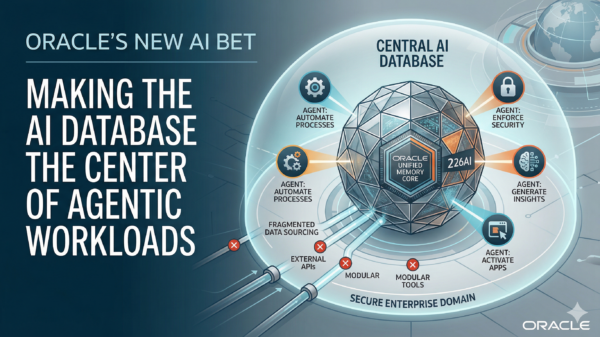
Oracle’s recent fiscal results were also a focal point of the podcast. The company reported its highest growth in 15 years, driven by a staggering $553 billion backlog in contracted future revenue, marking a 325% increase year-over-year. Warren highlighted that Oracle’s cloud business is growing at an impressive rate of 84%, but the costs associated with building data centers to support this growth have led to negative free cash flow of approximately $25 billion in the most recent quarter.
Oracle’s substantial debt, currently at $135 billion, raises questions about its long-term financial sustainability. However, Whiteman noted that this figure should be understood in context, as it equates to about two times sales and five times EBITDA—numbers that are not necessarily alarming. Yet, the uncertainty remains regarding how much of Oracle’s backlog will translate into actual revenue, especially as the AI landscape continues to evolve.
In summary, the podcast illustrated the complex interplay of competition and innovation among leading tech companies. As Amazon strives to protect its advertising model and Meta pivots towards autonomous AI interaction, Oracle grapples with balancing ambitious growth against rising debt. While the current landscape appears promising, the future of these firms remains intertwined with the unpredictable trajectory of artificial intelligence.
See also Tesseract Launches Site Manager and PRISM Vision Badge for Job Site Clarity
 Affordable Android Smartwatches That Offer Great Value and Features
 Russia”s AIDOL Robot Stumbles During Debut in Moscow
 AI Technology Revolutionizes Meat Processing at Cargill Slaughterhouse
 Seagate Unveils Exos 4U100: 3.2PB AI-Ready Storage with Advanced HAMR Tech