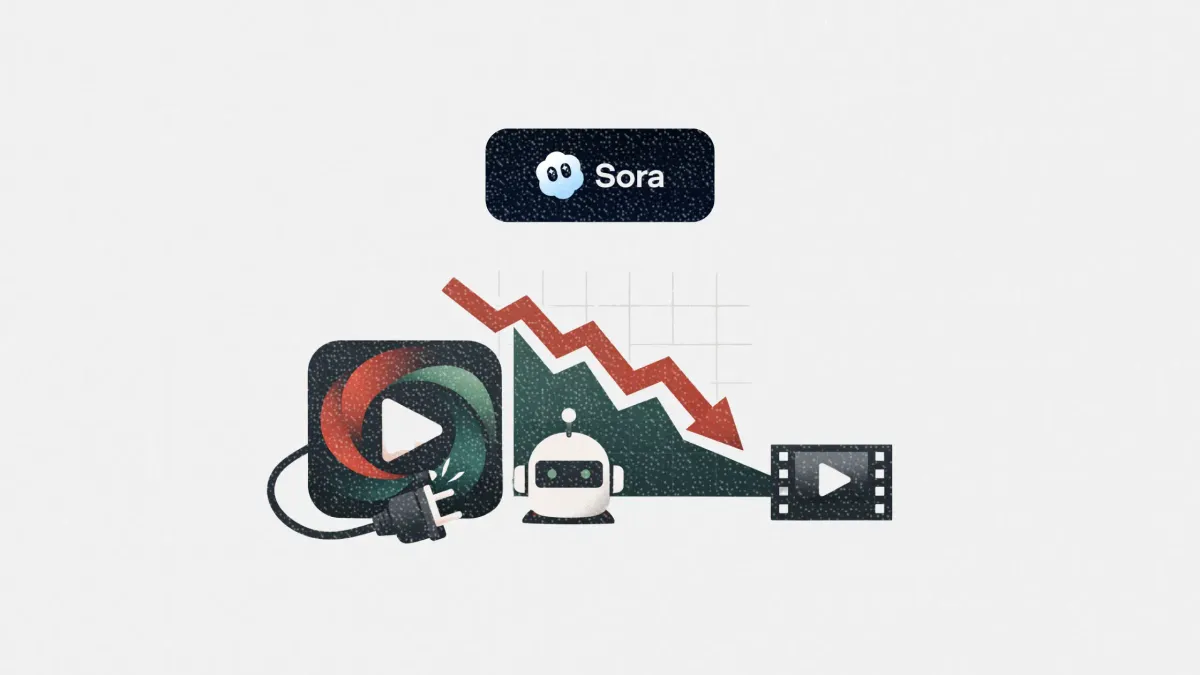
OpenAI has officially announced the discontinuation of its Sora app, a standalone AI video platform that launched just six months ago. The decision to shut down Sora comes as part of a broader strategic realignment within the company, which will now focus on areas such as world simulation and robotics applications. Although OpenAI has not provided a detailed timeline for the app’s shutdown or a full explanation for its closure, the company expressed gratitude to its community in a recent Twitter post, acknowledging the disappointment that follows the decision.
Sora was introduced as an innovative social video app that aimed to generate AI-driven content in a manner similar to existing platforms like TikTok. However, the application was met with challenges that ultimately led to its decline. Following an initial surge in popularity, with over 3.3 million downloads in November, the app experienced a sharp drop to approximately 1.1 million downloads by February. Revenue generated from in-app purchases was modest, estimated at around $2.1 million by Appfigures, raising questions about its long-term viability.
The operational risks associated with Sora, combined with its inability to sustain user engagement, contributed to OpenAI’s decision. The novelty of AI-generated content wore off quickly, with users finding that the platform lacked the social context and authenticity necessary for repeated interactions. Additionally, issues around content moderation surfaced, as users found ways to bypass safeguards, potentially creating deepfakes of public figures and copyrighted characters. These elements created an environment where brand safety became a significant concern.
Despite the app’s closure, the technology behind Sora remains crucial. The Sora 2 model, which powers advanced text-to-video generation, continues to be available through ChatGPT’s premium services. This underlying technology is capable of generating up to minute-long videos from text prompts, supports complex scenes, and utilizes advanced diffusion models and transformer architectures for enhanced visual outputs. Industry observers believe that while Sora as a standalone platform has failed, the technology itself holds considerable potential for applications in marketing and communications.
The lessons drawn from Sora’s short-lived existence are essential for marketers and communications professionals. First, the mere presence of AI capabilities does not ensure product-market fit. Marketers must consider the context and relevance of content in their campaigns, as automation cannot replace human connection. Additionally, the rapid rise and fall of emerging AI-native platforms like Sora signal an accelerating platform risk; marketers should avoid becoming overly dependent on any single platform.
Brand safety concerns remain a critical issue as well. With the proliferation of deepfakes and copyright violations, brands looking to experiment with generative video must establish clear governance and approval processes. Furthermore, the unobstructed shift toward embedded AI solutions rather than standalone applications indicates a trend that companies should be mindful of; the real value of such technologies likely lies within broader ecosystems like ChatGPT or enterprise tools.
While the shutdown of Sora may seem like a setback, it marks a recalibration for OpenAI, which is redirecting its focus toward technologies that promise long-term viability. For marketers, the key takeaway is a shift from hype-driven platforms to an emphasis on integrating advanced capabilities into actionable strategies. As the landscape of AI technology continues to evolve, maintaining audience trust, ensuring content relevance, and prioritizing brand safety will remain paramount.
See also Samsung Skips TikTok’s AI Ad Labels, Highlighting Enforcement Failures in Transparency Policies
 BVDW Reveals Email Marketing Guide Addressing AI Agents and 376 Billion Daily Messages
 Etsy Sees 5.2% Revenue Decline as Active Buyers Drop Amid AI Personalization Efforts
 Apple Hires Ex-Google VP Lilian Rincon to Oversee AI Marketing as Siri Upgrade Looms
 AI Transforms Customer Experience: 83% of Consumers Trust Brands with Excellent Service