












































AMD, a U.S. multinational tech firm, has unveiled plans to roll out its next-generation Helios AI rack at the CES 2026 in Las Vegas. The company’s CEO, Lisa Su, provided the first look at the Helios system during her keynote, offering more details on its design and construction. Su showcased a large Helios rack unit on stage, touting its superior performance as a direct shot at Nvidia’s Vera Rubin NVL72, also unveiled at the CES 2026 event. Nvidia has set the standard for rack-scale systems, which it debuted as its latest offering.
According to Su, Helios will directly compete with Nvidia’s NVL systems, aiming to match 72 of its MI455X chips against the latest NVL72’s 72 Rubin GPUs. This competitive stance underscores AMD’s strategy to capture a larger share of the rapidly growing AI market. In addition to the Helios system, AMD announced plans to expand its MI500 series GPUs, which the company claims will deliver up to 1,000 times the AI performance of Mi300X GPUs. Su emphasized that such performance increases will be critical as the number of daily AI users is projected to reach five billion over the next five years.
AMD also unveiled its new line of Ryzen AI 400 series PC chips while showcasing the MI-455 processors, noting their integral role in the data centers powering AI programs. The company aims to leverage its technological advancements to compete directly with Intel’s new Core Ultra 3 processors, which are built on Intel’s new 18A process technology.
In a notable collaboration, Su invited Generative Bionics CEO Daniele Pucci on stage to reveal the company’s humanoid robot, GENE.01, for the first time. AMD’s GPUs and CPUs power the robot, which is designed to operate in industrial environments. Su highlighted the necessity for tech firms to increase global computing capacity by at least 100 times in the coming years, a trend expected to benefit both Nvidia and AMD, which have seen their market caps rise to $4.5 trillion and $359 billion, respectively.
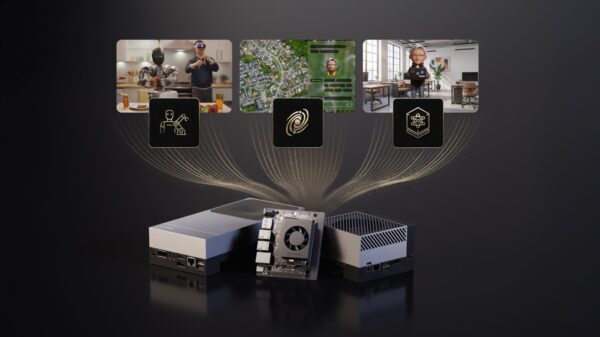
Additionally, AMD introduced its latest Ryzen AI Max+ chips for light workstations, mini-PCs, and laptops, along with the Ryzen Halo developer platform. The Halo platform enables developers to build AI models locally, reducing reliance on cloud-based solutions. This move positions AMD as a competitor to Nvidia’s DGX Spark mini-PC, which is priced at nearly $4,000, although AMD has yet to disclose pricing details for Halo.
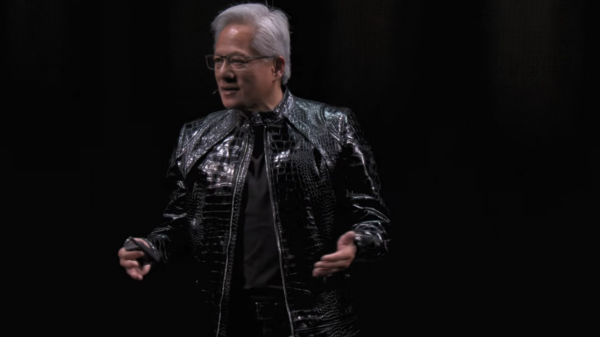
On the Nvidia front, the company unveiled its Rubin Platform, which combines Rubin GPUs and Vera CPUs to create a single Vera Rubin processor. Nvidia’s CEO Jensen Huang remarked, “Rubin arrives at exactly the right moment, as AI computing demand for both training and inference is going through the roof.” The Rubin platform is designed to enhance efficiency, potentially resulting in a fourfold reduction in the number of GPUs needed to train the same MoE (Mixture of Experts) systems. This efficiency could allow spare GPUs to be repurposed for other tasks while also reducing inference token costs by up to 10 times.
Nvidia continues to promote its AI storage, the Nvidia Inference Context Memory Storage, which is engineered to store and share data generated by a trillion-parameter, multi-step AI reasoning model. These advancements come as hyperscalers such as Microsoft, Amazon, Meta, and Google invest billions in large AI systems, including Nvidia’s DGXX SuperPOD AI supercomputer.
As computing needs escalate, the competition between AMD and Nvidia intensifies, shaping the future landscape of AI technology. With both companies making significant strides in their offerings at CES 2026, the battle for dominance in the AI sector is poised to redefine industry standards and capabilities in the coming years.
See also Baidu and Huawei Capture 70% of China’s GPU Cloud Market Amid U.S. Export Controls
 AMD Launches Ryzen AI 400 Chips, Claims 30% Multitasking Boost Over Intel’s Ultra 9
 Nvidia Launches Rubin AI Architecture; AMD Pushes Generative AI for Consumer PCs at CES 2026
 Razer Reveals AI-Powered Project AVA Companion and Next-Gen Gaming Innovations at CES 2026
 Siemens, NVIDIA Announce AI Industrial Revolution; Razer Unveils Game-Changing Tech at CES 2026