
















































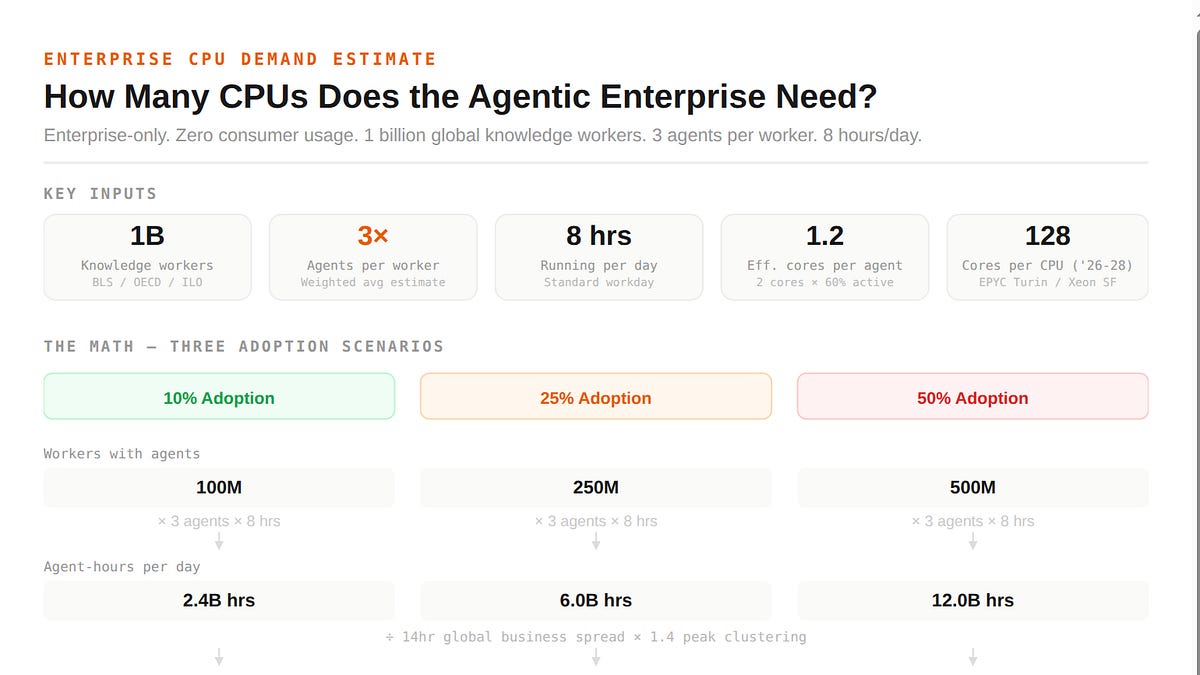
The demand for CPUs is experiencing a significant resurgence as the artificial intelligence landscape shifts from traditional chatbots to more complex agentic AI systems. This transformation, marked by intricate workflows that require extensive CPU utilization, highlights an evolving infrastructure imperative that industry players are now scrambling to meet. For over three years, NVIDIA’s GPUs have dominated discussions around AI compute power; however, analysts suggest that the spotlight is now turning to CPUs, which are expected to play an increasingly crucial role in powering these advanced AI workloads.
Historically, the interaction between CPUs and GPUs in AI tasks has favored GPUs, which were responsible for the heavy lifting involved in processing data. In traditional chatbot systems, the CPU merely tokenized input data and managed output, contributing only 5-10% of total computational effort. In contrast, agentic AI introduces a paradigm shift where autonomous systems not only respond to queries but also plan, execute, and manage multiple tasks through a web of sub-agents. As a result, the CPU’s role has evolved to encompass a wide range of responsibilities, including orchestration, tool execution, and reflection, ultimately leading to increased demand.
A recent study from Georgia Tech and Intel underscores this shift, revealing that CPU-related processing now accounts for 50-90% of latency in agentic AI workloads. The intricate orchestration required for these systems means that while GPUs are still pivotal for inference tasks, CPUs are tasked with the bulk of the computational work, including managing API calls and data parsing. This dynamic has led to a revised economic model for data centers; instead of a few high-end CPUs supporting many GPUs, a higher ratio of CPUs will be necessary as agentic AI systems proliferate.
The implications of this shift are already being observed in earnings reports across the tech sector. AMD reported a record $5.4 billion in its data center segment for Q4 2025, a significant increase driven largely by demand for its EPYC CPUs. CEO Lisa Su highlighted the surge in demand as agentic workflows require high-performance CPUs to support parallel tasks alongside GPUs. AMD’s latest EPYC Turin CPUs accounted for over half of their server CPU revenue, and Su anticipates double-digit growth for the server CPU market in 2026.
In contrast, Intel appears to have been caught off guard by this sudden spike in CPU demand. Although the company reported revenues of $13.7 billion in Q4, it acknowledged supply constraints that limited its ability to capitalize on the burgeoning market. CFO David Zinsner remarked that Intel “misjudged” the pace of demand and is reallocating manufacturing capabilities to prioritize server CPUs over client CPUs. The company expects to hit a low point in supply by Q1 2026 before improvement is anticipated in Q2, as it aims to meet the central role CPUs now play in AI orchestration.
This burgeoning demand for CPUs was notably highlighted during a recent strategic partnership between AWS and OpenAI, valued at $38 billion over seven years. The announcement revealed plans to expand access to “tens of millions of CPUs” for scaling agentic workloads, a detail that has sparked interest in industry circles. This is indicative of a broader recognition that CPU compute is essential for future AI developments.
NVIDIA is also making strides in this arena, introducing its upcoming Vera CPU, specifically designed for agentic reasoning workloads. With the capability to deliver up to twice the performance of its predecessor, the Vera CPU is positioned to address the rising demand for CPU resources. As AI capabilities continue to mature, some workloads may rely solely on CPUs, further emphasizing the need for a balanced architecture where both CPUs and GPUs operate in tandem.
However, industry experts warn that a CPU bottleneck may already be upon us. Intel’s struggles with yield issues and TSMC’s prioritization of AI accelerators are leading to supply chain constraints that could hinder the market’s ability to meet rising demand. With reports indicating that CPU prices are climbing and lead times extending, the supply chain’s challenges are compounded by a rush to secure CPUs amid increased memory prices, illustrating the urgent need for enhanced production capabilities.
As organizations adjust to this new landscape characterized by agentic AI, the role of CPUs will only grow more significant. The tech community is left contemplating how long the current bottleneck will last and how quickly manufacturers can adapt to the changing demands of the market. This evolving narrative around CPUs signifies not just a shift in technology but a fundamental change in how AI is integrated into broader business processes.
See also Lenovo ThinkPad L16 Gen 2 Features AMD Ryzen 5 Pro 215 CPU Without NPU
 Nvidia and Alphabet Set to Dominate AI Market with $650B Infrastructure Investment
 AMD Reveals AI Infrastructure Strategy to Meet Soaring Demand in APAC Region
 Nvidia Increases Intel Stake, Enhances AI Partnership Amid CPU Rivalry