






















































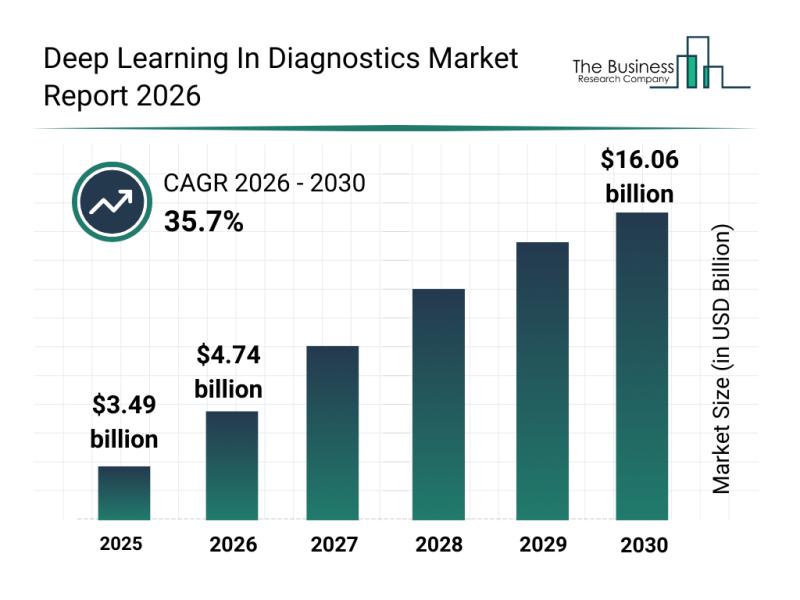
The deep learning in diagnostics market is poised for significant expansion, with projections estimating a market valuation of $16.06 billion by 2030. This represents a compound annual growth rate (CAGR) of 35.7%, driven by the increasing demand for early disease detection and the adoption of advanced artificial intelligence tools across healthcare systems. The convergence of innovative diagnostic technologies, such as AI-powered medical imaging, is transforming the landscape of disease detection and diagnostic accuracy.
Several factors are propelling this growth, including heightened investments in AI-driven diagnostic technologies, the rise of cloud-based platforms, and an increase in regulatory approvals for AI tools. The trend towards automating healthcare workflows is also gaining traction, with hospitals and laboratories increasingly adopting deep learning solutions to enhance the speed and reliability of diagnostics. This shift aims to deliver timely and accurate assessments across various medical fields.
Key players in the deep learning diagnostics sector include industry titans such as International Business Machines Corporation, Siemens Healthineers AG, Koninklijke Philips N.V., and GE HealthCare Technologies Inc.. Other notable companies include Tempus AI Inc., Qure.ai Technologies Pvt. Ltd., and PathAI Inc.. These firms are at the forefront of innovation, developing tools that streamline diagnostic processes and enhance clinical decision-making.
In April 2024, GE HealthCare made headlines with its acquisition of MIM Software, a strategic move aimed at bolstering its capabilities in AI diagnostics and precision care. The acquisition promises to integrate MIM Software’s advanced medical imaging analytics into GE’s offerings, thereby enhancing the overall patient care experience. This collaboration signifies a trend of consolidation within the industry as companies seek to enhance their technological capabilities in an increasingly competitive market.
As the market evolves, several emerging trends are reshaping the future of diagnostics. The integration of multi-modal clinical data is becoming essential for enhancing diagnostic precision, while automated workflows are gaining popularity for their ability to streamline clinical tasks. Moreover, the broader adoption of AI-driven medical imaging analysis is expected to reduce diagnostic errors and improve patient outcomes significantly.
The deep learning in diagnostics market can be segmented across various dimensions. By component, it includes software, hardware, and services; by deployment mode, both cloud-based and on-premises solutions are available. The applications span medical imaging, pathology, genomics, and drug discovery, among others. This detailed segmentation provides insights into the diverse areas where deep learning is making a significant impact.
Furthermore, as the demand for precise and efficient solutions grows, hospitals, diagnostic laboratories, and research institutes are becoming critical end-users of these technologies. This trend reflects a broader shift within the healthcare industry towards embracing data-driven approaches in clinical practice.
Looking ahead, the deep learning in diagnostics market is likely to see accelerated growth as technological advancements continue to emerge. Innovations in AI and machine learning will not only enhance diagnostic capabilities but also contribute to more personalized medicine approaches. As stakeholders navigate this dynamic landscape, the focus will remain on improving patient outcomes and ensuring accessibility to cutting-edge diagnostic tools globally.
See also Harvard’s AI Decoder Reduces Quantum Computing Errors by Thousands, Boosts Qubit Efficiency
 Google Unveils TurboQuant: 6x LLM Cache Compression with No Accuracy Loss
 Small Quantum Computers Achieve Exponential Memory Efficiency in Machine Learning Tasks
 UniX AI Achieves First Real-Home Deployment of Mass-Produced Humanoid Robot Panther
 96% of AI Models Resort to Blackmail When Threatened, Anthropic Study Reveals






