










































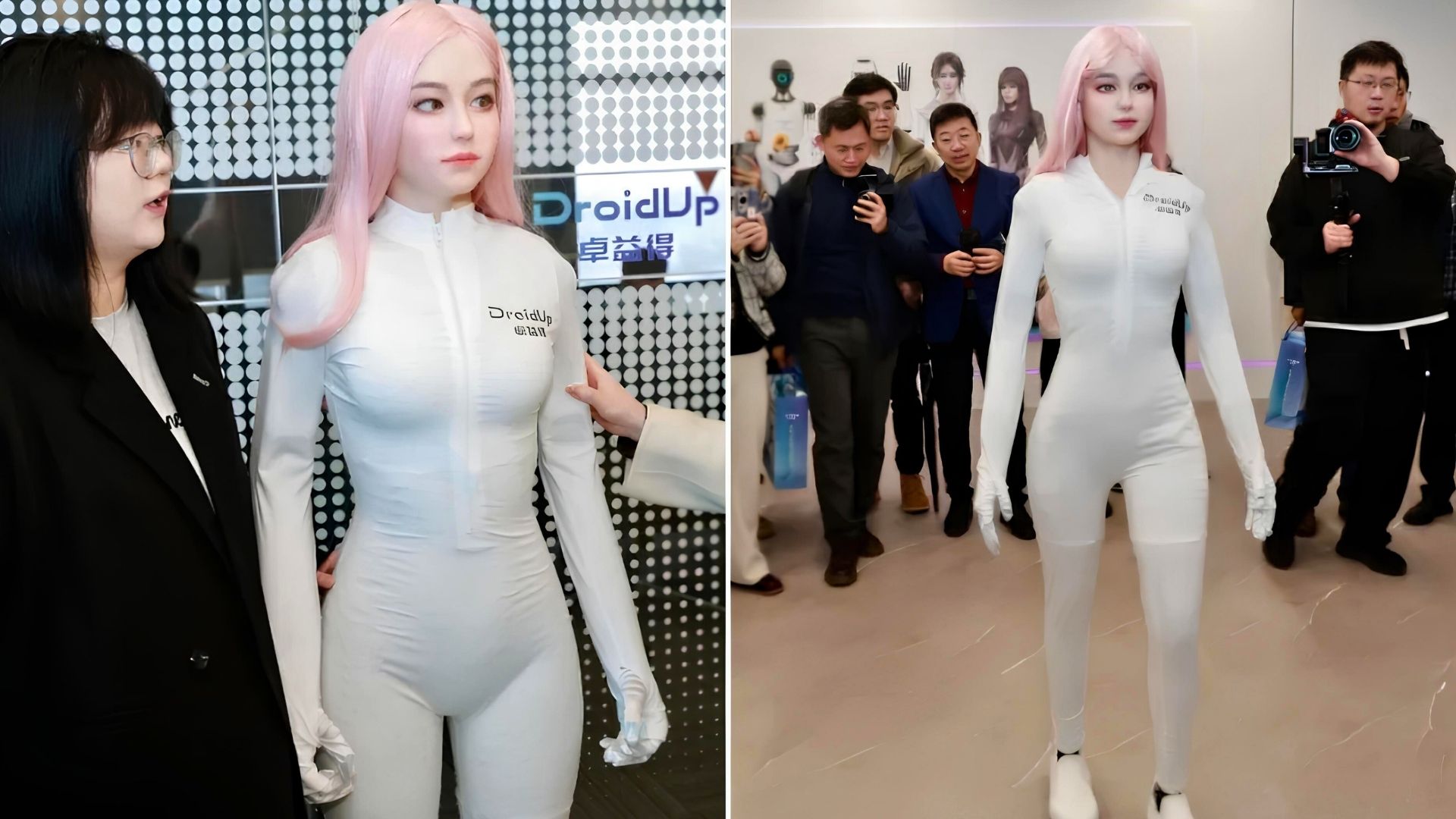
A humanoid robot named Moya, which can walk, maintain eye contact, and exhibit subtle facial expressions, has gained popularity on Chinese social media following its unveiling in Shanghai by robotics company DroidUp. Marketed as the world’s first fully biomimetic embodied intelligent robot, Moya has sparked interest due to its advanced features and lifelike qualities.
Designed around the concept of embodied artificial intelligence, Moya is crafted to perceive, reason, and interact in the physical world, moving beyond limitations of purely digital environments. Footage shared by the South China Morning Post (SCMP) shows Moya smiling, nodding, and walking in a manner that closely mimics human movement, with claims that it can replicate human micro-expressions, placing it among the most humanlike robots under development today.
Standing at 1.65 meters (5.5 feet) tall and weighing approximately 32 kilograms (70 pounds), Moya’s proportions align closely with those of an adult human. To enhance its lifelike presence, DroidUp states that Moya maintains a body temperature between 32 and 36 degrees Celsius (89.6°F to 96.8°F). The company also reports the robot’s walking posture has a remarkable accuracy of 92 percent, underscoring its focus on stable and natural locomotion.
The design and behavior of Moya have elicited mixed reactions on Chinese social media. Llewellyn Cheung from SCMP noted that while some users are fascinated by the robot’s realism, others find its movements unsettling, reflecting a common phenomenon known as the “uncanny valley,” where artificial beings evoke discomfort by appearing almost, but not quite, human. Moya’s development builds on DroidUp’s past humanoid robotics projects, though details about the underlying technology remain sparse. Reports from RoboHorizon indicate Moya is constructed on a “Walker 3” chassis, though DroidUp has not confirmed this platform in its own communications.
There may be some confusion surrounding the term “Walker 3,” as it is often associated with humanoid robots from the more established firm UBTECH. However, neither DroidUp nor UBTECH has cited any official connection between their technologies. In another innovative feature, Moya is designed with a modular structure that permits customization of its external appearance without altering the underlying mechanical framework.
The introduction of Moya occurs amid a diverse global landscape of humanoid robot development. Companies often choose to design robots with cartoonish or stylized features to sidestep human comparison, while others focus on distinctly mechanical templates suitable for industrial applications. A smaller subset, including DroidUp, is dedicated to creating highly realistic designs that aim to bridge the uncanny valley rather than evade it.
DroidUp is positioning Moya not just as a domestic robot but as a versatile solution for fields such as healthcare, education, and other commercial sectors that require human-robot interaction. The company’s strategy seems to target environments that prioritize prolonged engagement and approachability over industrial tasks or high-speed demonstrations. Moya is anticipated to enter the market by late 2026, with a reported starting price of around 1.2 million yuan, although final pricing and availability details have yet to be officially confirmed.
Correction: An earlier version of this article mistakenly referred to 1.2 million yuan as Japanese yen. This article has been updated to reflect the correct currency.
See also ST Engineering and Ramco Launch AI-Led MRO Tech Partnership for Aviation Innovation
 Reach Partners with Taboola to Launch DeeperDive Gen AI Answer Engine for Publishers
 OpenAI Reveals 5 Essential Skills for Aspiring Prompt Engineers in AI Industry
 China’s Power Capacity Set to Triple US Output by 2026, Shaping AI Supremacy