






































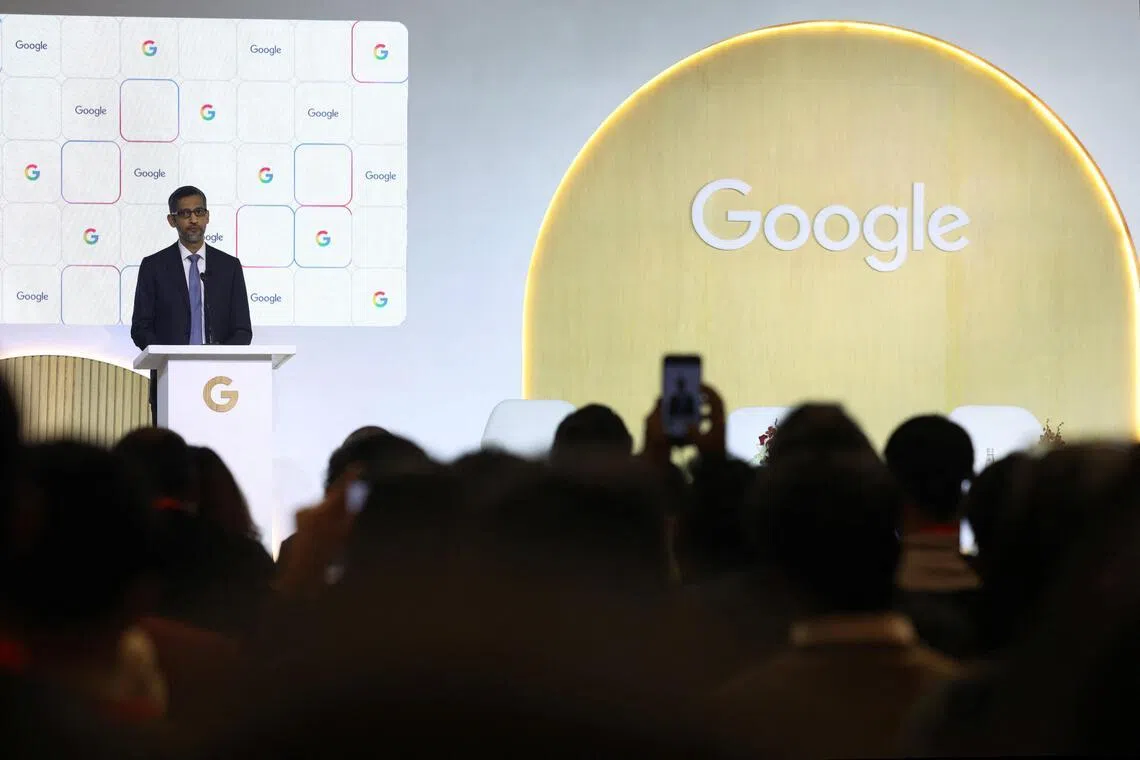
New Delhi – Google announced plans to construct new subsea cables from India, while chip giant Nvidia revealed partnerships with computing firms on February 18, as tech leaders raced to unveil deals and investments during a global AI conference in New Delhi.
This week’s AI Impact Summit marks the fourth annual gathering focused on governing the rapidly evolving technology, providing India an opportunity to enhance its standing in the burgeoning sector.
“India’s going to have an extraordinary trajectory with AI and we want to be a partner,” said Google CEO Sundar Pichai as the company revealed its strategy to improve connectivity in the South Asian nation.
Google’s initiative includes new direct undersea connections from India to Singapore, South Africa, and Australia, aimed at delivering faster connectivity as demand for computing power, particularly in AI, continues to surge.
This effort is part of Google’s $15 billion investment announced in October, intended to develop its largest AI data center hub outside the United States, located in Visakhapatnam, Andhra Pradesh.
On the same day, Nvidia, the world’s most valuable company, disclosed partnerships with three Indian cloud computing providers to supply advanced processors for data centers capable of training and running AI systems.
Amid the summit, which has attracted numerous world leaders and ministerial delegations, discussions are being held on the opportunities and threats posed by AI, including job displacement and misinformation.
By 2025, India climbed to third place in an annual global ranking of AI competitiveness, surpassing South Korea and Japan, as per researchers from Stanford University.
Despite ambitious infrastructure plans and goals for innovation, experts caution that India still has significant ground to cover before it can compete with the US and China in the AI sector.
The AI conference has spurred a wave of agreements, with Indian IT Minister Ashwini Vaishnaw stating on February 17 that the country anticipates over $200 billion in investments in the next two years, of which approximately $90 billion has already been committed.
Mumbai-based cloud and data center provider L&T announced on February 18 a collaboration with Nvidia to create what it describes as “India’s largest gigawatt-scale AI factory.”
“We are laying the foundation for world-class AI infrastructure that will power India’s growth,” stated Nvidia’s CEO Jensen Huang, although he did not disclose specific investment figures.
Nvidia is also engaging with other Indian AI infrastructure players, including Yotta, which secured a $2 billion agreement with the US company to acquire 20,000 high-end AI processors.
While Huang is not attending the AI summit, other significant figures from the US tech landscape, including OpenAI’s Sam Altman, Meta’s chief AI officer Alexandr Wang, and Microsoft founder Bill Gates, are present.
Microsoft announced a $50 billion investment over the decade to enhance AI adoption in developing countries, while US startup Anthropic and Indian IT giant Infosys plan to develop AI agents for the telecommunications sector.
Indian Prime Minister Narendra Modi, along with other global leaders such as French President Emmanuel Macron and Brazilian President Luiz Inacio Lula da Silva, are expected to issue a statement at the end of the week addressing the concerns raised by AI technology.
However, experts warn that the broad focus of the summit and the vague commitments made at previous global AI gatherings in France, South Korea, and Britain suggest that tangible agreements may remain elusive.
Nick Patience, practice lead for AI at tech research firm Futurum, stated that non-binding declarations might still “set the tone for what acceptable AI governance looks like.”
Nonetheless, he remarked that “the largest AI companies deploy capabilities at a pace that makes 18-month legislative cycles look glacial.”
As a result, the pressing question remains whether governments can evolve rapidly enough to establish meaningful regulations before the de facto standards are dictated by the companies themselves.
See also Anterior Secures $40M Funding to Boost AI Adoption in Health Plans, Totaling $64M
 Scout AI Unveils Lethal AI Agents for Military Drone Strikes in California Demo
 GVSU Secures $1M for Trustworthy AI Development as Blue Dot Tech Hub Launches
 Nvidia and Meta Expand Partnership with Billions for AI Infrastructure and CPUs
 Nvidia Secures Multiyear AI Chip Deal with Meta, Expanding CPU Footprint and Efficiency