









































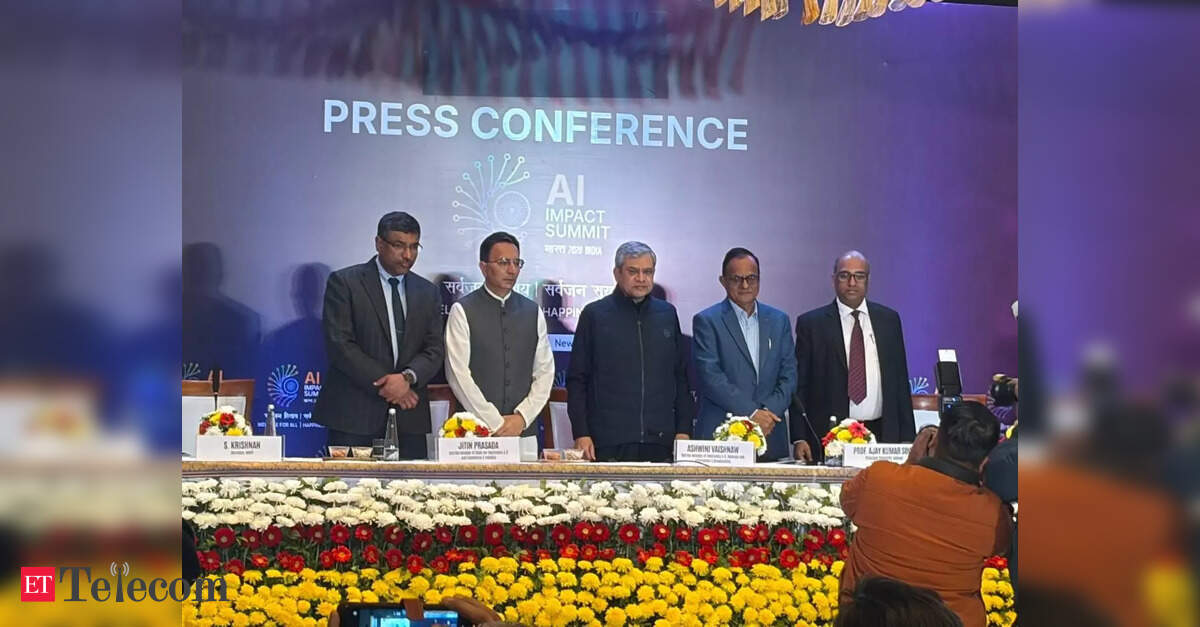
NEW DELHI: The Indian government is planning to launch AI Mission 2.0, building on the success of its initial program and a substantial investment of $70 billion in artificial intelligence (AI) computing infrastructure. Union Minister of Electronics and IT Ashwini Vaishnaw announced the initiative during a press conference on Friday, stating that discussions with stakeholders would commence soon to formulate the next phase of the ambitious program aimed at democratizing access to AI technology across the nation.
“You should be hearing about more additions to the common compute stack, and as we conclude the first part of the AI Mission, in another five to six months, we should be going for the AI Mission 2.0,” Vaishnaw remarked. The Cabinet’s approval of the mission in March 2024 comes with a budgetary allocation of ₹10,371.92 crore over the next five years, dedicated to enhancing infrastructure development, skilling, dataset refinement, and access to graphics processing units (GPUs), which are essential for AI workloads.
Since its inception, the mission has made significant strides in expanding India’s computing capabilities. The original target of deploying 10,000 GPUs has been surpassed, with the current count reaching 38,000, thereby providing broader access to AI resources.
Implementing the mission is IndiaAI, an independent business division under the Ministry of Electronics and IT. Vaishnaw noted, “We have about $70 billion invested already in the execution phase. The way we see the enthusiasm, we shouldn’t be surprised if this number doubles by the time the AI Impact Summit is over.” The summit is scheduled to take place in New Delhi from February 19 to February 20, 2026, featuring prominent executives from the technology sector, including Qualcomm CEO Cristiano Amon, Nvidia chief Jensen Huang, Salesforce CEO Marc Benioff, and Adobe CEO Shantanu Narayen. Additionally, top leadership from OpenAI and AI researcher Dario Amodei are expected to attend.
Vaishnaw emphasized India’s commitment to renewable energy sources, stating that “50% of our power capacity is generated through green sources,” reflecting the country’s robust energy grid. The minister highlighted the importance of talent development in the AI sector, noting that over 500,000 students have already benefited from industry-academic collaborations focused on AI skills. “Now we will take it to the next level. And the industry is going to be the main participant in that,” he added.
The Narendra Modi-led government has previously indicated that more than 6 million individuals are employed within the technology and AI ecosystem in India. A recent BCG survey revealed that approximately 26% of Indian companies have achieved AI maturity at scale. Vaishnaw pointed out that Indian firms have developed over 200 small language models (SLMs) tailored to meet the requirements of various sectors, and these models are expected to be launched at the upcoming AI Impact Summit.
Sanjay Lodha, CMD of Netweb, a Faridabad-based company, reiterated the importance of access to advanced computing in maximizing AI’s impact across industries. “Netweb will continue to contribute by enabling innovation, supporting talent development, and helping position India as a trusted global hub for AI development,” he stated.
As the government prepares for AI Mission 2.0, it aims to foster a sovereign AI ecosystem that meets evolving research and development needs, emphasizing collaboration among industry, academia, and government. This initiative reflects India’s strategic commitment to becoming a leader in the global AI landscape.
See also AI Innovations Support Ukraine’s Education Amid Ongoing War Crisis
 PaleBlueDot AI Secures $150M Series B, Surpassing $1B Valuation for Global AI Compute Expansion
 NVIDIA and TSMC Stocks Surge Over 59% on Strong AI Demand and Eased Trade Tensions
 Ex-Google Engineer Linwei Ding Convicted of Stealing 2,000+ AI Trade Secrets for China
 UCSD and Columbia Launch ChipBench to Evaluate LLMs in AI Chip Design with Key Metrics