








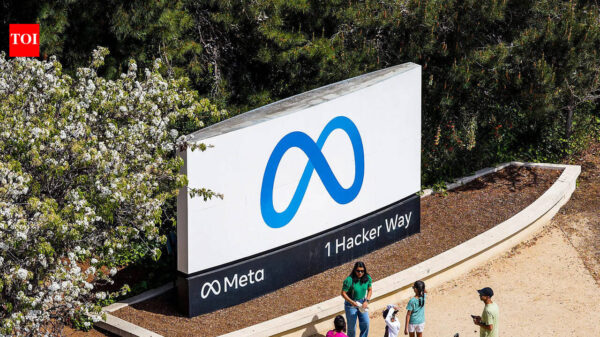


































Meta Platforms Inc. is intensifying its focus on artificial intelligence, mandating engineers across its divisions to adopt AI coding tools following significant layoffs earlier this week. Internal documents reviewed by Business Insider indicate that some teams are expected to use AI tools like Metamate and Google Gemini for over 75% of their code. This strategic shift comes as the company grapples with workforce reductions while simultaneously pushing for greater efficiency through AI.
The coding targets vary by team, with the creation org—responsible for key features such as Messenger, WhatsApp, and Facebook—aiming for 65% of its engineers to write over 75% of their code using AI tools by the first half of 2026. Meanwhile, the Scalable Machine Learning team has set a February 2026 target for 50% to 80% of its code to be AI-assisted. Additionally, a company-wide goal for the central products division calls for 55% of software engineers’ code changes to be “agent-assisted” by the fourth quarter of 2025.
Beyond code volume, the company is also aiming for 80% of mid-to-senior engineers to utilize AI tools such as DevMate, Metamate, and Google’s Gemini. This initiative emphasizes tool adoption rather than merely focusing on the percentage of output. A Meta spokesperson clarified that the company’s performance metrics will reward impactful use of these AI tools, though it remains uncertain if these targets will directly influence performance evaluations. Last November, employees were informed that “AI-driven impact” would become a central expectation starting in 2026.
The push for AI integration is part of a broader reorganization within Meta. A leaked memo revealed that a division of approximately 1,000 employees within Reality Labs has been restructured into smaller “pods,” each member now designated as either an AI Builder, AI Pod Lead, or AI Org Lead. This new structure aims to flatten hierarchies and promote cross-disciplinary collaboration, allowing engineers to potentially take on design responsibilities depending on the project.
Leading this initiative is Andrew Bosworth, Meta’s Chief Technology Officer, who has assumed direct oversight of the “AI for Work” program aimed at facilitating the adoption of AI tools across the company. This organizational shift is being implemented concurrently with substantial layoffs impacting divisions such as Reality Labs and recruitment.
Despite assurances from Meta that the layoffs and restructuring are unrelated, the timing raises questions about the company’s strategy to streamline its workforce while simultaneously demanding increased reliance on AI technology. CEO Mark Zuckerberg has characterized 2026 as a pivotal year, envisioning a future where AI could replace tasks traditionally requiring larger teams, streamlining operations to rely on a “very talented” individual.
This dual approach of workforce reduction and AI integration reflects a significant pivot in the tech landscape, as companies increasingly prioritize efficiency and innovation through automation. As Meta embarks on this ambitious journey, the implications for its remaining workforce and the technological ecosystem at large are profound, creating both opportunities and challenges in an evolving digital environment.
See also Tesseract Launches Site Manager and PRISM Vision Badge for Job Site Clarity
 Affordable Android Smartwatches That Offer Great Value and Features
 Russia”s AIDOL Robot Stumbles During Debut in Moscow
 AI Technology Revolutionizes Meat Processing at Cargill Slaughterhouse
 Seagate Unveils Exos 4U100: 3.2PB AI-Ready Storage with Advanced HAMR Tech