






















































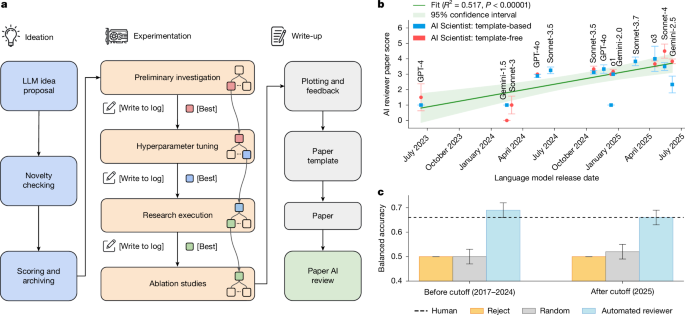
A new study has unveiled an innovative approach to scientific research powered by artificial intelligence, featuring an AI scientist and an automated reviewer designed to streamline the research process significantly. This combination aims to enhance the speed and efficiency of scientific discovery, potentially revolutionizing the field. Developed using advanced machine learning techniques, the systems leverage autoregressive large language models (LLMs) to not only generate research ideas but also rigorously evaluate them, marking a significant leap in the integration of AI within scientific inquiry.
The AI scientist operates in two distinct modes: a template-based system, which utilizes human-provided code as a foundation, and a template-free version that allows for more open-ended exploration. The template-based approach kicks off with a simple experiment based on a popular algorithm, after which the AI engages in an iterative process of idea generation. Each new idea is scrutinized for novelty against existing literature, ensuring that high-similarity concepts are discarded. This process is designed to cultivate a dynamic archive of innovative research proposals, mimicking the ambition of “an ambitious AI PhD student.” The script is further enhanced through multiple rounds of literature checks, employing the Semantic Scholar API.
Following the selection of a promising research idea, the AI scientist moves into the experimental phase. Here, it generates a comprehensive experimental plan utilizing a state-of-the-art coding assistant named Aider, which is tasked with modifying the codebase as needed. If any runtime errors occur, Aider steps in to debug the code through an automated process. Experimental outcomes are meticulously logged in an experimental journal, serving as a critical reference point for future experiments and manuscript generation.
Once experiments are complete, the AI synthesizes findings into a scientific manuscript using LaTeX. Aider generates various sections of the paper, including methods and results, while also conducting a literature review to ensure its findings are properly contextualized within existing research. The manuscript undergoes multiple editing cycles, optimizing clarity and coherence, before being compiled into a final PDF ready for submission.
Expanding the Possibilities
The template-free AI scientist takes this concept further by allowing for a more abstract form of research proposal generation. This version can formulate high-level research questions without being constrained by initial code. Integrating a literature review module ensures that the generated proposals are both innovative and relevant, while an experiment progress manager coordinates distinct stages of experimentation, from preliminary assessments to detailed analyses. Each stage is defined by explicit criteria, guiding the AI through a structured, yet flexible, research process.
To enhance the research capabilities, the system automatically integrates datasets from public repositories like HuggingFace. By generating data-loading code, the AI scientist can utilize a broader array of datasets, thus enriching its exploratory capabilities. This adaptability allows for human scientists to update the dataset list, ensuring that the system remains relevant in a rapidly evolving research landscape.
A significant leap forward comes from the introduction of a parallelized agentic tree search for experimentation. This method allows multiple experimental nodes to be executed concurrently, expediting the exploration process. Each node is defined comprehensively, including a collection of performance metrics and critiques from a vision-language model (VLM) that assesses generated visualizations for clarity and accuracy. The feedback helps refine future experiments, creating a dynamic feedback loop that enhances research quality.
To evaluate the AI-generated research, an automated reviewer has also been developed, emulating the peer-review process of top-tier machine learning conferences. This system generates structured reviews based on NeurIPS guidelines, producing scores and highlighting strengths and weaknesses of the manuscripts. The reviewer demonstrates comparable accuracy to human reviewers, achieving a balanced accuracy of 69% in comparison to 66% for humans, indicating that AI can provide valuable insights aligned with expert opinions.
Ethics approval for this study was secured from the University of British Columbia Behavioral Research Ethics Board. In collaboration with conference leadership, researchers ensured transparency by informing peer reviewers about the presence of AI-generated submissions, although the specific papers were not disclosed. All AI-generated manuscripts were withdrawn post-review, regardless of their evaluation outcomes.
The integration of AI in scientific research represents a transformative step forward, with the potential to enhance productivity and innovation in various fields. As these technologies evolve, they may redefine the landscape of scientific inquiry, paving the way for a new era of accelerated discovery and collaboration.
See also Private Equity Firms Embrace AI for Enhanced Research and Valuation Efficiency
 Anthropic Launches Anthropic Institute to Address AI Risks and Policy Challenges
 Quantum Computing Advances Drug Discovery, Reveals Long COVID Biomarkers Faster
 One in Four Brits Trust AI Over Doctors for Medical Advice, Survey Shows
 AI in Drug Discovery Market to Surge to $10.29B by 2031, Driven by 25.94% CAGR















