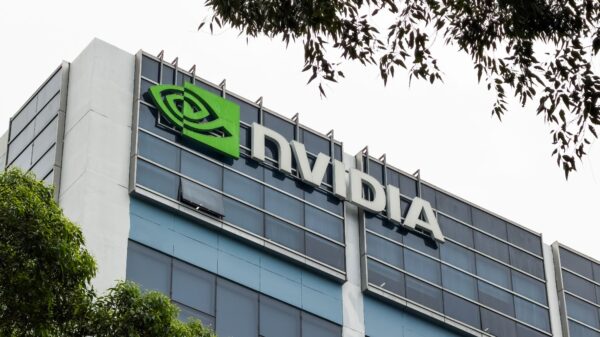














































Nvidia has announced a significant investment of US$2 billion in Marvell Technology, aiming to forge a strategic partnership that integrates Marvell’s custom chip designs with Nvidia’s proprietary networking and processing ecosystem. The deal, revealed on March 31, will leverage Nvidia’s NVLink Fusion platform, a rack-scale framework enabling customers to develop semi-custom AI infrastructure fully compatible with Nvidia’s existing hardware and software stack.
This collaboration seeks to respond to the surging demand for specialized AI hardware, as major technology players such as Alphabet and Meta are expected to invest at least US$630 billion in AI infrastructure this year. Following the announcement, shares of Marvell rose nearly 7%, while Nvidia’s shares increased by 2.7%.
Under the terms of the partnership, Marvell will supply custom “XPUs”—a term that encompasses various data processing units—and scale-up networking solutions through the NVLink Fusion platform. Nvidia will provide foundational technologies, including Vera CPUs, ConnectX NICs, BlueField DPUs, and Spectrum-X switches. The focus of this collaboration is to create a heterogeneous AI infrastructure, enabling customers to design specialized processors that integrate seamlessly with Nvidia’s GPUs, LPUs, and storage platforms.
“The inference inflection has arrived. Token generation demand is surging, and the world is racing to build AI factories. Together with Marvell, we are enabling customers to leverage Nvidia’s AI infrastructure ecosystem and scale to build specialized AI compute,” remarked Jensen Huang, founder and CEO of Nvidia.
The collaboration is not limited to data center computing; it will also explore advancements in silicon photonics and optical interconnect solutions, which are vital for high-speed, energy-efficient data transmission—currently a primary bottleneck in scaling large-scale AI systems. Furthermore, the partnership aims to enhance telecommunications infrastructure, utilizing Nvidia’s Aerial AI-RAN technology to facilitate the transition of 5G and 6G networks into AI-capable frameworks.
“Our expanded partnership with Nvidia reflects the growing importance of high-speed connectivity, optical interconnect, and accelerated infrastructure in scaling AI. By connecting Marvell’s leadership in high-performance analog, optical DSP, silicon photonics, and custom silicon to Nvidia’s expanding AI ecosystem through NVLink Fusion, we are enabling customers to build scalable, efficient AI infrastructure,” stated Matt Murphy, Chairman and CEO of Marvell.
Industry analysts view the US$2 billion investment as a strategic move to solidify Nvidia’s position within data centers while accommodating a shift towards custom silicon. “Nvidia gains access to Marvell’s semi-custom silicon and advanced optical interconnect capabilities to help scale data center-level AI systems where bandwidth and power efficiency are key bottlenecks,” noted Jacob Bourne, an analyst at EMarketer. Bourne emphasized that this deal enables chips from other suppliers to operate seamlessly within Nvidia-dominated environments.
Marvell has also indicated optimistic growth projections tied to the burgeoning AI sector, forecasting that its revenue could approach US$15 billion in fiscal 2028, reflecting a growth rate of nearly 40%. As companies increasingly invest in AI technologies, the partnership between Nvidia and Marvell positions both firms to play pivotal roles in shaping the future of AI infrastructure, ultimately addressing the escalating demand for robust and scalable computing solutions.
See also Tesseract Launches Site Manager and PRISM Vision Badge for Job Site Clarity
 Affordable Android Smartwatches That Offer Great Value and Features
 Russia”s AIDOL Robot Stumbles During Debut in Moscow
 AI Technology Revolutionizes Meat Processing at Cargill Slaughterhouse
 Seagate Unveils Exos 4U100: 3.2PB AI-Ready Storage with Advanced HAMR Tech