






















































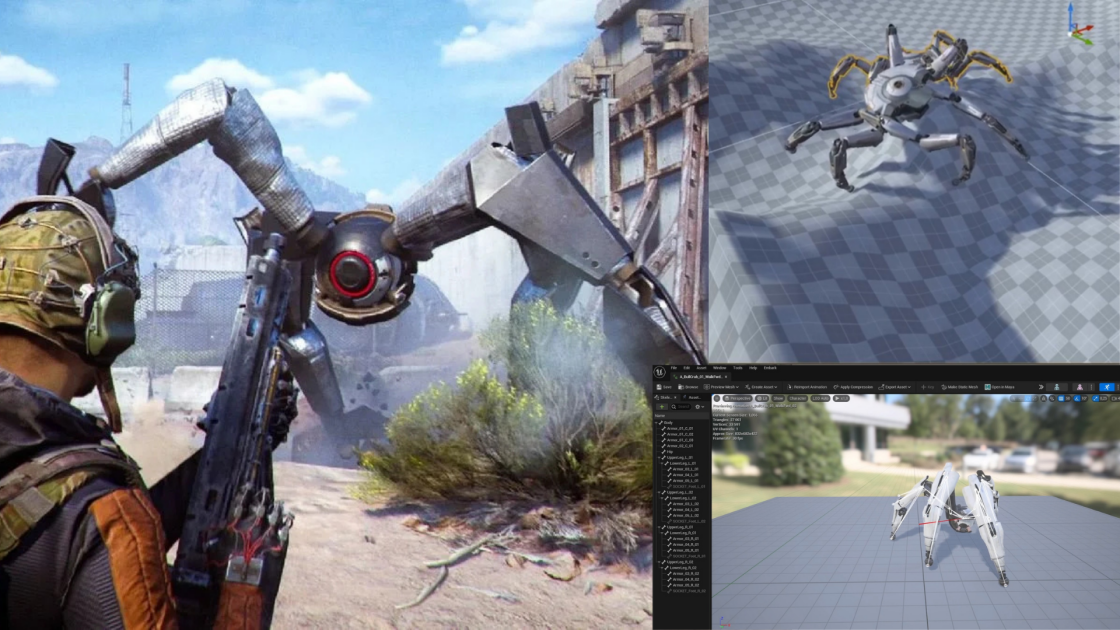
In a recent discussion, Martin Singh-Blom, a leading figure in AI development, provided insights into the evolving landscape of game design and artificial intelligence. The conversation revolved around the challenges and innovations that arise from integrating advanced AI with traditional gaming mechanics, particularly regarding enemy behavior and locomotion in robotic characters.
One of the key points raised was the difficulty of relying on traditional enemy patterns or scripted encounters in gaming. Singh-Blom emphasized that such methods are increasingly unviable due to the complexities of physics involved in game environments. “We can’t really do that because of the physics,” he stated, noting that attempts to implement more conventional behavior systems often falter when unexpected events occur, such as an enemy being pushed. This unpredictability significantly disrupts design patterns that game developers have historically relied on.
The conversation then shifted to the role of machine learning within the overall AI system. Contrary to some expectations, Singh-Blom clarified that the application of machine learning in their projects is quite limited. “The machine learning part is actually more limited than people think,” he explained. It is primarily utilized for locomotion tasks—specifically how robotic characters navigate terrain and position their limbs. Given the challenges traditional methods face with legged robots, the team turned to advanced techniques like reinforcement learning to address these issues effectively.
While drones can often rely on established control systems similar to those used in real-world applications, Singh-Blom noted that legged robots present unique challenges that require innovative solutions to ensure fluid movement. The integration of machine learning, however, is not extended to higher-level decision-making, which remains the domain of more traditional systems, such as behavior trees. “Once you move into higher-level decisions, like where to go or what to do, that’s handled by more traditional systems,” he elaborated.
This division between locomotion managed by machine learning and higher-level decisions governed by behavior trees creates a functional synergy within the AI framework. For instance, if a robot encounters an obstacle like a box, the behavior tree determines the robot’s intent to move forward, while the locomotion system calculates the most effective way to navigate the obstacle—be it climbing over it or maneuvering around it.
Looking ahead, the potential for more sophisticated decision-making capabilities in robotic characters is promising. As machine learning models become increasingly refined, there will be opportunities to shift more decision-making processes onto the machine learning side. “As the models improve, we can push more decision-making into the machine learning side,” Singh-Blom remarked, highlighting the exciting prospects for enhancing gameplay by allowing robots to make their own decisions. This advancement could lead to more dynamic and unpredictable interactions in gaming, such as a robot choosing to squeeze through a tight space or leap over an obstacle, ultimately enriching the player experience.
The ongoing interplay between traditional game design and cutting-edge AI technology underscores a broader trend in the gaming industry toward more immersive and responsive environments. As developers continue to explore the boundaries of physics and machine learning, the future of gaming holds the promise of increasingly complex and engaging experiences for players, setting a new standard for interactive entertainment.
See also Security Analytics Market to Reach $78.92 Billion by 2035 Amid Rising Cyber Threats
 Meta Assembles Elite AI Team to Enhance Facebook and Instagram Algorithms
 ASU Researcher Warns AI Overtrust Led to U.S. Military Strike on Iranian School, 170 Dead
 JMIR Reveals Moltbook Study: AI-to-AI Interactions Pose Critical Health Risks















