
















































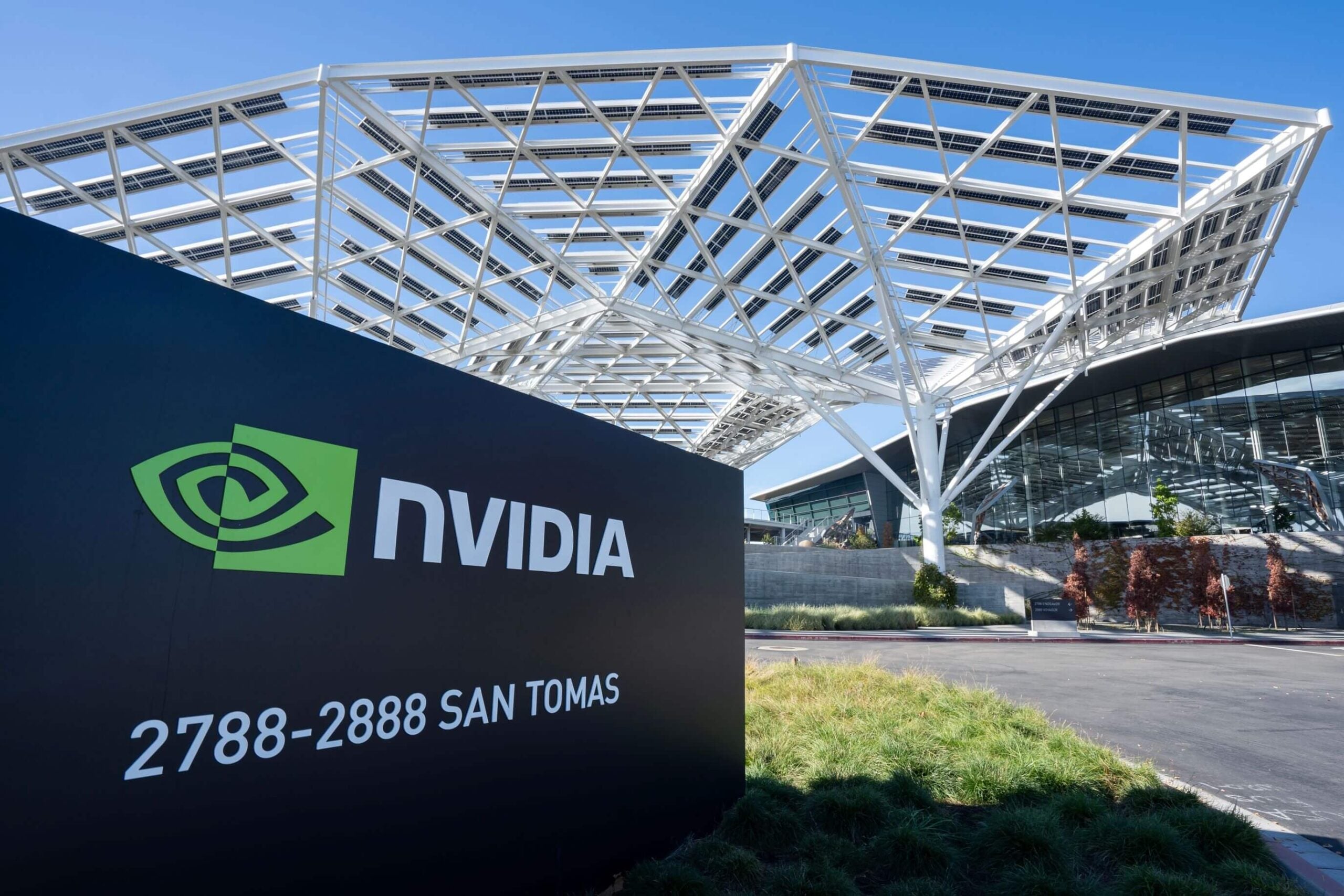
Nvidia’s stock received a slight boost following two significant announcements, underscoring the growing momentum in the AI hardware market. French AI firm Mistral AI revealed it has raised $830 million in debt financing to establish a new data center in Paris that will house approximately 13,800 Nvidia GB300 GPUs. This substantial order could translate into around $575 million in chip sales for Nvidia, based on estimates of GB300 rack costs provided by HSBC.
The announcement comes amid rising demand for AI hardware, with analysts consistently noting that the appetite for such technology shows no signs of waning. According to research by Omdia, global spending on cloud infrastructure hit $110.9 billion in the fourth quarter of 2025, marking a 29% increase year-over-year. Looking ahead, Omdia forecasts another 27% growth rate for 2026, a trend that Nvidia has been capitalizing on over the past two years.
In a more unconventional development, Starcloud, a startup focused on building data centers in space, announced it has secured $170 million in funding at a valuation of $1.1 billion. The company achieved a milestone late last year by successfully sending one of Nvidia’s H100 GPUs into space aboard its Starcloud-1 satellite, marking the first instance of an AI model being trained in orbit. Starcloud’s plans include launching a second satellite later this year, which will feature a full GPU cluster and the largest commercial deployable radiator sent to space, capable of generating 100 times the computing power of its predecessor.
These space-based data centers aim to address challenges faced by terrestrial facilities, including concerns related to power grid strain, water use, and community opposition. With the potential to harness solar energy and bypass traditional cooling systems, orbital data centers offer a promising alternative, albeit one fraught with technical and cost challenges that are still being navigated.
To support this burgeoning space initiative, Nvidia introduced the Space-1 Vera Rubin computing module on March 16, designed to mitigate data bottlenecks commonly associated with orbital systems. Limited bandwidth between satellites and Earth necessitates processing data at the source, rather than transmitting raw data for analysis, a scenario that Nvidia’s new hardware aims to rectify.
The competition in the orbital computing sector is intensifying. SpaceX, led by Elon Musk, is reportedly exploring plans for solar-powered orbital data centers, with potential funding coming from a public listing. Meanwhile, Blue Origin, founded by Jeff Bezos, is seeking regulatory approval to deploy nearly 52,000 satellites capable of AI computing into orbit.
Nvidia currently trades with a forward price-to-earnings ratio of approximately 21.4, reflecting a valuation that still anticipates growth despite being lower than in recent quarters. The company’s market capitalization stands above $4 trillion. As the demand for AI capabilities continues to grow, Nvidia’s strategic moves in both terrestrial and orbital arenas may well position it at the forefront of the next technological frontier.
See also Tesseract Launches Site Manager and PRISM Vision Badge for Job Site Clarity
 Affordable Android Smartwatches That Offer Great Value and Features
 Russia”s AIDOL Robot Stumbles During Debut in Moscow
 AI Technology Revolutionizes Meat Processing at Cargill Slaughterhouse
 Seagate Unveils Exos 4U100: 3.2PB AI-Ready Storage with Advanced HAMR Tech