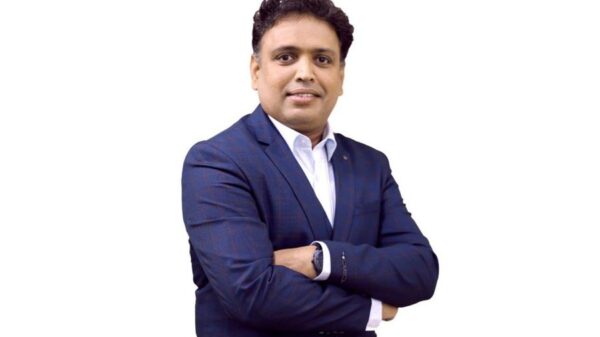



























On a sunny morning in January, Matthew Harvey Sanders, a former Canadian infantry officer turned tech CEO, welcomed me into the Pontifical Russian College in Rome. The 43-year-old leads an initiative that aims to digitize centuries-old Catholic texts using advanced technology. His company, Longbeard, has developed software known as Vulgate, which scans and ingests these texts into what he calls Magisterium AI, potentially the largest dataset of Catholic literature in existence, comprising nearly 30,000 sacred works.
Sanders opened the door to a room lined with robotic scanners and piles of religious texts, including the Vatican’s statistical yearbook, Annuarium Statisticum Ecclesiae. Each day, he and his team work to unlock the dusty archives of the church, making its teachings accessible to seekers worldwide. “We’re basically trying to get our hands on everything the church has ever said,” he explained, emphasizing the AI’s role as an extraordinarily advanced librarian equipped to understand the church’s views on faith and morals.
The technology employed in this endeavor is remarkable. Robotic arms delicately turn the pages of ancient texts, scanning them at a rate of about 1,800 pages per hour. Once scanned, the information becomes available globally within 15 minutes, allowing users to query it in any language on any device. However, Sanders’ mission extends beyond mere digitization; he aims to foster internal spiritual transformation. “We want to turn a curious seeker into a saint,” he said, highlighting the need to teach AI about the diverse forms of sainthood.
Faith and AI
Concerns and excitement about AI were echoed at the recent Rome Summit on Ethics and Artificial Intelligence, where Elder Gerrit W. Gong, a member of the Quorum of the Twelve Apostles of The Church of Jesus Christ of Latter-day Saints, spoke about AI’s dual nature. “In a balanced perspective, AI is neither the sum of, nor the solution to, all our opportunities or problems,” he stated, addressing a diverse audience of faith leaders.
Despite AI’s growing capabilities in human-like conversation, models struggle with existential questions related to God and faith. A recent evaluation by Gloo, a tech company serving faith organizations, revealed significant weaknesses in AI’s understanding of faith and meaning. The firm evaluated prominent AI models against principles relating to human flourishing and found that while models excelled at fact-based queries, their faith-related responses fell short. For instance, the average score on questions framed within a Christian context was a dismal 48 out of 100.
Nick Skytland, Gloo’s vice president, highlighted that even ostensibly neutral AI models carry inherent worldviews. “They try to be everything to everyone, but that comes at the expense of theological perspective,” he explained. As technology evolves, many Christians feel a sense of urgency to shape AI’s moral framework, learning from past experiences with social media and its unregulated growth.
In this context, initiatives are rising to create ethical frameworks for AI, such as the Rome Call of AI Ethics, signed by various religious leaders and tech giants like Microsoft and IBM. These efforts aim to emphasize the moral implications tied to technology, a sentiment echoed by Pope Leo XIV, who argued that intelligence must also encompass the appreciation of truth and beauty.
Sanders’ project aligns with these growing efforts, as he seeks to equip AI with a faithful understanding of Catholic teachings. With permission from the Vatican, he has digitized significant theological works and is exploring ways to incorporate the wisdom of church figures like Saint Augustine into Magisterium AI. Currently, his platform serves users—including church leaders—across 185 countries.
However, the broader question remains: How can various faith traditions contribute to shaping AI systems that reflect a shared moral compass? This is particularly pressing as the U.S. witnesses a decline in church attendance, with about 4,000 congregations closing annually. Despite this, many religious leaders are leveraging AI to streamline administrative tasks, allowing them more time for pastoral responsibilities. Yet, as Elder Gong has noted, caution is essential in using AI within spiritual contexts.
Amid these advancements, the emergence of groups like “Christians in AI” reflects a desire for faith to intersect meaningfully with technology. Formed in response to claims of AI sentience, the group now engages in prayer meetings and discussions about the ethical dimensions of AI development. Leaders like Richard Zhang from Google DeepMind advocate for a balanced approach to integrating faith values into AI systems. “It allows us to ask the right questions,” Zhang stated.
With technological advancements accelerating, the challenge lies in ensuring these systems reflect the diverse values of a pluralistic society. As Elder Gong articulated, AI could enhance our understanding of humanity’s interconnectedness and assist in addressing global challenges, such as language translation for the church. The evolving landscape of faith and technology suggests a new epoch where values and ethics will play a critical role in shaping the future of AI, potentially leading humanity to deeper moral and spiritual insights.
This story appears in the April 2026 issue of Deseret Magazine.
See also Tesseract Launches Site Manager and PRISM Vision Badge for Job Site Clarity
 Affordable Android Smartwatches That Offer Great Value and Features
 Russia”s AIDOL Robot Stumbles During Debut in Moscow
 AI Technology Revolutionizes Meat Processing at Cargill Slaughterhouse
 Seagate Unveils Exos 4U100: 3.2PB AI-Ready Storage with Advanced HAMR Tech