





































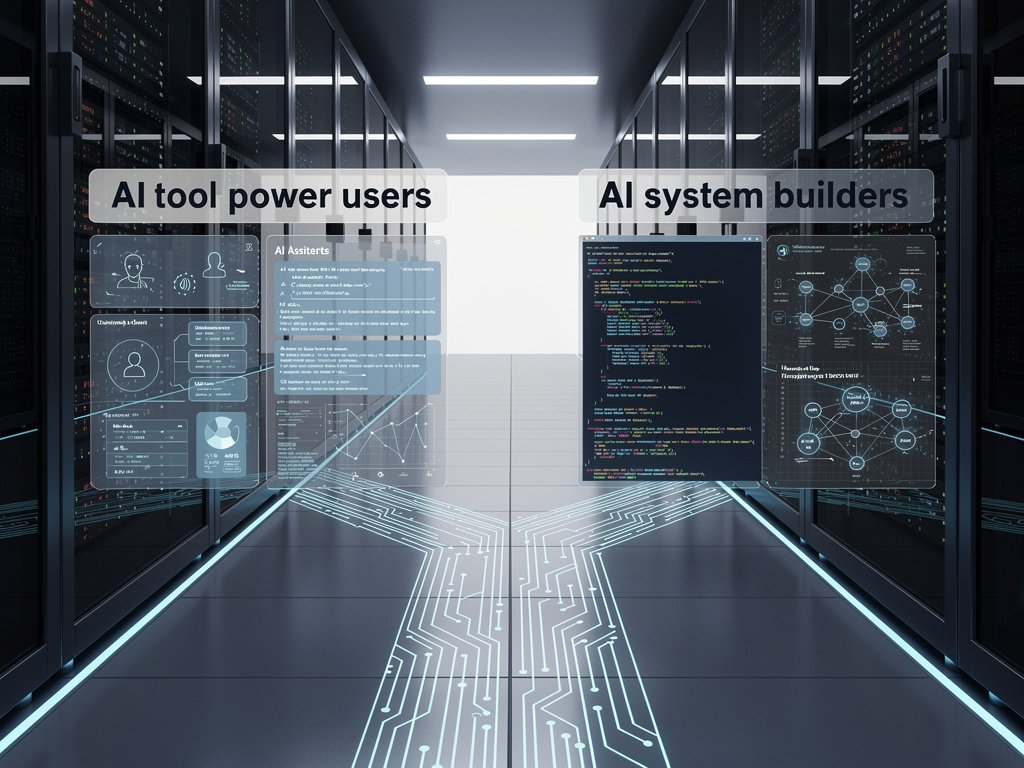
The landscape of software engineering is undergoing a seismic shift as generative artificial intelligence (AI) transforms traditional career paths within the field. Developers now face a crucial decision: embrace AI as a powerful ally or pivot towards creating and refining these technologies. This bifurcation in professional trajectories is reshaping the way software engineers work and the skills they need to thrive in a rapidly evolving environment.
For years, the route to success in software engineering was relatively clear: master programming languages, learn frameworks, and steadily rise from junior to senior roles by tackling increasingly complex coding challenges. However, as AI coding assistants like GitHub Copilot become commonplace, the comfortable middle ground for many developers is eroding. The emergence of AI tools has automated routine tasks, such as writing unit tests and generating standard functions, thereby significantly enhancing productivity but also diminishing the value of traditional skills that defined the entry-level developer experience.
A recent analysis by Digital Trends highlights a growing divide in software engineering roles. On one side are the “AI-assisted developers,” who leverage AI as a crucial partner, shifting their focus from writing code to designing and orchestrating complex systems. This evolution marks a fundamental change from mere implementation to strategic oversight. Developers in this category will need to master the art of crafting sophisticated prompts for AI tools, critically evaluating their outputs, and integrating them into broader application architectures.
The productivity gains for these AI-assisted developers are considerable. A study by researchers at MIT and GitHub found that developers utilizing AI assistants completed tasks more than 55% faster than those who did not. This acceleration allows developers to engage in higher-order problem-solving, enhancing job satisfaction as they can focus on more substantive aspects of their projects. As a result, the role of the developer is transforming into that of a pilot, guiding advanced AI tools rather than merely constructing them from scratch.
As these dynamics unfold, a new set of skills is emerging as essential. Successful AI-assisted developers will need strong debugging capabilities and a deep understanding of software architecture. They must identify instances where AI-generated code is flawed or insecure, ensuring that the accelerated pace of development does not compromise quality, security, or maintainability.
Conversely, the other side of this professional divide is represented by the “AI system builders.” These specialists—comprising machine learning experts, data scientists, and research engineers—are tasked with creating and fine-tuning the very AI systems that assist developers. This role demands a sophisticated grasp of mathematics, statistics, and computer science principles that far exceeds traditional application development skills.
The demand for talent capable of building advanced AI systems is intense, creating a competitive environment for hiring. While many software engineers are learning to use AI tools, the pool of those who can develop next-generation models remains small and highly coveted. These roles involve crafting innovative model architectures, optimizing algorithms for performance on specialized hardware like GPUs, and curating data for effective training. As a result, engineers in this domain are pushing the boundaries of what AI can achieve, making their work not just vital but also highly lucrative.
The rapid development of AI technologies is reshaping hiring practices within corporations. Employers are moving away from a focus on language-specific expertise, which can be easily supplemented by AI, and are prioritizing fundamental problem-solving abilities and conceptual understanding. The 2023 Stack Overflow Developer Survey, which included over 90,000 developers, revealed that 82% are either using or planning to use AI tools in their work within the next year. This widespread adoption signals that AI literacy is becoming a baseline requirement in the software engineering job market.
For both aspiring and current engineers, the message is clear: stagnation is not an option. The industry is rapidly evolving, leaving behind those who can only write boilerplate code. The future belongs to those who can deftly manage AI to produce exceptional products, or those rare individuals who can innovate and build the AI technologies of tomorrow. The great divide in software development is not just a trend; it is a defining career decision for a generation of engineers.
See also Elastic Launches Agent Builder and Context-Driven AI Tools; Shares Potentially Undervalued by 47%
 AI Transforms Clinical Research: 5 Trends Boosting Recruitment by 20% and Cutting Timelines by 6 Months
 TresVista Partners with RapidCanvas to Enhance AI Workflows for Financial Services
 Thorne Launches AI Wellness Chatbot Taia to Personalize Health Guidance for Consumers
 AI-Driven EDA Tools Slash Chip Design Costs by 60% at CES 2026, Ushering Silicon Renaissance