











































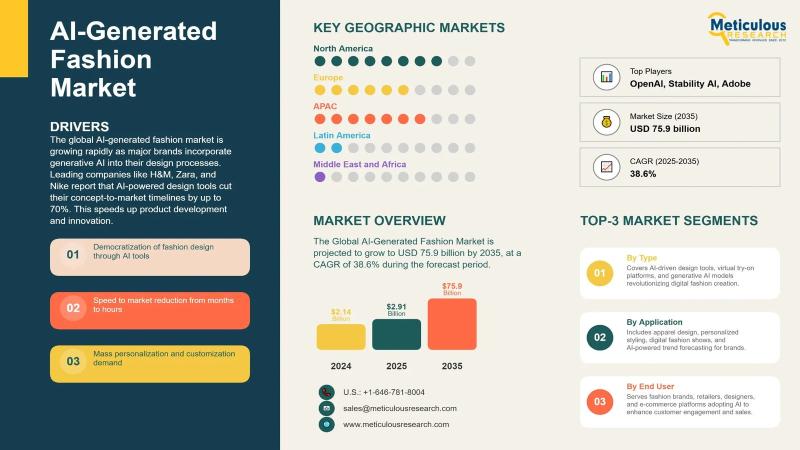
The fashion industry is undergoing a transformative shift driven by artificial intelligence (AI), marking one of the most significant changes since the invention of the sewing machine. AI is not merely a tool for designers; it is actively creating entire collections, generating virtual garments, and personalizing fashion experiences at an unprecedented scale. According to new research from Meticulous Research®, the global market for AI-generated fashion reached $2.14 billion in 2024, with projections estimating it will skyrocket to $75.9 billion by 2035, reflecting a robust annual growth rate of 38.6%. This burgeoning sector signifies a leap into a digital-first, hyper-personalized future for fashion.
AI-generated fashion encompasses a range of technologies, including generative AI, machine learning, and digital design tools. These innovations facilitate everything from initial concept and pattern creation to the virtual clothing market and digital ownership. The rapid expansion of this market highlights the industry’s pivot toward speed, personalization, sustainability, and digital-first business models that are only viable through the application of AI.
Several key factors are fueling this remarkable growth. Notably, major global fashion brands are leveraging AI to drastically reduce product development timelines. Design cycles that once spanned months can now be completed in just days, allowing brands to respond more rapidly to market trends and consumer demands. Generative design tools are capable of producing high-quality, production-ready fashion concepts in large volumes with unparalleled speed, fundamentally altering the operational dynamics of fashion houses.
Another significant advantage of AI is the ability to offer personalized fashion at scale. AI-driven personalization has revolutionized consumer experiences, enabling millions of customers to receive clothing recommendations tailored to their preferences, body types, and purchasing behaviors. Platforms utilizing AI-powered styling and visual search are increasing customer engagement, boosting conversion rates, and enhancing loyalty in ways that traditional retail models have struggled to achieve.
The rise of virtual fashion is also emerging as a high-growth sector. Fuelling this trend are gaming platforms, digital avatars, and NFT-based apparel, which have allowed both luxury and mass-market brands to monetize digital-only garments. This expansion into immersive digital environments is creating entirely new revenue streams that do not rely on physical production.
Additionally, the focus on sustainability is driving AI-generated fashion’s appeal. By minimizing material waste and addressing overproduction, AI technologies enable brands to implement virtual prototyping and digital sampling, significantly reducing the need for physical samples. This not only helps in cost reduction and shortened development cycles but also mitigates the environmental impact that has long plagued the industry.
The barriers to entry for new designers are also diminishing. Affordable AI-powered design platforms are democratizing fashion creation, allowing entrepreneurs and independent designers to access comprehensive design and production tools at a fraction of the cost of traditional software. This accessibility is opening the door for thousands of new fashion businesses to enter the market each year without the need for substantial capital investment.
Fashion brands and designers currently lead the demand for AI-generated fashion, accounting for nearly 60% of the total market. The urgency for rapid product launches and trend responsiveness, coupled with improved inventory performance, is driving this trend. Fast-fashion companies are particularly adept at utilizing AI to release thousands of new products weekly, achieving significantly higher sell-through rates.
Generative AI models dominate the technology landscape, representing almost half of the market. These models facilitate the large-scale production of manufacturable designs, generating millions of design variations daily, thus supporting both physical and digital fashion production simultaneously. North America, commanding around 40% of the global market share, benefits from a solid fashion-tech ecosystem, substantial venture capital investments, and widespread adoption among leading brands, with numerous fashion technology startups continuing to spur innovation in the region.
Recent technological advancements include multimodal AI systems that can process text prompts, images, sketches, and 3D models concurrently. Real-time garment rendering allows for highly accurate digital simulations, while blockchain technology is employed to track design ownership and authenticate digital fashion assets. In-store edge AI solutions are also beginning to allow real-time garment customization on site.
Despite the burgeoning momentum, the market does face challenges, particularly concerning intellectual property rights, quality assurance, and workforce implications due to automation. Industry participants are actively addressing these issues through licensed training data, blockchain-based verification systems, and hybrid creative workflows that ensure human designers remain integral to the creative process.
AI-generated fashion has transitioned from a novelty to an essential component of the industry. By facilitating faster design cycles, personalized consumer experiences, digital ownership, and sustainable production practices, AI is not just redefining the fashion landscape—it’s reshaping how fashion is created and consumed on a global scale. The potential for sustained high-growth momentum through 2035 and beyond indicates that this technology will not only alter the fabric of fashion but also reimagine it entirely.
See also C-suite Executives Anticipate 43% AI Adoption by 2030 Amid Cost Pressures and Risk Management Priorities
 AI and Geopolitical Tensions Drive Surge in Global Cyber Fraud Risks, Experts Warn
 Trump Demands Microsoft Cover AI Data Center Electricity Costs Amid Rising Bills
 Go!Foton Unveils Innovative Fiber Slack Panel for AI-Ready Data Centers at BICSI 2026
 Illumina Unveils Billion Cell Atlas to Transform AI-Driven Drug Discovery at Scale