









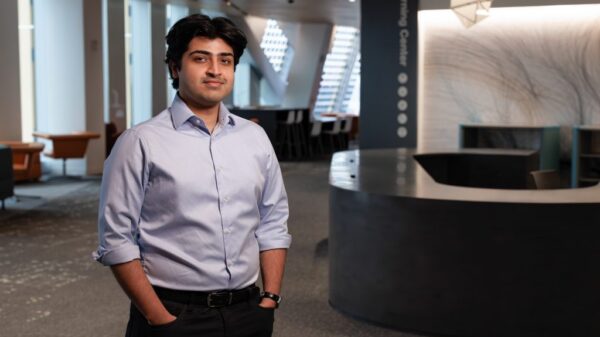























In a groundbreaking advancement for assistive technology, the AI company Envision has developed mirrors that allow blind individuals to see themselves for the first time. Founded by Indian-origin CEO Karthik Mahadevan, Envision’s technology has emerged as a game-changer, enabling users to access visual information through artificial intelligence.
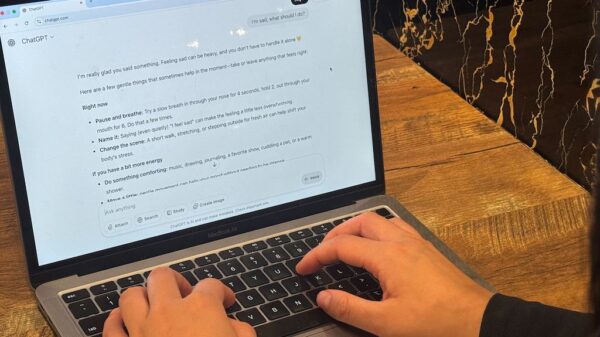
The application, which has gained popularity among those with vision impairments, utilizes image recognition and intelligent processing to describe images. It provides feedback, comparisons, and guidance, transforming how blind individuals perceive their surroundings. Mahadevan stated in an interview with the BBC that the initiative began in 2017, initially offering only basic descriptions. “When we started in 2017, we were able to offer basic descriptions, just a short sentence of two or three words,” he explained.
From its inception as a mobile app that assisted users in reading printed text, Envision has since evolved to integrate advanced AI models into smart glasses, enriching the interaction between blind users and their visual environment. The application is used for various purposes, ranging from reading letters to shopping. Surprisingly, some users employ it for tasks like makeup application and outfit coordination, a feature that highlights its versatility.
Lucy Edwards, a blind content creator, expressed the transformative impact this technology has had on her life. After having vision for the first 17 years of her life, she shared, “It feels like AI is pretending to be my mirror. The truth is that I haven’t had an opinion about my face for 12 years. Suddenly I’m taking a photo and I can ask AI to give me all the details, to give me a score out of 10, and although it’s not the same as seeing, it’s the closest I’m going to get for now.”
Another user, Milagros Costabel, noted the utility of a different app called ‘Be My Eyes’, which allows her to upload photos to verify her skincare results. “Your skin is hydrated, but it definitely doesn’t look like the almost perfect example of reflective skin, with non-existent pores as if it were glass, in beauty ads,” the app informed her.
Despite the promise of AI-enhanced mirrors, experts caution about the potential implications for body image among blind users. Helena Lewis-Smith, an applied health psychology researcher at the University of Bristol, remarked, “We have seen that people who seek more feedback about their bodies, in all areas, have lower body image satisfaction. AI is opening up this possibility for blind people.” The concern is that many AI models are trained to idealize Western body standards, which could lead to distorted perceptions of self-worth.
Lewis-Smith elaborated on the risks associated with AI-driven feedback, suggesting that these tools might often present images that imply significant changes are necessary, potentially undermining users’ confidence. “In psychological literature, rather than how a person looks, we understand that body image is not one-dimensional and is made up of several factors,” she added. This complexity is something AI struggles to comprehend.
Mahadevan acknowledged the challenges, stating, “At first, the descriptions were very good, but we noticed that many of them were inaccurate and changed important details, or invented information when what was in the image didn’t seem to be enough.” However, he noted that improvements in technology have significantly reduced these errors.
Edwards describes the duality of the AI experience. While the technology can provide flattering descriptions, it can also lead to harsh realities when users inquire about their appearance. Despite these potential pitfalls, she remains optimistic. “We’re going to take it as a positive thing because even though we don’t see visual beauty in the same way that sighted people do, the more robots that describe photos to us, guide us, and help us with shopping, the happier we’ll be.” The journey towards greater independence and self-perception for blind individuals is now aided by technology that was once thought impossible.
As Envision continues to refine its AI mirrors and expand on its applications, the implications for users are profound. The introduction of this technology not only represents a significant step forward in accessibility but also raises important questions about self-image and trust in AI, shaping a future where technology can help bridge the gap between sighted and blind experiences.
See also Prologis Targets $30B-$50B Investment to Build 10 GW of Data Centers Amid AI Boom
 Box’s Q4 Report Due March 3: Will AI Strategy Drive Growth or Signal Risks?
 Budget 2026: Renewable Energy Sector Demands Urgent Support for Storage, Grid Efficiency
 Microsoft Signs $750M AI Deal with Perplexity to Boost Azure’s Multi-Cloud Strategy