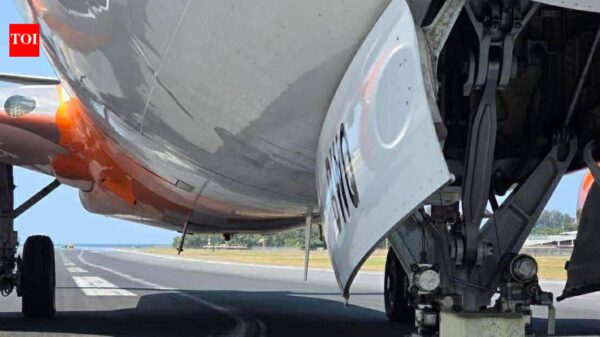





















































NEW DELHI: An Air India Express Boeing 737 MAX, operating flight IX 938, made a hard landing at Phuket International Airport on Wednesday, leaving 138 individuals on board unharmed. The aircraft, which had taken off from Hyderabad at 6:23 AM local time, touched down at 11:25 AM but reportedly bounced during its initial landing attempt. On the second contact with the runway, both nose wheels detached, causing the aircraft to become immobilized on the runway and leading to the closure of the airport for necessary inspections.
The Directorate General of Civil Aviation (DGCA) confirmed it is coordinating with Thai aviation authorities regarding the incident. Flight tracking service Flightradar24 noted that Phuket’s sole runway remained closed for nearly seven hours following the incident, resulting in the diversion of approximately 20 flights to alternative airports. By 5:30 AM yesterday, Air India Express announced the successful reinstallation of the nose wheels, allowing for the resumption of normal airport operations. “We apologize for the incident, which will be investigated in accordance with established procedures,” the airline stated.
According to a senior DGCA official, the aircraft involved, registered as VT-BWQ, was subjected to routine maintenance just three days prior to the incident, with both nose wheels replaced on March 8, 2026. Passengers were safely deplaned onto the runway and escorted to the terminal. The aircraft was subsequently towed to a bay for further inspection.
Eyewitness accounts and expert analysis suggest that the hard landing could be attributed to the challenging conditions at Phuket Airport, which features a distinct upslope followed by a downslope. This terrain can complicate flare perception—a critical visual and sensory process pilots use to gauge altitude, speed, and closure rate during landing. “Phuket is a tricky place to land if the winds are strong and thermals are present, especially during the hot afternoons,” remarked a senior B737 captain. He noted that the pilots likely adhered to safety protocols, though an investigation would be necessary to determine the exact cause.
The incident has raised questions regarding flight safety and operational procedures in challenging geographical locations. An Air India Express spokesperson confirmed that the crew followed all standard procedures during the landing, thanking passengers and airport authorities for their cooperation throughout the situation. The airline expressed its commitment to a thorough investigation in collaboration with the appropriate Thai authorities.
As the travel industry continues to recover from the pandemic, incidents like this underscore the importance of maintaining high safety standards in aviation. With the DGCA actively involved, the findings of the investigation are anticipated to contribute to ongoing safety improvements in the sector, particularly in regions known for difficult landing conditions. Stakeholders are hopeful that the industry will learn from this incident, ensuring that passenger safety remains paramount in all operational contexts.
See also Germany”s National Team Prepares for World Cup Qualifiers with Disco Atmosphere
 95% of AI Projects Fail in Companies According to MIT
 AI in Food & Beverages Market to Surge from $11.08B to $263.80B by 2032
 Satya Nadella Supports OpenAI’s $100B Revenue Goal, Highlights AI Funding Needs
 Wall Street Recovers from Early Loss as Nvidia Surges 1.8% Amid Market Volatility