









































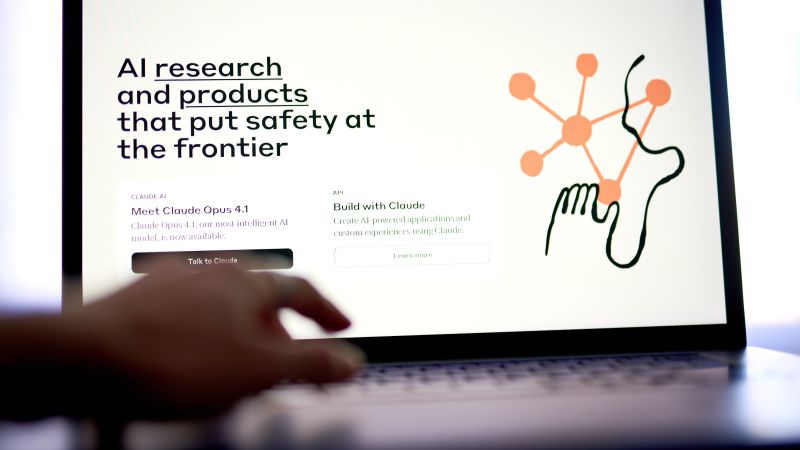
Anthropic made headlines this week with the announcement of its new AI model, Claude Opus 4.6, which aims to enhance its Cowork AI assistant, a tool designed for office and coding tasks. The upgrade follows a period of volatility in the stock market, particularly affecting companies providing legal and financial analysis software, which have seen significant declines amid growing concerns that AI advancements might replace specialized software tools.
On Thursday, Anthropic unveiled Claude Opus 4.6, highlighting its potential to revolutionize the workplace. The model’s advancements come at a time when tech giants like OpenAI and Google are in a competitive rush to develop AI models that could define the future of work. The Nasdaq index has experienced its worst two-day decline since April, largely attributed to fears surrounding the impact of AI on employment and software job markets.
Experts are grappling with the implications of AI technologies, questioning whether these tools will ultimately displace jobs. The introduction of Claude Opus 4.6 could exacerbate those concerns as it aims to outperform existing solutions, such as those from OpenAI, which also launched a new platform for creating AI agents that simulate colleague-like interactions.
Anthropic is positioning Opus 4.6 as a transformative force in knowledge work, particularly in financial and legal sectors. Dianne Penn, head of product management for research at Anthropic, emphasized the model’s capabilities, stating, “We think that Opus 4.6 is going to be an inflection point for knowledge work in many ways.”
One notable enhancement in Opus 4.6 is the expanded context window, allowing the model to process information from 200,000 tokens to one million. This means Claude will be able to handle more complex tasks, such as implementing comprehensive changes across entire codebases. “Giving Claude the ability to process more information at once should enable it to handle more complicated tasks,” Penn added.
Additionally, the model will improve its reasoning capabilities, better recognizing when to take time to analyze requests and when to respond quickly. Initial assessments suggest that Claude Opus 4.6 outperforms OpenAI’s GPT-5.2 model in handling knowledge work, particularly in finance and legal applications.
The latest update also includes a new PowerPoint integration, allowing users to create slides that align with corporate templates based on layout and font recognition. This functionality is particularly challenging due to the subjective nature of design elements, as opposed to the more data-driven tasks managed in applications like Excel.
Furthermore, files created with Claude Opus 4.6, such as documents, spreadsheets, and presentations, are designed to be closer to “production-ready” from the outset, requiring less human oversight. In addition to enhancements for office tasks, the update offers improvements for software engineering, enabling coding projects to be divided among multiple AI agents, mimicking the collaborative nature of human engineering teams.
The release of Opus 4.6 comes in the wake of a sharp decline in software stocks, triggered by the introduction of plugins for Anthropic’s Cowork tool, which allow customization for specific industries such as legal and finance. This has raised fears that AI could replace established research and financial analysis software providers. An exchange-traded fund focused on the software industry experienced its worst downturn since April, with stocks like Thomson Reuters falling by 15.83% and LegalZoom dropping nearly 20% in just one day.
As questions about AI’s impact on the job market grow, particularly for entry-level tech positions, a report from Oxford Economics noted an 8% decline in employment for recent computer science graduates since 2022. Despite this, Penn indicated that Anthropic is mindful of these concerns and studies AI’s effects on labor through initiatives like the Economic Index report.
However, Jacob Bourne, a technology analyst with eMarketer, suggested that the panic surrounding AI’s job market disruption may be overblown. “Panic over this is probably misplaced,” Bourne stated, adding that security concerns could deter larger enterprises from adopting AI tools that require access to sensitive files and browsing activities.
Looking ahead, while Anthropic and its competitors race to refine their AI offerings, the challenge remains for legacy enterprise software providers to adapt and evolve in response to the rapidly changing landscape of knowledge work. As AI becomes increasingly embedded in workplace operations, its influence will continue to shape the future of various industries.
See also OpenAI Begins Testing Ads in ChatGPT, While Anthropic’s Claude Stays Ad-Free
 WHO Faces Clash Over AI Data Sovereignty as Global Health Governance Unfolds
 Palantir’s AI Platform Fuels 1,700% Stock Surge, Unlocks $4.3B in New Contracts
 Meta Tests Standalone ‘Vibes’ App for AI-Generated Videos, Reshaping Content Creation
 UN Submits 40 Experts for Global AI Panel to Enhance Governance and Safety Post-Approval