









































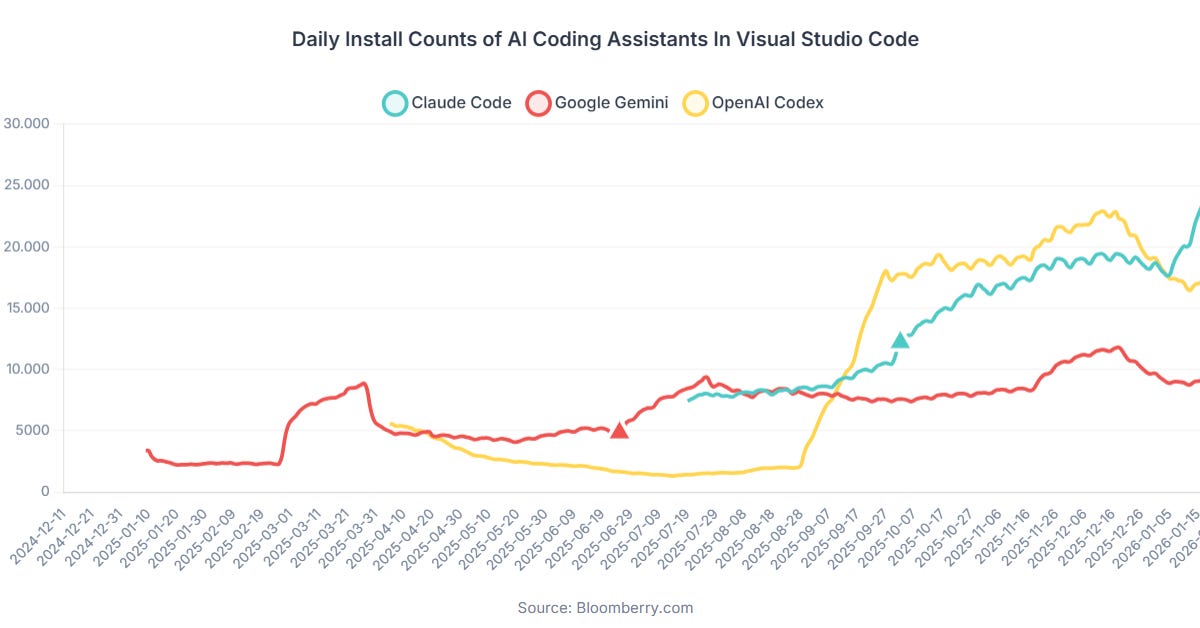
Anthropic’s AI coding assistant, Claude Code, has gained remarkable traction since its launch. In the final months of 2025, it achieved an annualized run rate of $1 billion just six months post-launch, a feat even ChatGPT couldn’t match. Recent data suggests that Claude Code may now be nearing a $2 billion annual revenue run rate, propelled by significant acceleration in usage in January 2026.
Overall, Anthropic’s revenue soared from approximately $1 billion at the start of 2025 to an impressive $5 billion by August, marking a fivefold increase within eight months. Projections indicate that the company could reach $9 billion by the end of the year. However, beyond this raw revenue growth, **Claude Code** has positioned itself as a critical tool for developers facing complex coding challenges. At a recent meetup in Seattle, over 150 engineers gathered to exchange use cases, underscoring the product’s growing importance in the developer community.
More notably, a principal engineer from Google claimed that Claude Code could replicate a year’s worth of architectural work in just one hour. This sentiment reflects the adoption of Claude Code within major engineering teams at Microsoft, which has encouraged even non-developers to leverage its capabilities.
Market Penetration and Growth
By August 2025, Anthropic’s customer base had expanded to over 300,000 business clients from fewer than 1,000 two years prior. According to Thunderbit, Claude Code’s share of the enterprise AI assistant market rose from 18% in 2024 to 29% in 2025, a significant 61% year-over-year increase that narrows the gap with ChatGPT.
Recently, Anthropic signed a term sheet for a $10 billion funding round, bringing its valuation to $350 billion—a near doubling from the $183 billion recorded in September 2025. This rapid ascent highlights the firm’s growing appeal, largely attributed to its developer-centric approach.
In a landscape cluttered with AI coding tools such as GitHub Copilot, Cursor, and Amazon CodeWhisperer, Claude Code stands out due to its unique architecture. Unlike traditional coding assistants that operate as simple IDE extensions, Claude Code integrates directly into the terminal with full file system and command-line access. This design fosters a continuous relationship between developers and the AI, enabling it to manage state across sessions and handle complex multi-step tasks autonomously.
As noted by Noah Brier on Bloomberg’s Odd Lots podcast, “it’s more like hiring a junior developer than using autocomplete.” This architectural decision allows Claude Code to build context over time, remembering key architectural decisions and maintaining to-do lists, a feature traditional chat-based assistants lack.
Moreover, Claude Code’s ability to leverage Unix commands enables it to effectively engage with tools that developers already use, reinforcing its position as a capable agent rather than merely an assistant. This feature allows developers to remain within their existing workflows, facilitating rapid adoption.
Technical Advancements
The underlying AI models also contribute significantly to Claude Code’s success. In May 2025, Anthropic launched Claude 4, which demonstrated superior coding capabilities across various benchmarks. The subsequent release of Claude Sonnet 4.5 in September marked a leap in performance, achieving an 80.9% score on the SWE-bench Verified while using up to 65% fewer tokens than previous iterations.
These enhancements translate into tangible improvements in productivity. Notably, internal data from Anthropic suggests that developers utilizing Claude Code report substantial efficiency gains, outperforming those using competitor tools. For companies employing numerous engineers, these gains could translate to significant annual savings, enhancing the economic rationale for investing in AI coding infrastructure.
Anthropic’s aggressive pursuit of the enterprise market sets it apart from competitors like OpenAI, which has gained consumer attention with its ChatGPT platform. While OpenAI is projected to generate higher absolute revenue figures in 2025, Anthropic’s faster growth trajectory positions it for potential profitability by 2028, while OpenAI may face steep losses due to extensive compute costs.
As Claude Code continues to carve out its niche in the enterprise AI landscape, its impact on the software development market illustrates the significance of coding tools in enhancing productivity. With an estimated 36 million developers globally, the potential economic value generated through AI in this domain could reach as high as $525 billion annually.
As Anthropic continues to innovate and expand its offerings, the trajectory of Claude Code suggests that it may indeed be experiencing its own “ChatGPT moment,” demonstrating the profound impact AI tools can have on the future of work and productivity.
See also Tech Earnings Awaited: Big Players Face Pressure to Show AI Investment Returns
 Influencer Agencies Prioritize AI Strategy as 48% Shift in Client Expectations Emerges
 WhatsApp Unveils Advanced Meta AI ‘Thinking Mode’ to Enhance User Interaction
 Cloud and AI Investments Surge as Enterprises Shift to Strategic Outsourcing by 2026
 Google.org Unveils $20M AI Fund to Propel 12 Breakthroughs in Health and Agriculture