







































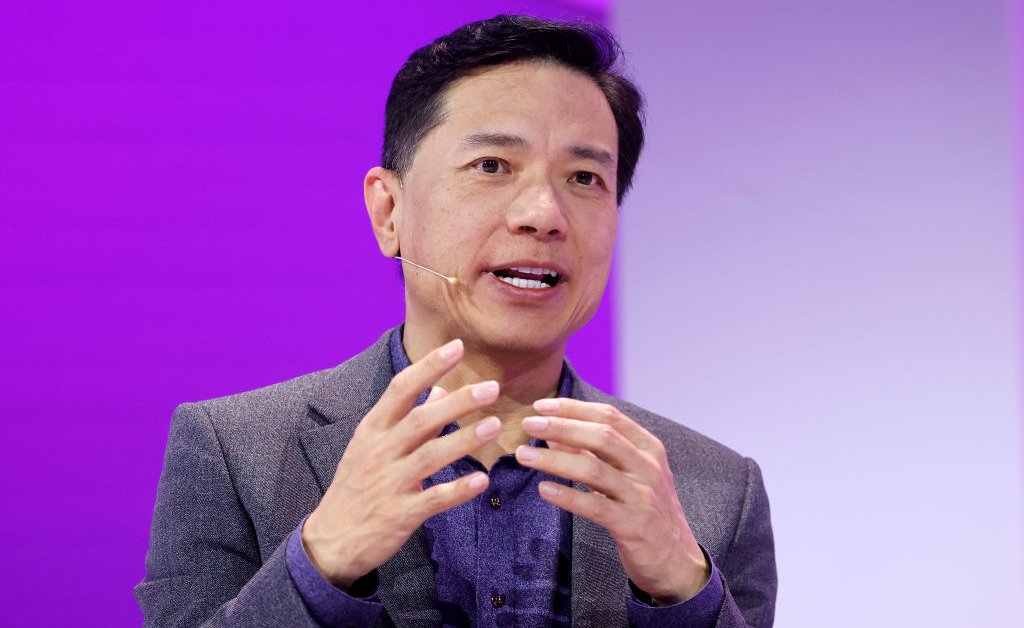
At Baidu’s Beijing headquarters, a plaque displaying the number “1417” marks the origin of the $50 billion tech giant founded by Robin Li in 2000. This number represents the hotel room across from Peking University where Li and his team first envisioned Baidu as China’s leading search engine. While initially focused on search technology, Li’s interest in artificial intelligence (AI) simmered beneath the surface, influenced by his academic background at Peking and Tsinghua universities. However, his pursuit of AI was sidelined during his graduate studies in the U.S. in 1991, as a professor warned him against it due to job market uncertainties.
Fast forward to today, and that caution appears misplaced. The global AI market was pegged at $244 billion last year, with AI chip leader Nvidia emerging as the world’s most valuable company, worth over $4 trillion. Li’s foresight into AI’s potential has positioned Baidu as one of China’s foremost full-stack AI firms, developing everything from chips and cloud infrastructure to AI models and applications.
In a recent interview with TIME during the Baidu World conference, Li reflected on the evolution of AI in society. He noted that in 2000, he had no idea AI would become as integral as it is today. “When I founded Baidu, I recognized the Internet’s potential in China, but I couldn’t connect AI with search engines,” he stated. It wasn’t until around 2010 that Baidu began incorporating machine learning into its search algorithms, and by 2012, with advancements in deep learning, Li recognized the transformative power of AI.
Looking ahead, Li suggested that 2025 might be a pivotal year for AI adoption, as businesses shift focus from foundational models, which dominated discussions in 2023 and 2024, to the application phase. “We’ve witnessed various scenarios where this new wave of AI is adding value,” he explained.
Baidu’s latest offering, Ernie Bot 5.0, has been positioned to compete with other leading large language models like ChatGPT and DeepSeek. Li emphasized an application-driven approach, focusing on niche areas where the model can excel, such as search and digital human applications. “Our model is particularly adept at instruction following and creative writing,” he noted, adding that these capabilities are crucial in areas like live streaming and e-commerce.
Li foresees a consolidation within the foundational model space akin to past technological evolutions, where only a few dominant players will emerge, but numerous successful applications will thrive in various directions. He cautioned against focusing solely on chip development, advocating instead for increased application value to ensure sustainable innovation. “Don’t focus on models; focus on applications,” he urged.
Baidu’s commitment to open-source development has cultivated a vibrant community around its AI framework, PaddlePaddle, which has millions of developers. Li believes that while open-source promotes visibility, true innovation lies in developing models that effectively solve real-world problems.
As Baidu expands its robotaxi service, Apollo Go, into international markets, Li faces regulatory and geopolitical challenges. With operations in 22 cities, he noted that the deployment of self-driving vehicles varies significantly across regions. “Wherever regulators allow us to operate, we are eager to expand,” he stated, highlighting Baidu’s adaptability in partnerships with companies like Uber and Lyft.
While China boasts a robust supply chain for EV components, Li acknowledged that the country still lags behind the U.S. in the GPU and AI accelerator space. “We’re probably two to three generations behind,” he admitted, though he maintains that this gap won’t hinder the development of valuable applications.
In contrast to the U.S. approach, which often frames AI development as an arms race for artificial general intelligence (AGI), Li emphasized the importance of application-driven AI in China. “We care more about applications,” he said, arguing that solving real-world problems should take precedence over the pursuit of AGI.
Addressing concerns about AI’s potential to displace jobs, Li acknowledged the short-term challenges posed by increased productivity but expressed optimism about new job creation in the long term. “We need to find ways to handle this,” he stated, noting that Baidu has established data labeling centers that have generated thousands of jobs.
On the topic of energy consumption by data centers, Li shared Baidu’s commitment to efficiency, achieved through advanced design strategies developed over many years. He highlighted the significant energy savings possible through smaller models and optimized inference costs, a focus that differentiates Chinese firms from their U.S. counterparts.
As Baidu’s innovations continue to unfold, Li remains optimistic yet realistic about the future of AI. “The technology evolves so rapidly,” he remarked, emphasizing the need for the industry to adapt continuously. The next decade holds unpredictable challenges and opportunities as AI reshapes society.
For further insights on AI and technology, visit Nvidia, OpenAI, and DeepMind.
See also Unlock AI Success: Key Criteria for Choosing a Top-Tier Visibility Agency Today
 Korean Government Investigates Elon Musk’s Grok Over 23,000 Deepfake Images of Minors
 AI.DB.F Stock Evaluation: Buy at 99.98, Target 101.22; Neutral Ratings Persist
 DeepSnitch AI Surges 140% as Investors Shift from Shiba Inu to High-Utility Presales
 Anthropic Unveils Security Center for Claude Code to Enhance Code Security Management