













































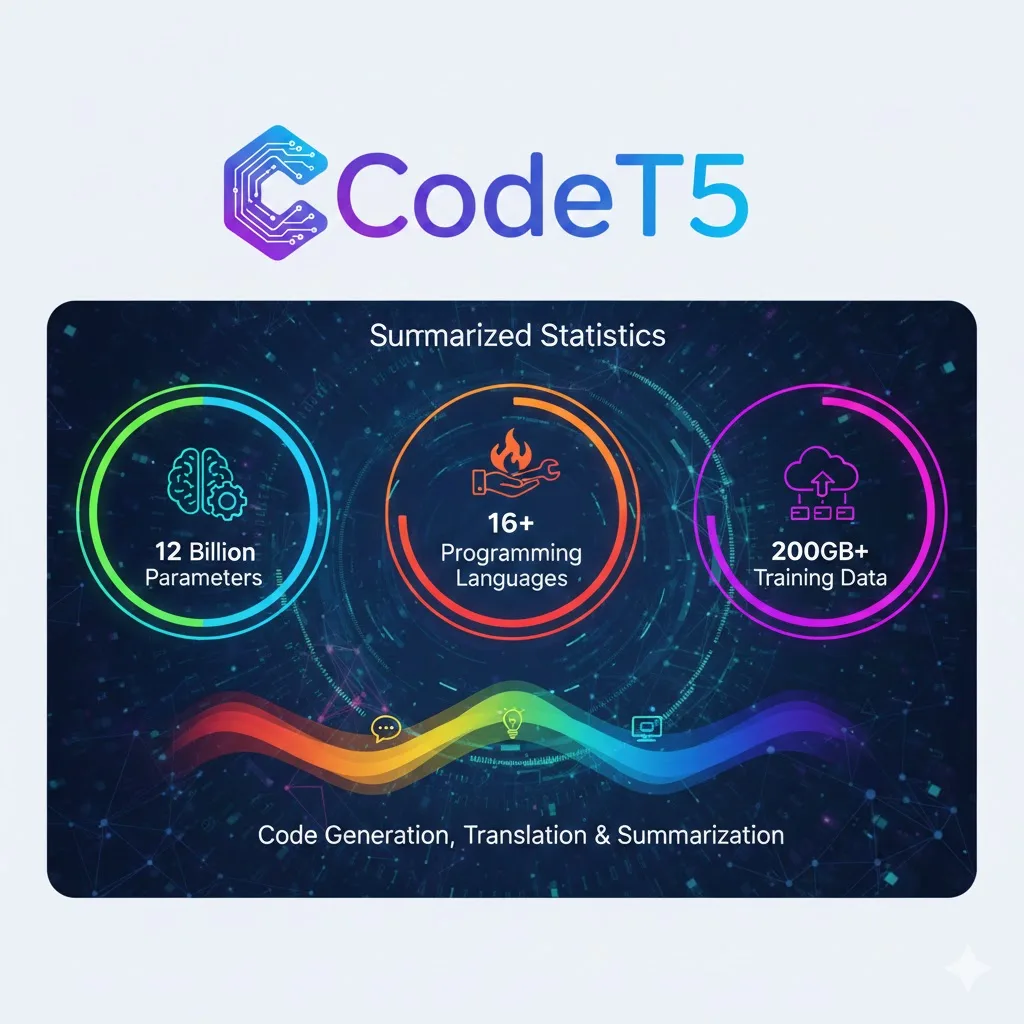
Salesforce Research has made significant strides in the field of open-source code intelligence through its model CodeT5, which reached 22,172 monthly downloads on Hugging Face as of December 2025. This impressive figure underscores its status as a leading tool among developers, fueled by a versatile architecture that includes variants ranging from 60 million to 16 billion parameters. Notably, the InstructCodeT5+ 16B variant achieved a pass rate of 35.0% on the HumanEval benchmark, setting a new standard for performance in code evaluation tasks.
The CodeT5 model family, which spans several sizes and capabilities, has garnered over 3,100 stars and 487 forks on GitHub, indicative of robust engagement from the developer community. This model architecture, which is built on the T5 encoder-decoder framework, supports flexible functionality tailored for both understanding and generating code. The fine-tuned variants developed by community programmers are also noteworthy, with 86 specialized applications focusing on tasks such as vulnerability detection and code review automation.
Significantly, the CodeT5 family’s training dataset has expanded considerably, processing 51.5 billion tokens compared to its predecessor’s 8.35 million training instances. This shift reflects a commitment to improving multilingual code representation, now supporting nine programming languages including the recently added C++. Training was conducted using permissively licensed repositories, ensuring compliance for commercial applications.
Performance benchmarks reveal that larger models yield significant advantages in code evaluation. The InstructCodeT5+ 16B model not only exceeded OpenAI’s code-cushman-001 in terms of pass rates but also highlighted the advantages of greater parameter counts in achieving improved results. For example, the model achieved a pass rate of 42.9% when augmented with CodeT generation strategies, demonstrating effective code synthesis capabilities.
Notably, the environmental impact of these training processes has been addressed, with the CodeT5-base variant generating 49.25 kg of CO2 during training, a figure that has been fully offset through carbon credits from Google Cloud Platform. This commitment to sustainability aligns with growing concerns over the ecological footprint of AI development.
CodeT5’s influence extends into the academic realm as well, with over 1,500 research citations noted as of late 2025. The underlying methodologies from Salesforce Research have contributed significantly to the advancement of techniques in code generation and understanding, positioning CodeT5 as a vital resource in the ongoing evolution of code intelligence.
As developers continue to explore its capabilities, the sustained interest shown in CodeT5, along with its community-driven enhancements, suggests that it will remain a pivotal tool in software engineering and natural language processing. The model’s ability to adapt to diverse programming tasks while maintaining high performance indicates a promising future for open-source initiatives in AI innovation.
See also UK Government Orders Elon Musk’s X to Address Grok AI’s Production of Non-Consensual Images
 Hyundai, Boston Dynamics, and Google DeepMind Invest $150B to Transform Humanoid Robotics
 AI Expert Pushes Back Timeline for Superintelligence, Now Sees 2034 as New Milestone
 Wellhub Launches AI Tool to Personalize Wellness Routines, Targeting Gen Z Engagement