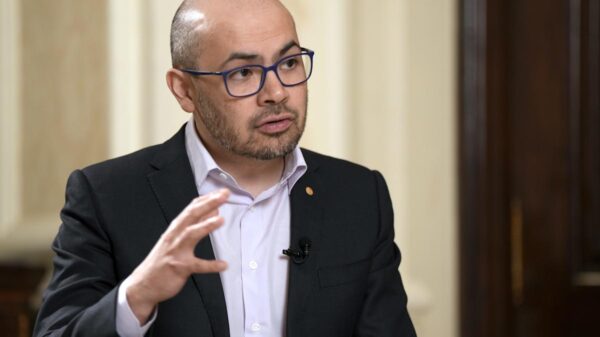







































Demis Hassabis, co-founder and CEO of DeepMind, has lauded the United Kingdom’s artificial intelligence ecosystem, asserting that its rich talent pool offers a structural advantage over Silicon Valley in the formation of cutting-edge AI ventures. Speaking during a recent discussion with investor Harry Stebbings, Hassabis highlighted the concentration of world-class universities like Cambridge, Oxford, Imperial College London, and UCL as pivotal contributors to this advantage. He remarked that these institutions produce top-tier graduates and researchers who are “the envy of the world.”
Hassabis indicated that the UK’s historical commitment to scientific excellence has been foundational in shaping DeepMind’s early achievements. He referenced a lineage of revolutionary thinkers, including Alan Turing and Isaac Newton, pointing out that the country possesses all the essential elements needed to cultivate transformative AI companies. Nonetheless, he noted that this talent had not been fully harnessed for the establishment of ambitious deep-tech startups in the past.
This gap has now created a unique opportunity for the UK. According to Hassabis, the comparatively lower competition for elite AI talent in London versus Silicon Valley has enabled DeepMind to recruit more efficiently. He described this dynamic as a “huge structural advantage,” which allows the company to attract not only local experts but also leading researchers from across Europe.
“I saw London and the UK as having incredible talent from top universities like Cambridge, Oxford, Imperial and UCL,” Hassabis stated, explaining that the region’s academic strength and engineering expertise render it an ideal hub for innovation. He added that this environment has empowered DeepMind to compete on a global scale from its inception.
The comments come amid Google’s ongoing expansion of its AI presence through various UK-focused initiatives, reinforcing the nation’s status as a key player in artificial intelligence research and development. Stebbings emphasized Hassabis’s substantial influence, suggesting that his contributions to AI might position him among the most significant scientific figures in history. While acknowledging the audacity of this claim, he contended that breakthroughs in artificial intelligence could reshape humanity in a manner similar to past scientific revolutions.
Hassabis’s remarks underscore a broader evolution in the global technology landscape, where both Europe and the UK are increasingly recognized as formidable contenders in AI innovation. With access to elite talent, a robust academic foundation, and growing support from institutions, DeepMind’s trajectory illustrates how the region is narrowing the gap with Silicon Valley, and in some aspects, gaining a definitive edge.
This shift in perspective towards the UK’s capabilities in AI could signal a substantial transformation in the competitive dynamics of the global technology sector. As institutions and companies in the UK continue to leverage their intellectual resources, the potential for further advancements in artificial intelligence appears promising, marking a significant chapter in the ongoing evolution of the field.
See also Germany”s National Team Prepares for World Cup Qualifiers with Disco Atmosphere
 95% of AI Projects Fail in Companies According to MIT
 AI in Food & Beverages Market to Surge from $11.08B to $263.80B by 2032
 Satya Nadella Supports OpenAI’s $100B Revenue Goal, Highlights AI Funding Needs
 Wall Street Recovers from Early Loss as Nvidia Surges 1.8% Amid Market Volatility