


















































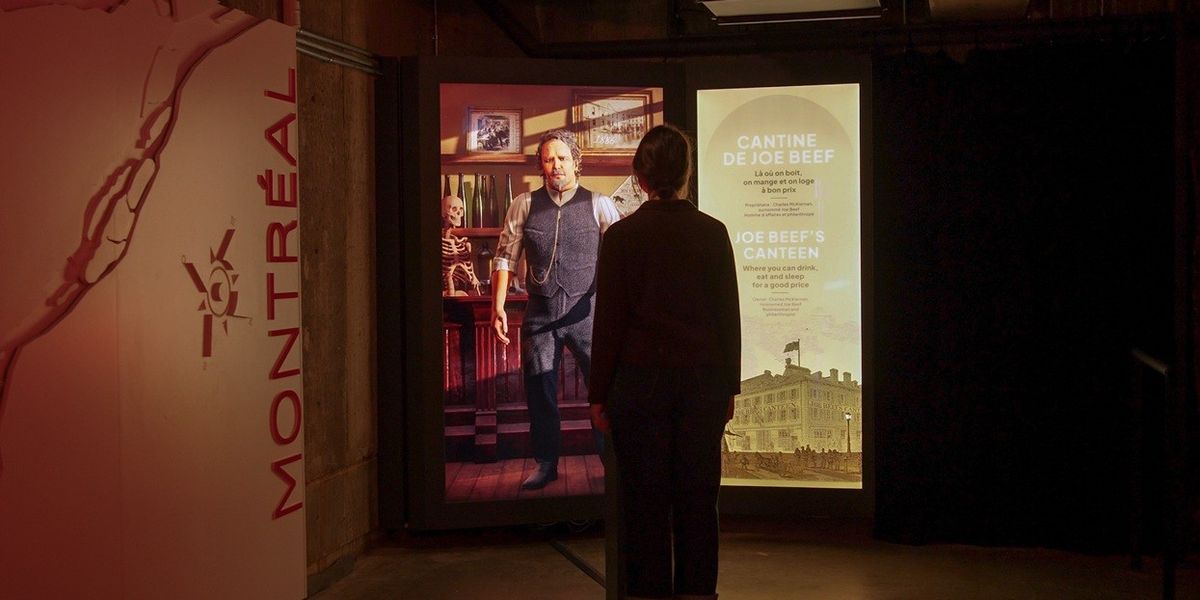
Dpt., an international experiential design and production studio, has unveiled an AI-powered interactive character based on Joe Beef, a notable tavern keeper from 19th-century Montreal, at the Pointe-à-Callière Museum. This innovative project aims to create an immersive experience that allows museum visitors to engage in direct conversations with Beef, whose real name was Charles McKiernan, thereby exploring Montreal’s rich history through dialogue.
The interactive character is designed to facilitate a personal encounter that reflects Beef’s dedication to workers and the underprivileged at a time when industrialization was transforming the city. His tavern, located near the port, served as a hub for solidarity and debate among the local community. Dpt. faced the challenge of crafting a dynamic interaction that would honor Beef’s historical significance while avoiding any distortion of his narrative.
To achieve this, Dpt. employed a sophisticated blend of a real-time conversational AI system and a fully animated 3D character capable of bilingual voice interaction. This technology allows visitors to engage in open-ended conversations without reducing the historical context to mere monologues or presenting AI as a novelty. The system operates on-site, utilizing a retrieval-augmented generation (RAG) framework that anchors the character’s responses in verified archival sources related to both Beef and the socio-political landscape of 19th-century Montreal.
The installation is strategically placed in the museum’s crypt, precisely where Beef’s original tavern once stood. Equipped with a presence detector, the installation activates upon a visitor’s approach, enabling Beef to greet them in either French or English. This seamless transition into conversation allows for a natural dialogue that adapts to the visitor’s queries and language preferences. “This approach fundamentally transforms the role of artificial intelligence,” said Nicolas S. Roy, president of Dpt. “It is no longer used to deliver information in a top-down way, but to support a credible, embodied dialogue in which speech circulates freely.”
Through this interaction, visitors can genuinely challenge Beef’s responses, creating a dialogue that is both accurate and fluid. The installation has demonstrated a capacity to retain visitor attention beyond typical dwell times, marking a significant shift from static historical interpretation to a dynamic exchange. The project sets a high standard for participatory cultural mediation, moving away from traditional methods of museum storytelling.
In its broader context, this initiative forms part of Dpt.’s ongoing research into conversational mediation within cultural environments. The framework established by the Joe Beef project can potentially extend to other historical figures and cultural institutions, allowing for a more profound engagement with history. Roy emphasizes that “artificial intelligence is not the subject—it is a medium, a tool serving a narrative, a context, and a mission.” This perspective encourages a redefinition of the relationship between technology, knowledge, and the public in cultural institutions.
With over 15 years of experience in creating interactive, immersive experiences that blend storytelling with emerging technology, Dpt. aims to reshape how culture resonates across both virtual and physical spaces. The Joe Beef project exemplifies an emerging trend in cultural AI, where technology serves to enrich the visitor experience rather than merely inform. It aspires to create moments where history speaks in the first person, transforming passive observation into active dialogue.
As cultural institutions increasingly adopt AI-driven experiences, the Joe Beef installation stands as a notable example of how technology can enhance engagement, making history accessible and relevant to contemporary audiences. The project illustrates the potential for AI to act not merely as a faceless machine delivering facts, but as a presence that invites conversation and reflection.
See also OpenAI Abandons Sora Project, Sparking Debate on AI’s Role in Hollywood’s Future
 Germany”s National Team Prepares for World Cup Qualifiers with Disco Atmosphere
 95% of AI Projects Fail in Companies According to MIT
 AI in Food & Beverages Market to Surge from $11.08B to $263.80B by 2032
 Satya Nadella Supports OpenAI’s $100B Revenue Goal, Highlights AI Funding Needs