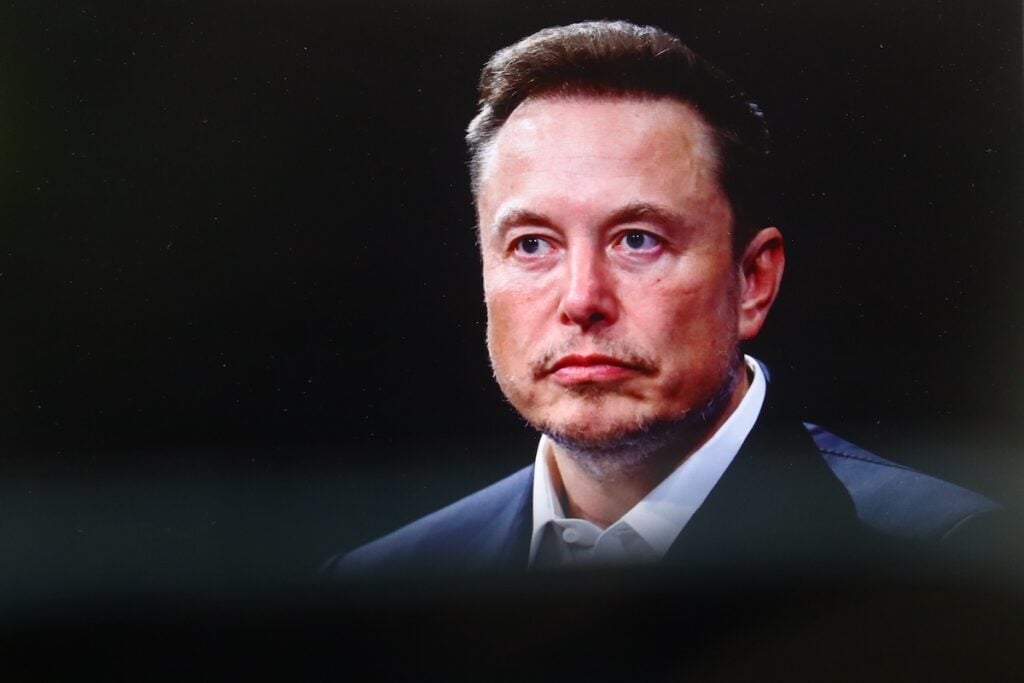
On Monday, Tesla Inc. (NASDAQ:TSLA) CEO Elon Musk entered the debate surrounding artificial intelligence, aligning himself with Alphabet Inc. (NASDAQ:GOOG) (NASDAQ:GOOGL) Google DeepMind CEO Demis Hassabis. This came after Meta Platforms, Inc. (NASDAQ:META) outgoing AI chief Yann LeCun dismissed the concept of “general intelligence” as an illusion, highlighting a growing divide among prominent AI researchers regarding the definition of intelligence.
Musk amplified Hassabis’ rebuttal to LeCun with a succinct post on X, stating, “Demis is right.” This public exchange underscores a significant rift in the AI community regarding whether artificial general intelligence, or AGI, represents a meaningful goal.
Hassabis responded vigorously to LeCun’s assertion that there is “no such thing as general intelligence,” arguing that the critique conflates general intelligence with universal intelligence. In an elaborate post, Hassabis contended that the human brain is among the most complex systems known and serves as a highly general learning machine. He acknowledged that while no real-world system can entirely escape specialization, the architecture of the human brain, akin to contemporary AI models, possesses the capability to learn any computable task given adequate time, memory, and data.
Hassabis further emphasized humanity’s capability to invent complex concepts such as chess, science, and modern engineering, despite our evolutionary roots in survival-based tasks like hunting and gathering. This, he argues, illustrates the broad scope of human intelligence rather than its limitations.
LeCun, in response, characterized the disagreement as largely semantic. He objected to equating “general” with “human-level” intelligence, arguing that humans are specialized systems optimized for efficiency in narrow domains. While acknowledging that the human brain is theoretically Turing complete, LeCun claimed it is often inefficient for most computational problems encountered in real-world scenarios. He posited that the brain can represent only a minuscule fraction of all possible functions, rendering true generality impractical.
This debate illuminates a central fault line in AI research: the question of whether AGI is a feasible objective or merely a misleading label. Other tech leaders have weighed in on the matter; for example, Salesforce Inc. (NYSE:CRM) CEO Marc Benioff previously noted that the reality of AGI does not live up to the prevailing hype.
Conversely, Hassabis has projected a roughly 50% chance that AGI will emerge within the next five years. Fellow AI researchers Ben Mann from Anthropic has suggested that AGI could be achieved by 2028, while OpenAI CEO Sam Altman has similarly indicated that AGI might arrive during former President Donald Trump’s next term. Echoing this sentiment, former Google CEO Eric Schmidt remarked in an April fireside chat that it is reasonable to expect AGI to materialize between 2028 and 2030.
The implications of this ongoing debate extend beyond academic circles, influencing both investment strategies and public perception of AI technologies. As companies like Google, Meta, and Tesla continue to push boundaries in AI research and application, the discourse surrounding AGI will likely shape the landscape of technological advancement for years to come.
As the discussion evolves, the AI community remains watchful for developments that could either substantiate or dismantle these conflicting viewpoints on the nature and potential of artificial intelligence.
See also AI Transforms Agricultural Workforce: Advancing Eco Agriculture’s FieldLark Enhances Human Decision-Making
 AI Transforms Supply Chain Resilience: New Insights Enable Strategic Adaptation Amid Global Shifts
 Woman Celebrates AI Wedding to ChatGPT Character Klaus Amid Growing Tech-Intimacy Trend
 IBM Shares Stabilize Near $303 Amid Confluent Acquisition and AI Strategy Insights
 AI-Driven Drug Optimization Market to Surge from $450B to $7.87T by 2030, Catalyzed by COVID-19