


















































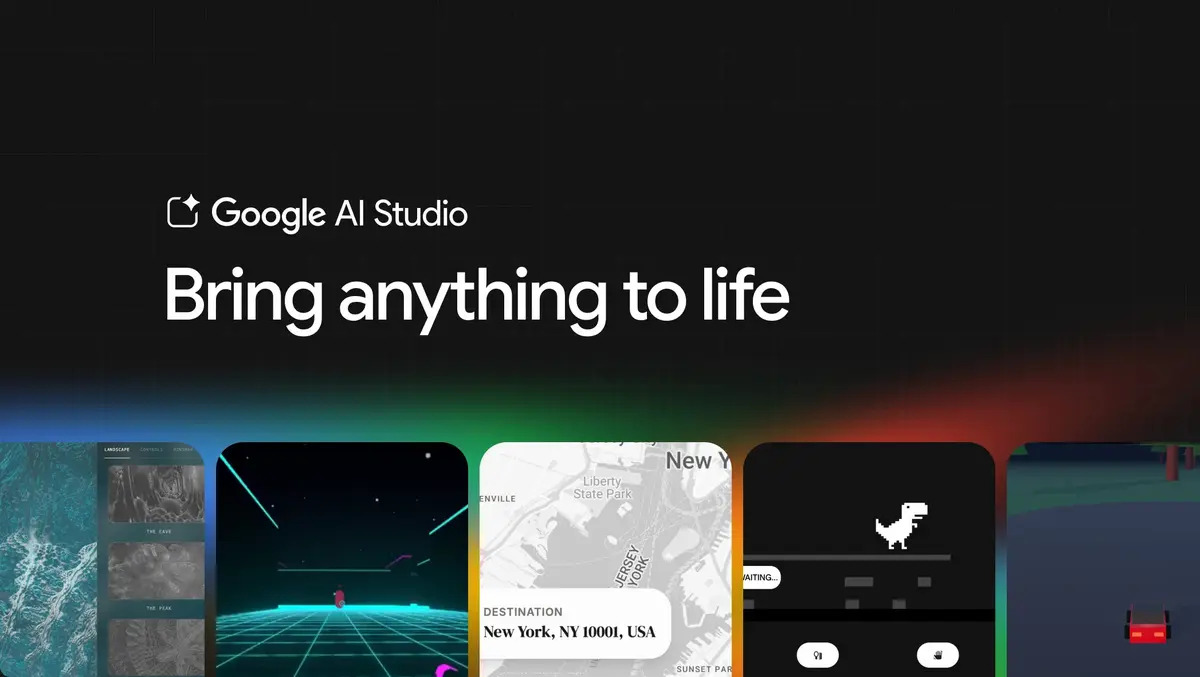
Google has unveiled a comprehensive coding environment within Google AI Studio, introducing a new coding agent named Antigravity. This update allows developers to convert text prompts into fully functional web applications directly within the interface, enhancing the platform’s capabilities significantly.
The enhanced features include integrated Firebase services for database storage and user authentication, and expanded support for popular frameworks such as Next.js, in addition to React and Angular. This transition propels Google AI Studio from simple prompt-based prototyping into a robust environment for full application development, accommodating both front-end and back-end tasks. Developers can now build applications equipped with persistent data storage, user sign-in capabilities, and connections to external services all within a single tool.
A key addition to this functionality is the support for collaborative software development. Antigravity can facilitate the creation of real-time applications like multiplayer games and shared workspaces that enable multiple users to interact simultaneously. The backend setup is streamlined through Firebase integration, allowing the coding agent to recognize when an application needs database connectivity or login capabilities. With user consent, it can provision Cloud Firestore and Firebase Authentication, including Google sign-in options.
Additionally, Antigravity is capable of utilizing external web development libraries as necessary. In practical applications, it can install tools such as Framer Motion for animations or Shadcn for user interface elements if required by the project. This feature demonstrates a broader effort to make AI-generated code more practical and applicable for production use, moving beyond simple prototypes to applications that leverage established web frameworks, third-party packages, and secure access to external APIs.
Users now have the option to input their own API credentials for various external services, including databases, payment systems, and Google products like Maps. These credentials are stored securely in a new Secrets Manager feature within the settings of the product. Another notable enhancement is the introduction of session persistence, allowing users to close their browser tabs and return later with their work state intact across devices and sessions.
The updated Antigravity agent is designed to maintain a more extensive context from users’ projects and earlier prompts. Google asserts that this capability will enable the agent to make more accurate code modifications over multiple steps and manage more complex applications based on simpler instructions. The inclusion of Next.js is particularly significant, as it has become a popular choice among modern web application developers. By integrating this framework alongside React and Angular, Google aims to broaden the scope of projects that can be initiated directly within AI Studio.
This announcement arrives amid a competitive landscape where major technology firms are striving to enhance AI coding assistants’ roles within software development processes. Initially conceived as tools for code completion or chat-based assistance, many of these products are now evolving to generate larger segments of applications and connect them to cloud services.
Google reports that the upgraded AI Studio has already facilitated the creation of hundreds of thousands of applications internally in recent months, a testament to its extensive testing of AI-assisted development prior to wider external deployment. For Google, this update strengthens the connection between Firebase and its AI development tools. By linking generated applications directly to Firestore and Firebase Authentication in a unified workflow, the platform offers a seamless experience for developers and addresses a significant challenge faced by AI coding products—the gap between producing a demo and delivering functional software that effectively manages identity, data storage, and service integrations.
As Google positions AI Studio as a comprehensive solution for application development, it aims to streamline workflows that were previously fragmented, paving the way for more integrated and efficient software creation processes in an increasingly AI-driven landscape.
See also Germany”s National Team Prepares for World Cup Qualifiers with Disco Atmosphere
 95% of AI Projects Fail in Companies According to MIT
 AI in Food & Beverages Market to Surge from $11.08B to $263.80B by 2032
 Satya Nadella Supports OpenAI’s $100B Revenue Goal, Highlights AI Funding Needs
 Wall Street Recovers from Early Loss as Nvidia Surges 1.8% Amid Market Volatility